Wize University Statistics Textbook > Hypothesis Testing with One Sample
Type I and Type II Errors
Popular Courses
COMM 214
Concordia University
STAT 151
University of Alberta
AP Statistics Exam Prep Course
AP Exam Prep
Statistics
General Course
Intro to Statistics
University Study Guides
COMM 215
Concordia University
STAT 213
University of Calgary
COMM 191
University of British Columbia
STA 100
University of California - Davis
Grade 12 Data Management
Ontario High School
STATS 2244A/B
Western University
STAT 200
University of British Columbia
Intro to Statistics
University Study Guides
STATS 2035
Western University
STAT 161
University of Alberta
QMS 210
Toronto Metropolitan University
STAT 263
Queen's University
STAT*2040
University of Guelph
ENDG 319
University of Calgary
MGCR 271
McGill University
0:00 / 0:00
Type I and Type II Errors
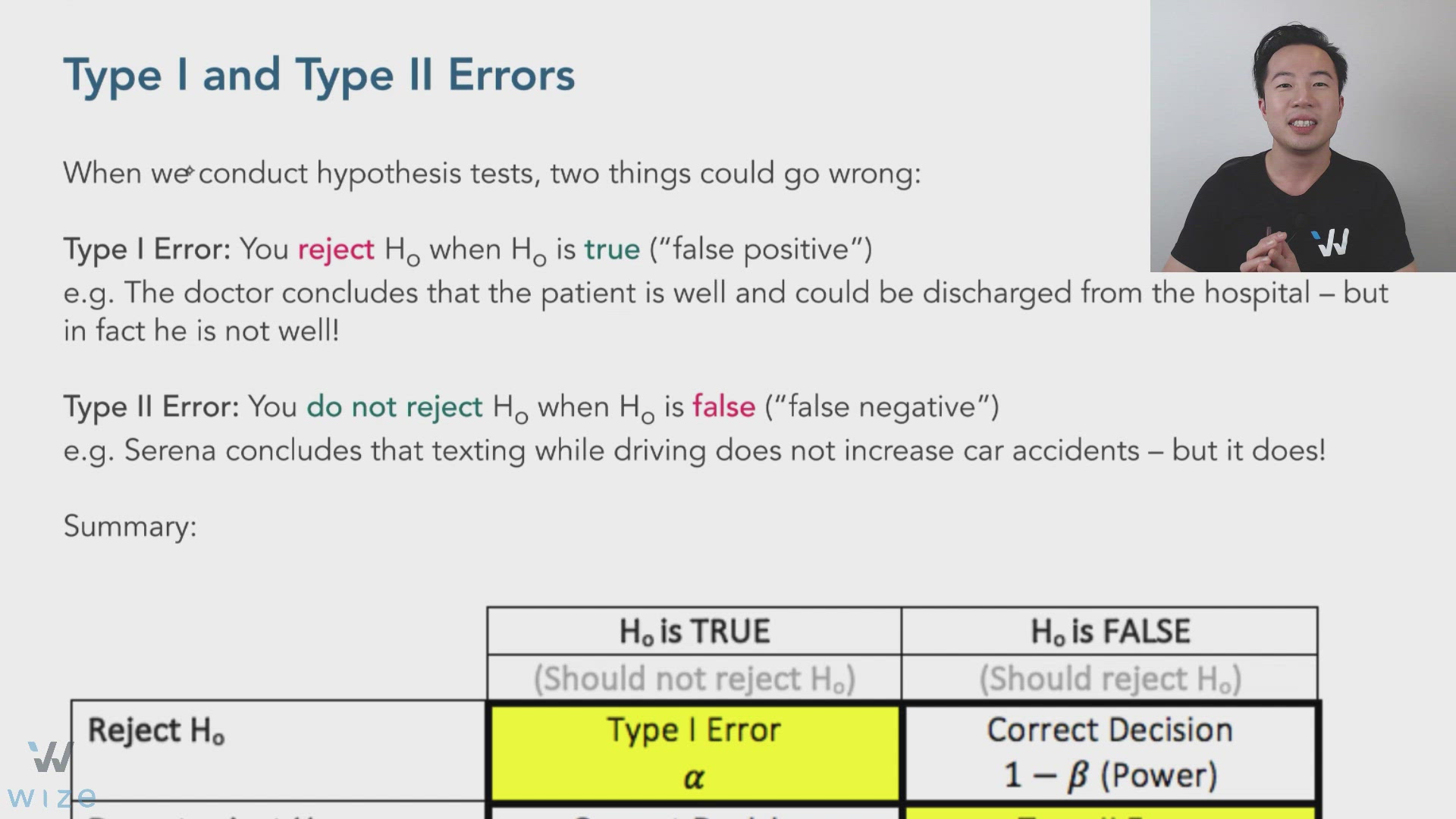
When we conduct hypothesis tests, two things could go wrong:
Type I Error: You reject Ho when Ho is true (“false positive”)
e.g. The doctor concludes that the patient is well and could be discharged from the hospital – but in fact he is not well!
Type II Error: You do not reject Ho when Ho is false (“false negative”)
e.g. Serena concludes that texting while driving does not increase car accidents – but it does!
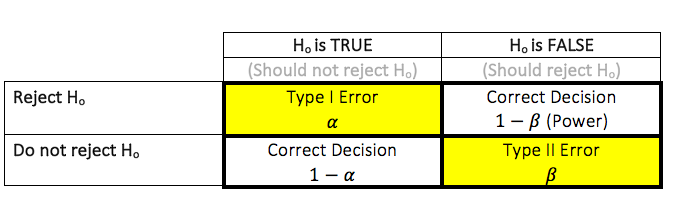
Summary
Watch Out!
Our conclusion is based on our sample data; we may never really know if is in fact true or false.
Example
: “The old bridge is not dangerous.”
: “The old bridge is dangerous.”
In this example, committing which type of error is more serious: Type I or Type II?
Type I error: Reject you believe that the old bridge is dangerous – but it is not!
Type II error: Fail to reject you believe that the old bridge is not dangerous – but it is!
In this example, Type II error is more serious because you end up using a bridge that is dangerous. A Type I error is when you decide not to use the bridge even though it is safe, which is just an inconvenience.
Wize Tip
If you reject Ho Type I Error is possible (Type II Error is not possible)
If you fail to reject Ho Type II Error is possible (Type I Error is not possible)
Consider this conclusion: “We fail to reject and we proved that the old bridge is not dangerous.”
THIS IS WRONG! If we do not reject , that doesn’t mean we proved it’s true that the bridge is not dangerous. We just do not have evidence that the bridge is dangerous ().
Watch Out!
Failing to reject that does not confirm or prove that is true!
Correct conclusion: “We do not reject and conclude that there is no evidence that the bridge is dangerous.”
Summary
- When we reject , we have evidence to support .
- If is in fact true but we reject it, then we’ve committed a Type I Error.
- When we do not reject , we have no evidence to support but it does not prove that true; we just didn’t find evidence against
- If is in fact false but we failed to reject it, then we’ve committed a Type II Error.
0:00 / 0:00
Example: Type I and Type II Errors
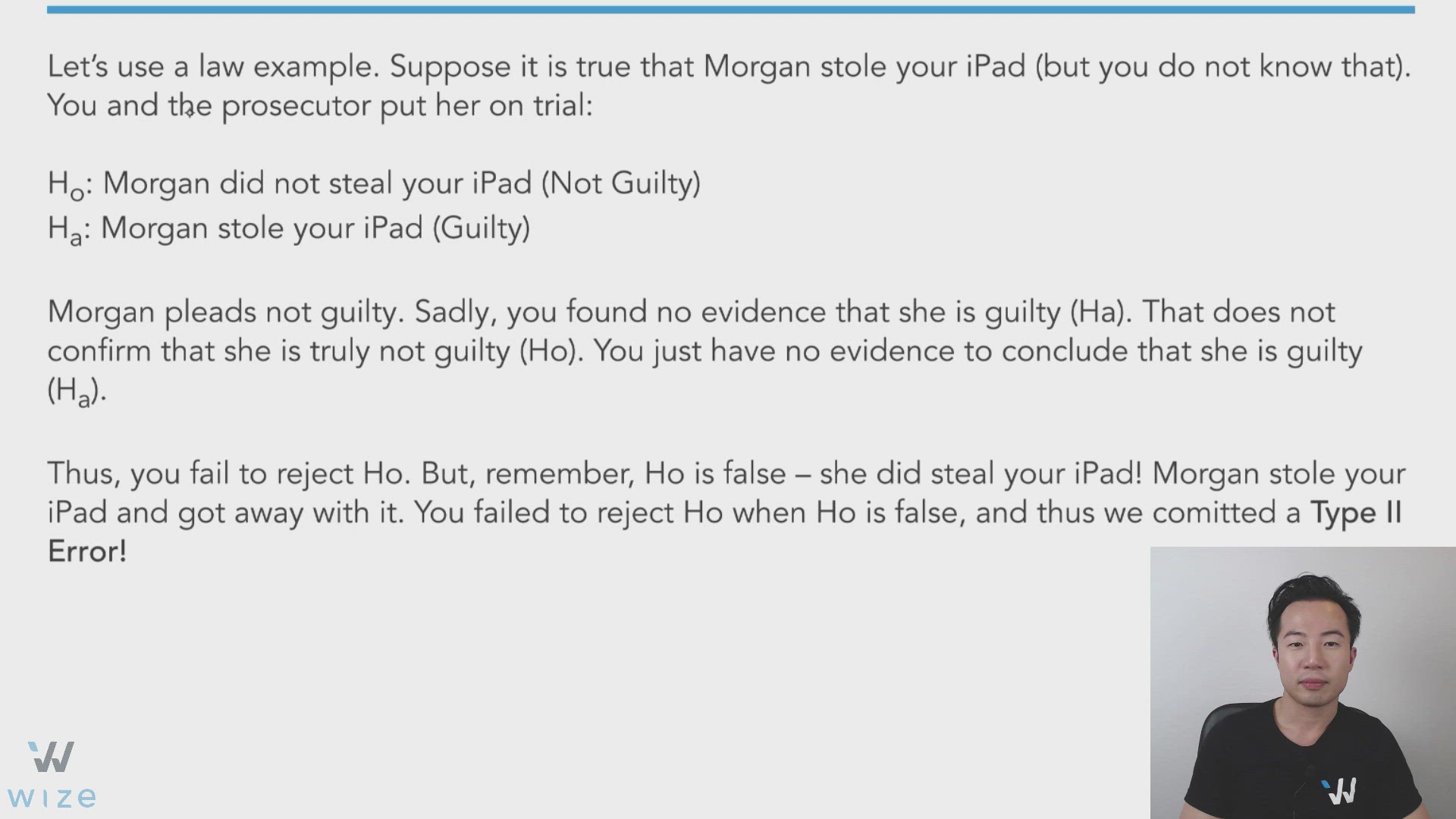
Let’s use a law example. Suppose it is true that Morgan stole your iPad (but you do not know that). You and the prosecutor put her on trial:
: Morgan did not steal your iPad (Not Guilty)
: Morgan stole your iPad (Guilty)
Morgan pleads not guilty. Sadly, you found no evidence that she is guilty () so you cannot prosecute her.
(a) Did we prove that Morgan is not guilty?
No, that does not prove that she is truly not guilty (). You just have no evidence to conclude that she is guilty ().
(b) Did we commit a Type I error, Type II error, or make the correct decision?
Since you lack evidence, you fail to reject so you conclude that there is no evidence that Morgan is guilty. But remember: is false because she did steal your iPad (and got away with it)! You failed to reject , and, because is false, we have committed a Type II Error.
Practice: Type I and Type II Errors
The mayor believes that the crime rate has stayed the same but in fact it is much worse.
Determine if a Type I Error, Type II Error, or correct decision has been made.
Practice: Type I and Type II Errors
Carbo Max claimed to have developed a pill that will allow people to eat carbs and not gain weight. People who tried it gained weight. Lawsuits ensued.
Determine if a Type I Error, Type II Error, or correct decision has been made.
0:00 / 0:00
Power
Making the Correct Decision
After running a hypothesis test, you want to draw the right conclusion. If the null hypothesis is in fact false, you should reject it. Power is the probability of correctly rejecting a false null hypothesis.
- You want a high power.
- If the close to 1, it means that, given that the null hypothesis is false, there is a high probability that you will reject it.
Example
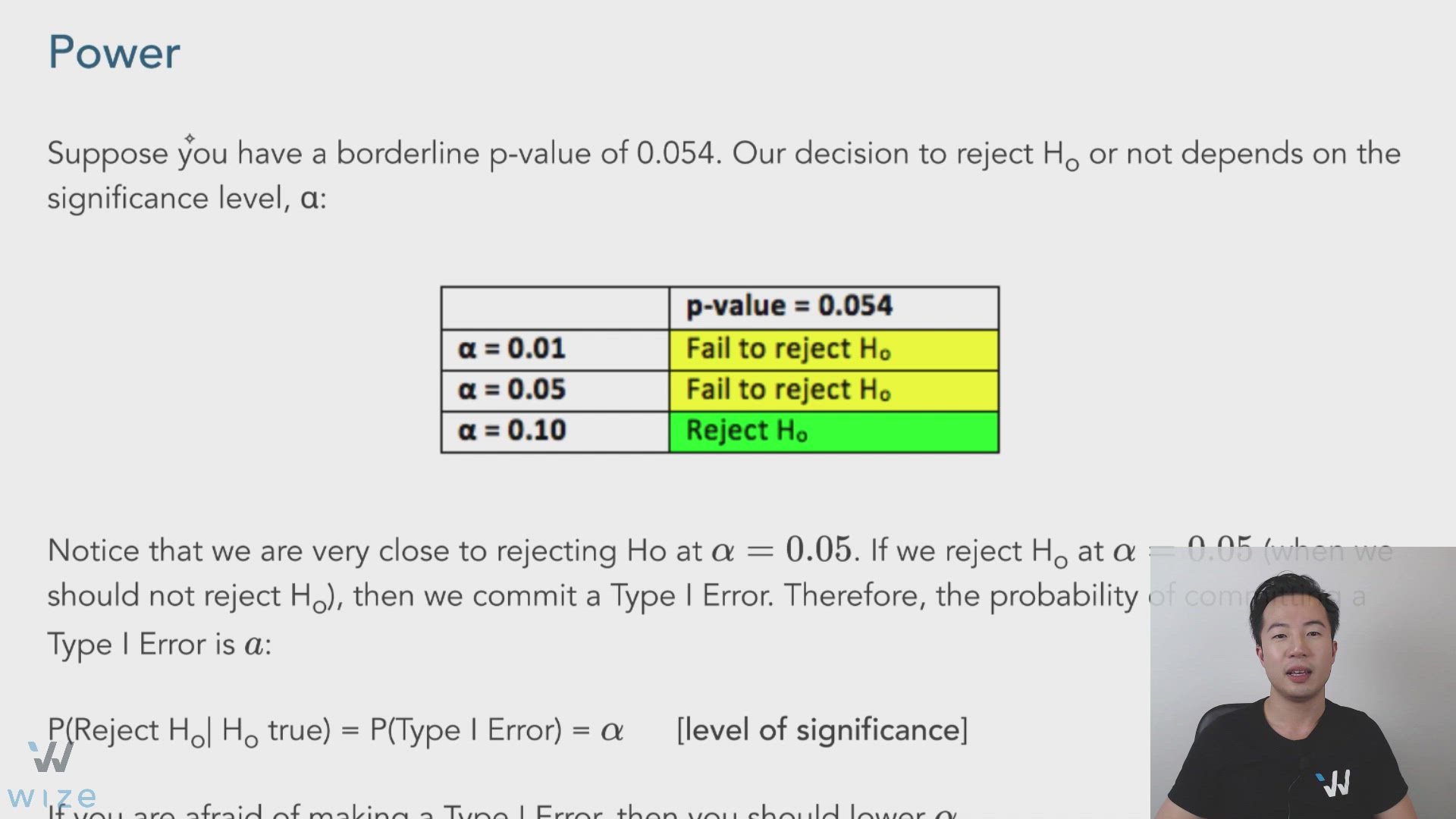
Suppose you have a borderline p-value of 0.054. Our decision to reject or not depends on the significance level, :
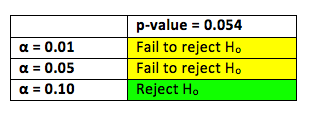
Notice that we are very close to rejecting at . If we reject at (when we should not reject ), then we commit a Type I Error. Therefore, the probability of committing a Type I Error is :
significance level
Wize Concept
If you are afraid of making a Type I Error, then you should lower .
Unfortunately, if you reduce your chance of making a Type I Error – guess what? You’ll increase your chance of making a Type II Error!
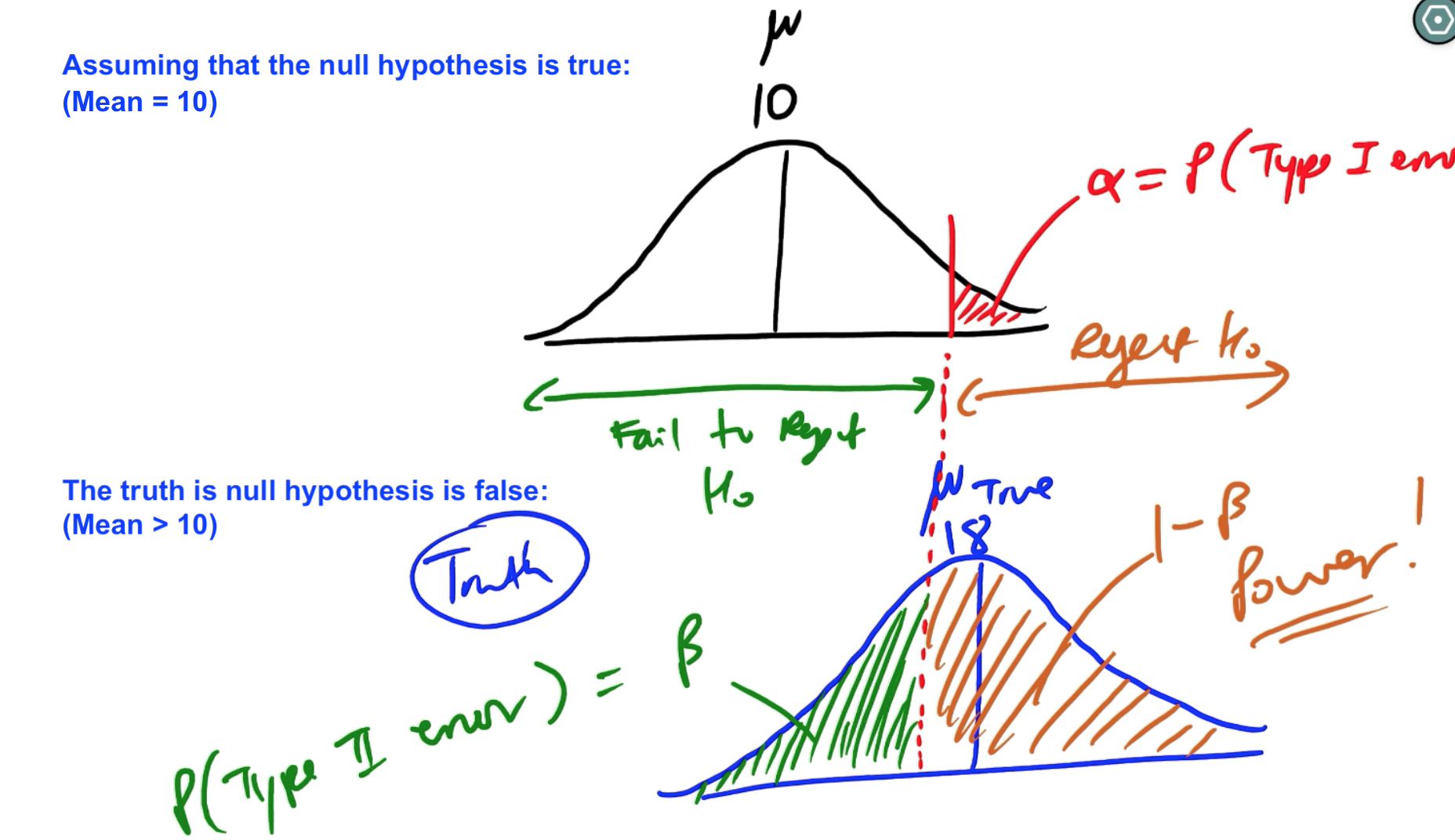
The probability of committing a Type II Error is :
Conversely:
power
Wize Concept
Power is the probability of correctly rejecting a false null hypothesis.
Example
- Assuming is true.
- Suppose the true mean is in fact greater than 10!
- Therefore, is false.
Is Type I Error or Type II More Dangerous?
We should strive to optimally keep the probability of each type of error small by selecting a reasonably small (i.e. or lower) and a high power.
You should also take into consideration which type of error is more serious:
- If it is more dangerous to commit a Type I error, then should be small.
- If it is more dangerous to commit a Type II error, then should be small.
What is the power of a hypothesis test?