0:00 / 0:00

Linear Combinations of Random Variables

For a random variable XX, let...
  • E(X)=E\left(X\right)= expected value or mean
  • Var(X)=Var\left(X\right)= variance
  • SD(X)=SD\left(X\right)= standard deviation

A new distribution could be formed by combining random variables Given the mean and standard deviation a given distribution, we can combine random variables to find the combined mean, combined variance, and combined standard deviation of the new distribution.

Linear Rescaling of RV

A linear rescaling is a transformation of the form Y=aX+bY=a\textcolor{orange}{X}+b

  • E(aX+b)=aE(X)+bE\left(a\textcolor{orange}{X}+b\right)=aE\left(\textcolor{orange}{X}\right)+b
  • Var(aX+b)=a2Var(X)Var\left(a\textcolor{orange}{X}+b\right)=a^2Var\left(\textcolor{orange}{X}\right)
  • SD(aX+b)=aVar(X)SD(a\textcolor{orange}{X}+b)=|a|\sqrt{Var(\textcolor{orange}{X})}


Combining RV for Weighted Averages

A linear combination of two random variables XX and YY is in the form aX+bYa\textcolor{orange}{X}+b\textcolor{green}{Y} where a weighted average is involved such that a+b=1a+b=1.
  • E(aX+bY)=aE(X)+bE(Y)E\left(a\textcolor{orange}{X}+b\textcolor{green}{Y}\right)=aE\left(\textcolor{orange}{X}\right)+bE\left(\textcolor{green}{Y}\right)
  • Var(aX+bY)=a2Var(X)+b2Var(Y)Var\left(a\textcolor{orange}{X}+b\textcolor{green}{Y}\right)=a^2Var\left(\textcolor{orange}{X}\right)+b^2Var\left(\textcolor{green}{Y}\right)
  • SD(aX+bY)=a2Var(X)+b2Var(Y)SD\left(a\textcolor{orange}{X}+b\textcolor{green}{Y}\right)=\sqrt{a^2Var\left(\textcolor{orange}{X}\right)+b^2Var\left(\textcolor{green}{Y}\right)}

  • E(aXbY)=aE(X)bE(Y)E\left(a\textcolor{orange}{X}-b\textcolor{green}{Y}\right)=aE\left(\textcolor{orange}{X}\right)-bE\left(\textcolor{green}{Y}\right)
  • Var(aXbY)=a2Var(X)+b2Var(Y)Var\left(a\textcolor{orange}{X}-b\textcolor{green}{Y}\right)=a^2Var\left(\textcolor{orange}{X}\right)+b^2Var\left(\textcolor{green}{Y}\right)
  • SD(aXbY)=a2Var(X)+b2Var(Y)SD\left(a\textcolor{orange}{X}-b\textcolor{green}{Y}\right)=\sqrt{a^2Var\left(\textcolor{orange}{X}\right)+b^2Var\left(\textcolor{green}{Y}\right)}


Wize Tip
The standard deviation is the square-root of the variance.

When combining random variables, always add variances. You cannot subtract variances.

0:00 / 0:00

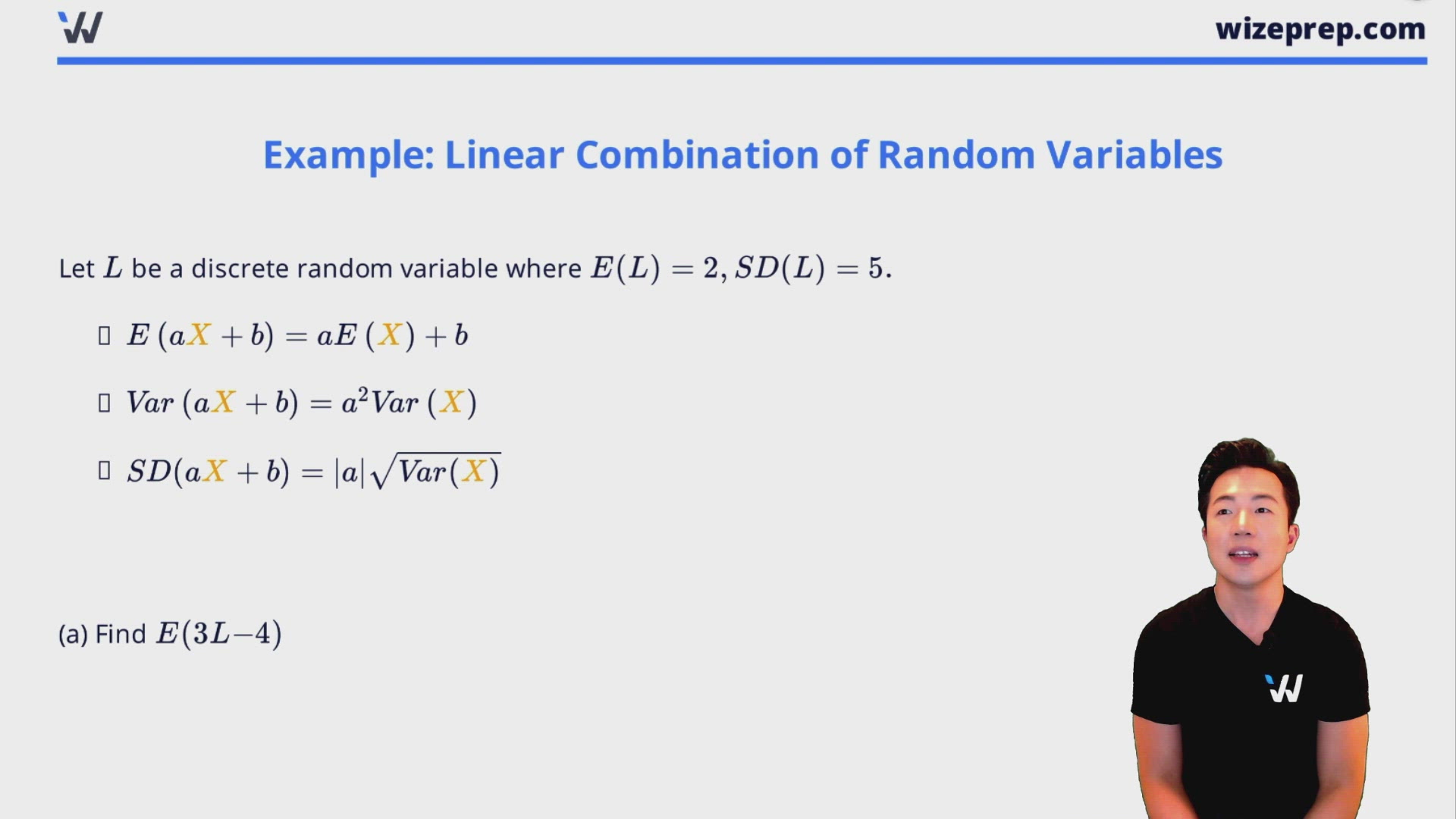
Example: Linear Combination of Random Variables


Let LL be a discrete random variable where 𝐸(𝐿)=2,SD(𝐿)=5.𝐸(𝐿)=2,SD(𝐿)=5.
  • E(aX+b)=aE(X)+bE\left(a\textcolor{orange}X+b\right)=aE\left(\textcolor{orange}X\right)+b
  • Var(aX+b)=a2Var(X)Var\left(a\textcolor{orange}{X}+b\right)=a^2Var\left(\textcolor{orange}{X}\right)
  • SD(aX+b)=aVar(X)SD(a\textcolor{orange}{X}+b)=|a|\sqrt{Var(\textcolor{orange}{X})}

(a) Find 𝐸(3𝐿4)𝐸(3𝐿 − 4)

E(aX+b)=aE(X)+bE\left(a\textcolor{orange}X+b\right)=aE\left(\textcolor{orange}X\right)+b

𝐸(3𝐿4)=3(2)4=2𝐸(3𝐿 − 4) = 3(2) − 4 = 2


(b) Find SD(𝐿+12)SD(−𝐿+12)

SD(aX+b)=aV(X)SD(a\textcolor{orange}{X}+b)=|a|\sqrt{V(\textcolor{orange}{X})}

Tip: Imagine an invisible 1 in front of the LL, so a=1a=-1.

SD(𝐿+12)=1SD(𝐿)=(1)(5)=5SD(−𝐿+12)=|−1|SD(𝐿)=(1)(5)=5

I personally prefer to solve for the variance first, then find the square-root of the variance to solve for the standard deviation:

V(aX+b)=a2V(X)V\left(a\textcolor{orange}{X}+b\right)=a^2V\left(\textcolor{orange}{X}\right)

Var(𝐿+12)=(1)2(5)2=25Var(−𝐿+12)=\left(-1\right)^2\left(5\right)^2=25
SD=Var=25=5SD=\sqrt{Var}=\sqrt{25}=5

Let QQ be a discrete random variable where 𝐸(Q)=25,SD(Q)=6.𝐸(Q)=25,SD(Q)=6.


(a) Find 𝐸(Q21)𝐸\left(\frac{Q}{2}−1\right)

(b) Find SD(Q21)SD\left(\frac{Q}{2}−1\right)

0:00 / 0:00

Example: Combining Random Variables with Weighted Averages


Conrad invests in two portfolios, 40% in the Aggressive Portfolio and 60% in the Slow-and-Steady Portfolio. His wealth manager determined that the average rate of return in the Aggressive Portfolio is 14.5% with a standard deviation of 20% – risky! The Slow-and-Steady Portfolio has an average rate of return of 3.3% with a standard deviation of 1%.

Determine the mean rate of return, variance, and standard deviation of his portfolios. (Assume the two portfolios are independent.)
  • E(aX+bY)=aE(X)+bE(Y)E\left(a\textcolor{orange}{X}+b\textcolor{green}{Y}\right)=aE\left(\textcolor{orange}{X}\right)+bE\left(\textcolor{green}{Y}\right)
  • Var(aX+bY)=a2Var(X)+b2Var(Y)Var\left(a\textcolor{orange}{X}+b\textcolor{green}{Y}\right)=a^2Var\left(\textcolor{orange}{X}\right)+b^2Var\left(\textcolor{green}{Y}\right)
  • SD(aX+bY)=a2Var(X)+b2Var(Y)SD\left(a\textcolor{orange}{X}+b\textcolor{green}{Y}\right)=\sqrt{a^2Var\left(\textcolor{orange}{X}\right)+b^2Var\left(\textcolor{green}{Y}\right)}
a=0.4 a=0.4\
b=0.6b=0.6

Let Portfolio P=0.4X+0.6YP=0.4X+0.6Y

Combined mean:

E(aX+bY)=aE(X)+bE(Y)E\left(a\textcolor{orange}{X}+b\textcolor{green}{Y}\right)=aE\left(\textcolor{orange}{X}\right)+bE\left(\textcolor{green}{Y}\right)

E(P)=0.4(14.5)+0.6(3.3)=7.78E\left(P\right)=0.4\left(14.5\right)+0.6\left(3.3\right)=7.78 (or 7.78%)

Combined variance:

Var(aX+bY)=a2Var(X)+b2Var(Y)Var\left(a\textcolor{orange}{X}+b\textcolor{green}{Y}\right)=a^2Var\left(\textcolor{orange}{X}\right)+b^2Var\left(\textcolor{green}{Y}\right)

Var(P)=(0.4)2(20)2+(0.6)2(1)2=64.36Var\left(P\right)=\left(0.4\right)^2\left(20\right)^2+\left(0.6\right)^2\left(1\right)^2=64.36 (or 64.36%)

Combined standard deviation:

SD(aX+bY)=a2Var(X)+b2Var(Y)SD\left(a\textcolor{orange}{X}+b\textcolor{green}{Y}\right)=\sqrt{a^2Var\left(\textcolor{orange}{X}\right)+b^2Var\left(\textcolor{green}{Y}\right)}

SD(P)=Var(P)=64.36=8.022SD\left(P\right)=\sqrt{Var\left(P\right)}=\sqrt{64.36}=8.022 (or 8.022%)


PAGE BREAK
Alternative Method:

Combined mean:

E(aX+bY)=aE(X)+bE(Y)E\left(a\textcolor{orange}{X}+b\textcolor{green}{Y}\right)=aE\left(\textcolor{orange}{X}\right)+bE\left(\textcolor{green}{Y}\right)

E(P)=0.4(0.145)+0.6(0.033)=0.0778E\left(P\right)=0.4\left(0.145\right)+0.6\left(0.033\right)=0.0778 (or 7.78%)

Combined variance:

Var(aX+bY)=a2Var(X)+b2Var(Y)Var\left(a\textcolor{orange}{X}+b\textcolor{green}{Y}\right)=a^2Var\left(\textcolor{orange}{X}\right)+b^2Var\left(\textcolor{green}{Y}\right)

Var(P)=(0.4)2(0.2)2+(0.6)2(0.01)2=0.006436Var\left(P\right)=\left(0.4\right)^2\left(0.2\right)^2+\left(0.6\right)^2\left(0.01\right)^2=0.006436*

*Note: The variance’s usefulness is limited here because the units are squared and not the same as the original data.

Combined standard deviation:

SD(aX+bY)=a2Var(X)+b2Var(Y)SD\left(a\textcolor{orange}{X}+b\textcolor{green}{Y}\right)=\sqrt{a^2Var\left(\textcolor{orange}{X}\right)+b^2Var\left(\textcolor{green}{Y}\right)}

SD(P)=Var(P)=0.006436=0.08022SD\left(P\right)=\sqrt{Var\left(P\right)}=\sqrt{0.006436}=0.08022 (or 8.022%)


Practice: Combining Random Variables with Weighted Average

The midterm is worth 30% of your overall grade; the final exam is worth 70%.

The average grade on the midterm is 68% with a standard deviation of 12%.
The average grade on the final exam is 73% with a standard deviation of 16%
Video Player Error

Your browser or device wasn't able to play this video.

Try updating to the latest version of Chrome, Edge, or Safari, or disabling hardware acceleration in your browser settings, then reload the page.

Error code: VIDEO_ERROR-4

Functions of Two Independent Random Variables X and Y

Two random variables XX and YY are independent if knowing the value of one of them does not affect the probabilities for the other one.
If X and Y are independent, we have these formulas:
  • E(XY)=E(X)×E(Y)E(\textcolor{orange}{X}\textcolor{blue}{Y})=\textcolor{orange}{E(X)}\times\textcolor{blue}{E(Y)}
  • E(X+Y)=E(X)+E(Y)E(\textcolor{orange}{X}\textcolor{blue}{+Y})=\textcolor{orange}{E(X)}+\textcolor{blue}{E(Y)}
  • E(XY)=E(X)E(Y)E(\textcolor{orange}{X}\textcolor{blue}{-Y})=\textcolor{orange}{E(X)}-\textcolor{blue}{E(Y)}
  • Var(X+Y)=Var(X)+Var(Y)Var(\textcolor{orange}{X}+\textcolor{blue}{Y})=\textcolor{orange}{Var(X)}+\textcolor{blue}{Var(Y)}
  • Var(XY)=Var(X)+Var(Y)Var(\textcolor{orange}{X}-\textcolor{blue}{Y})=\textcolor{orange}{Var(X)}+\textcolor{blue}{Var(Y)}

Watch Out!
V(XY)=V(X)+V(Y)V(\textcolor{orange}{X}-\textcolor{blue}{Y})=\textcolor{orange}{V(X)}+\textcolor{blue}{V(Y)}
This formula is NOT a mistake! Never subtract variances! Always add variances.


The standard deviation is the square-root of the variance:
  • SD(X+Y)=Var(X)+Var(Y)SD(\textcolor{orange}{X}+\textcolor{blue}{Y})=\sqrt{\textcolor{orange}{Var(X)}+\textcolor{blue}{Var(Y)}}
  • SD(XY)=Var(X)+Var(Y)SD(\textcolor{orange}{X}-\textcolor{blue}{Y})=\sqrt{\textcolor{orange}{Var(X)}+\textcolor{blue}{Var(Y)}}

Watch Out!
Do not add or subtract standard deviations! Always combine the variances first (by adding) and then find the square-root of the combined variances to solve for the combined standard deviation.

As you can see, there are a lot of formulas but they will all make sense after we do a bunch of examples.


0:00 / 0:00

Example: Combining Independent Random Variables

Let 𝐴𝐴, 𝐵𝐵 be two discrete independent random variables with:

E(A)=10, SD(𝐴)=5E\left(A\right)=10,\ SD(𝐴)=5
E(B)=26, SD(𝐵)=12E\left(B\right)=26,\ SD(𝐵)=12

  • E(XY)=E(X)×E(Y)E(\textcolor{orange}X\textcolor{blue}Y)=\textcolor{orange}{E(X)}\times \textcolor{blue}{E(Y)}
  • E(X+Y)=E(X)+E(Y)E(\textcolor{orange}{X}\textcolor{blue}{+Y})=\textcolor{orange}{E(X)}+\textcolor{blue}{E(Y)}
  • E(XY)=E(X)E(Y)E(\textcolor{orange}{X}\textcolor{blue}{-Y})=\textcolor{orange}{E(X)}-\textcolor{blue}{E(Y)}
  • Var(X+Y)=Var(X)+Var(Y)Var(\textcolor{orange}{X}+\textcolor{blue}{Y})=\textcolor{orange}{Var(X)}+\textcolor{blue}{Var(Y)}
  • Var(XY)=Var(X)+Var(Y)Var(\textcolor{orange}{X}-\textcolor{blue}{Y})=\textcolor{orange}{Var(X)}+\textcolor{blue}{Var(Y)}
The standard deviation is the square-root of the variance:
  • SD(X+Y)=SD(XY)=Var(X)+Var(Y)SD(\textcolor{orange}{X}+\textcolor{blue}{Y})=SD(\textcolor{orange}{X}-\textcolor{blue}{Y})=\sqrt{\textcolor{orange}{Var(X)}+\textcolor{blue}{Var(Y)}}

(a) Find E(A+B)E\left(A+B\right)
E(A+B)=E(A)+E(B)=10+26=36E(\textcolor{orange}{A}\textcolor{blue}{+B})=\textcolor{orange}{E(A)}+\textcolor{blue}{E(B)}=10+26=36
(b) Find SD(A+B)SD(A+B)
Do not add standard deviations! Add variances first, then find the square-root of the combined variances.

SD(A+B)SD(A+B)
=Var(A+B)=\sqrt{Var(A+B)}
=Var(A)+Var(B)=\sqrt{Var(A)+Var(B)}
=52+122=\sqrt{5^2+12^2}
=169=\sqrt{169}
=13=13

(c) Find SD(2𝐴𝐵)SD(2𝐴−𝐵)

Do not subtract standard deviations! Add variances first, then find the square-root of the combined variances.

SD(2AB)SD(2A-B)
=Var(2AB)=\sqrt{Var(2A-B)}
=22Var(A)+(1)2Var(B)=\sqrt{2^2Var(A)+(-1)^2Var(B)}
=4Var(A)+1Var(B)=\sqrt{4Var\left(A\right)+1Var\left(B\right)}
=452+122=\sqrt{4\cdot5^2+12^2}
=100+144=\sqrt{100+144}
=244=\sqrt{244}
Suppose that certain car parts are manufactured so that their heights are independent of each other, with a mean of μ=31.2\mu=31.2 cm and a standard deviation of σ=0.1\sigma=0.1 cm.

If 2 of these parts are stacked on top of each other to form a new part, what are the mean and standard deviation of this new part?
You have 50 job candidates to interview for a job at your firm. Each interview lasts an average of 12 minutes with a standard deviation of 3 minutes. What is the mean and standard deviation of the total time to interview all 50 candidates (not counting breaks in between)?