Wize University Statistics Textbook > Discrete Random Variables
Cumulative Distribution Function
Popular Courses
AP Statistics Exam Prep Course
AP Exam Prep
Statistics
General Course
Intro to Statistics
University Study Guides
STA 100
University of California - Davis
Grade 12 Data Management
Ontario High School
Intro to Statistics
University Study Guides
STAT 161
University of Alberta
MAT133Y1
University of Toronto
ECON 221
Concordia University
STAT 251
University of British Columbia
COMM 162
Queen's University
Grade 12 Statistics
Canada High School
MATH 203
McGill University
STA 2391
University of Ottawa
MATH 156
University of Alberta
STAT-2910
University of Windsor
Stats 8
Oregon State
STAT 1000
University of Manitoba
ENGR 371
Concordia University
SC/MATH 2930 3.00
York University

0:00 / 0:00
Cumulative Distribution Function (CDF)
A cumulative distribution function assigns a "running total" probability for the each value of .
For discrete random variables, we use a cumulative distribution table.
Wize Tip
- The column must contain all possible values of
- The first value in the CDF is the same as in the PDF
- The values must increase as we go down the column
- The last value in the CDF must equal 1
- Given a PDF you can always get a CDF (vice versa)
- Don't forget about calculating probabilities using the complement rule!

0:00 / 0:00
Example: Cumulative Distribution Function (CDF)
Let be a discrete random variable with values all possible even integers. The following cumulative distribution information is given:
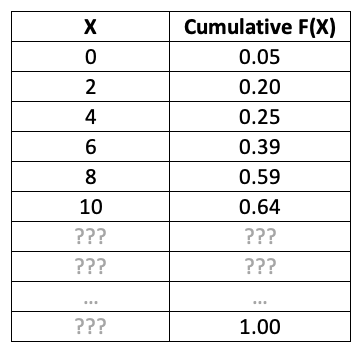
a) Find
Since we don’t have information for , we will use the complement
b) Find
c) Find
The answer is not 0.39!
Or, you could have created the probability distribution function first, and then answered the questions.

The cumulative distribution function (cdf) of a discrete random variable that only takes on integer values is given by .
Suppose , , , and
Find