Wize High School Grade 11 Biology Textbook > Genetics of Inheritance
Pedigrees & Family Trees
Pedigree Analysis
Inheritance of Autosomal Traits
Example: Autosomal Recessive
Example: Autosomal Dominant
Inheritance of X-linked Traits
Sex-linked Genes & Reciprocal Crosses
Example: Sex Linked Traits
Example: X-linked Dominant
Practice: Type of Inhertiance
Practice: AD, AR, or X?
Practice: Type of Inheritance 2
Popular Courses
Find My Course

0:00 / 0:00
Pedigree Analysis
A pedigree chart is a series of symbols used to depict family members affected by a genetic trait in a family tree.
- Circles represent females and squares represent males in the chart below.
- Colored shapes represent individuals affected by a genetic trait (e.g. color blindness).
- The roman numeral stands for which generation the individuals belong to.
- The digit identifies the individual within each generation.

- The founding parents are the male and female in the first generation.
- The founding family consists of the founding parents and their children.
Use of Pedigree Charts and Rules
- Pedigrees can be used to study the genetics of inherited diseases – to determine the mode of transmission:
- Dominance: whether a disease is dominant or recessive.
- Linkage: whether a disease is X-linked (on the X chromosome) or autosomal (not on sex chromosomes).
4 key things to remember when analyzing pedigrees:
- An unaffected person cannot carry any alleles of a dominant trait.
- Why? If the trait is dominant, having the allele means the person would present disease.
- An unaffected person can be carrying the trait if it is recessive.
- Why? If the trait is recessive, someone requires two alleles in order to show disease.
- If the trait is X-linked, a recessive allele is sufficient to affect a male.
- Why? Males only have one X chromosome. Let's say the mutation is on a protein that is on chromosome X. Since they only have one X, the protein produced is only the mutated one. There's no second X to compensate.
- Fathers transmit X-linked genes to their daughters only, while mothers transmit X-linked genes to both their sons and daughters.
- Why? Fathers (males) only have one X chromosome (and one Y). If a man has a male son, they must have given their Y chromosome to their son. If a man has a daughter, they must have given their X chromosome to them.
Watch Out!
Your course may not follow exactly the color scheme here. In that case, understand the legend that is relevant for your course!


0:00 / 0:00
Inheritance of Autosomal Traits
Autosomal traits are ones that are not linked to the sex chromosomes. X-linked traits are ones linked to the X sex chromosome.
Autosomal Dominant
How to tell if a trait is dominant:
- It is prevalent within the pedigree (i.e. more than half affected). Both males and females express the allele and can transmit it equally to sons and daughters.
- The trait is present in almost all generations. Direct transmission through three generations is practically diagnostic of a dominant.
- In affected families, the ratio of affected to unaffected children is almost always 1:1.
- There are no carriers. If both parents are unaffected, all the children are unaffected.
- That is, no two unaffected parents (white circle and square) give rise to an affected child (dark symbol).

Autosomal Recessive
How to tell if a trait is recessive:
- Carriers have the recessive allele but don't have the actual trait.
- The trait is not very prevalent in the family (i.e. not many have the trait or disease, not present in all generations).
- Two unaffected parents have a child that is affected by the trait or disease, usually in the ratio of one affected to three unaffected.
- When both parents are affected all the children are affected.


0:00 / 0:00
Example: Autosomal Recessive
A patient is suspected of having an inherited disorder. Pedigree analysis shows the pattern below, which of the choices is most compatible with the patient's condition?

A) Autosomal Dominant Disease
B) Autosomal Recessive Disease
C) X-linked Dominant Disease
D) X-linked Recessive Disease
E) Mitochondrial disease
Both males and females are affected, and each of the affected individuals on this pedigree has inherited the disorder from asymptomatic parents, consistent with an autosomal recessive inheritance pattern. Therefore, the answer is b.
0:00 / 0:00
Example: Autosomal Dominant
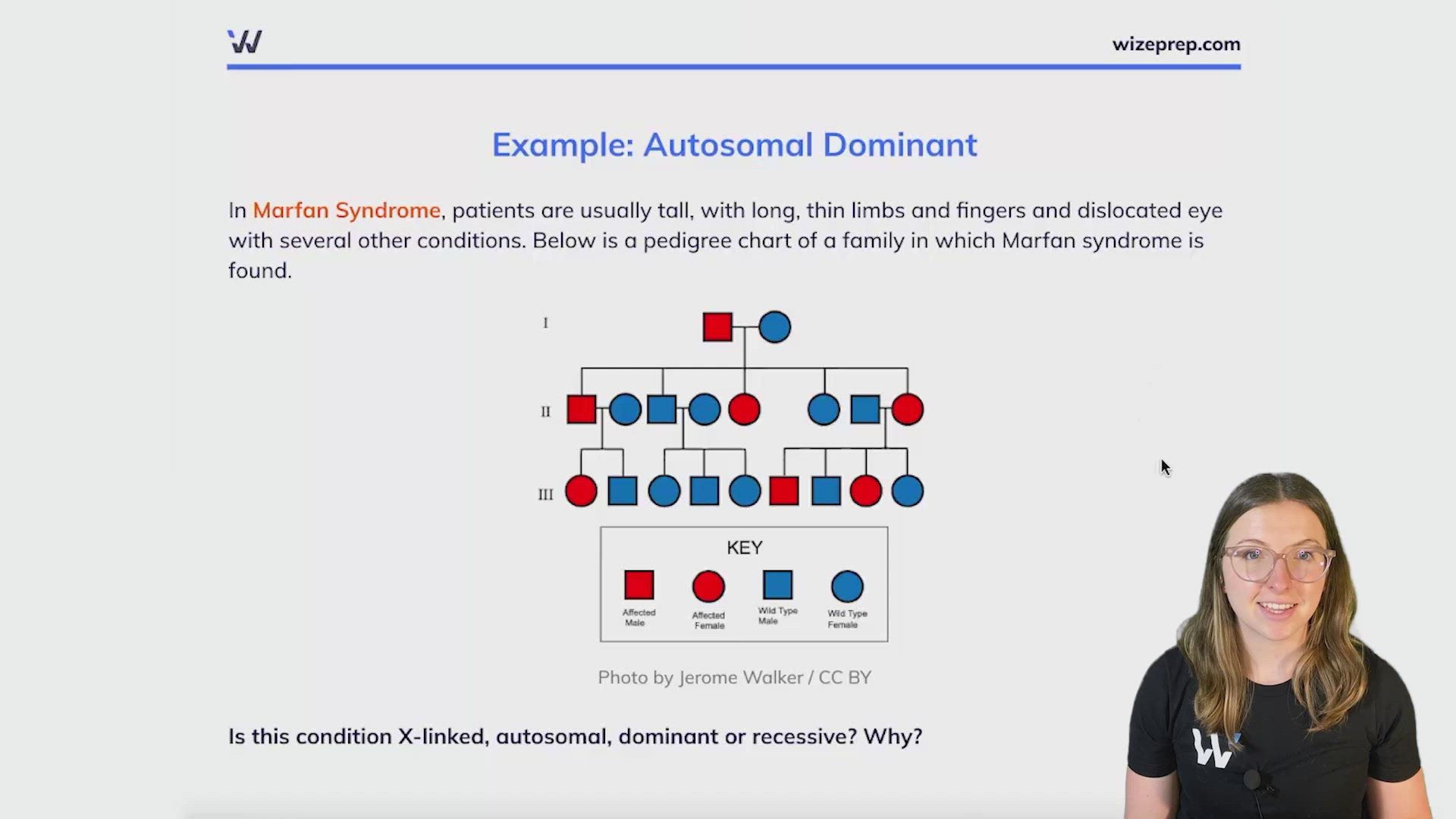
In Marfan Syndrome, patients are usually tall, with long, thin limbs and fingers and dislocated eye with several other conditions. Below is a pedigree chart of a family in which Marfan syndrome is found.

Is this condition X-linked, autosomal, dominant or recessive? Why?
Autosomal dominant.
Looks like both males and females are equally affected, it is present in every generation, and an affected parent passes it on to 1/2 of its offspring. Also no children of unaffected parents have the disease.
What is the ratio of affected to unaffected children if one heterozygous (affected) parent mates with a normal (unaffected) parent? Use B for the dominant allele, and b for the recessive.
Unrelated marriage partners therefore usually recessive homozygotes (bb) and the mating can be represented:
Bb x bb =>
The possibilities for children are: 1 Bb, 1 Bb, 1 bb, 1 bb =>
Ratio of affected:unaffected is 1: 1
What is the ratio of affected to unaffected children if one heterozygous (affected) parent mates with another heterozygous (affected) parent?
Matings between heterozygotes are the only kind that can produce homozygous offspring (remember Mendelian laws):
Bb x Bb =>
The possibilities for children are: 1 BB, 1 Bb, 1 Bb, 1 bb =>
The ratio is 1:2:1 (or 3 affected: 1 unaffected).
0:00 / 0:00
Inheritance of X-linked traits
X-linked traits are those that are present on the X chromosome.
X-Linked Recessive
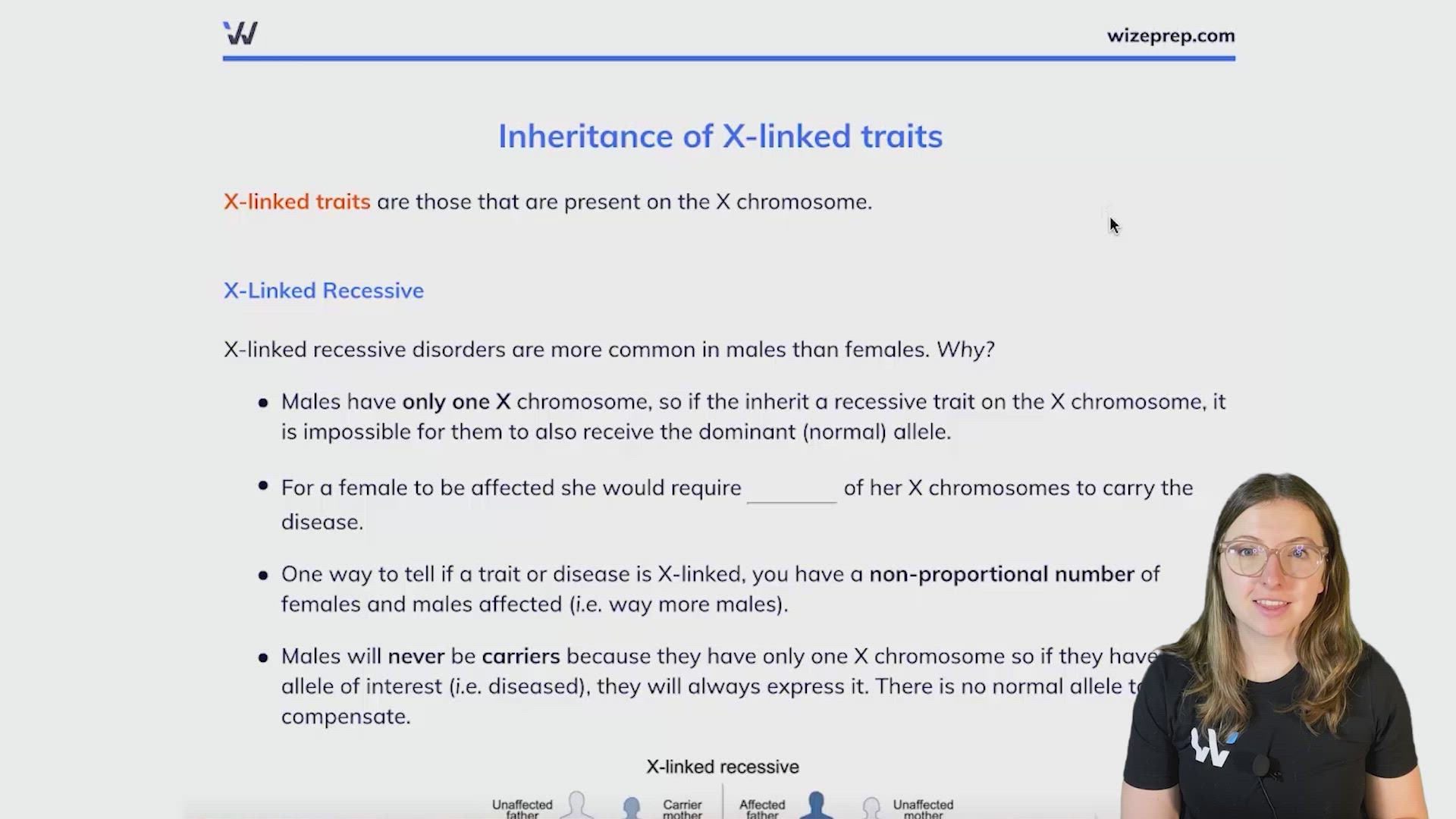
X-linked recessive disorders are more common in males than females. Why?
- Males have only one X chromosome, so if the inherit a recessive trait on the X chromosome, it is impossible for them to also receive the dominant (normal) allele.
- For a female to be affected she would requirebothof her X chromosomes to carry the disease.
- One way to tell if a trait or disease is X-linked, you have a non-proportional number of females and males affected (i.e. way more males).
- Males will never be carriers because they have only one X chromosome so if they have the allele of interest (i.e. diseased), they will always express it. There is no normal allele to compensate.

- Females can be carriers, but are rarely affected.
- Only affected if they are unlucky enough to receive both recessive alleles, one from each parent.
- Or if they are carriers and their normal X chromosome is inactivated.
- Two non-affected parents can yield an affected male.
- Why? Non-affected father = normal X chromosome.
- Non-affected mother = 1 normal X chromosome, 1 diseased chromosome (carrier).
- Only boys can be affected because for girls to be affected the father must have had the disease.
X-linked Dominant
- Highly prevalent in the family. The condition occurs twice as frequently in females as in males.
- No carriers.
- If father is affected, all daughters will have it, but never a son.
- An affected woman passes the condition to half her sons and half her daughters.
0:00 / 0:00
Reciprocal Crosses
- Used to determine if a gene is sex linked or autosomal
- Sex linked = found on the X chromosome
- Autosomal = found on non-sex chromosomes
- Must do 2 different crosses:
- Mutant phenotype male x normal female
- Mutant phenotype female x normal male
Example Reciprocal Cross:
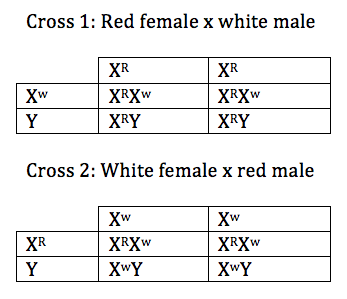
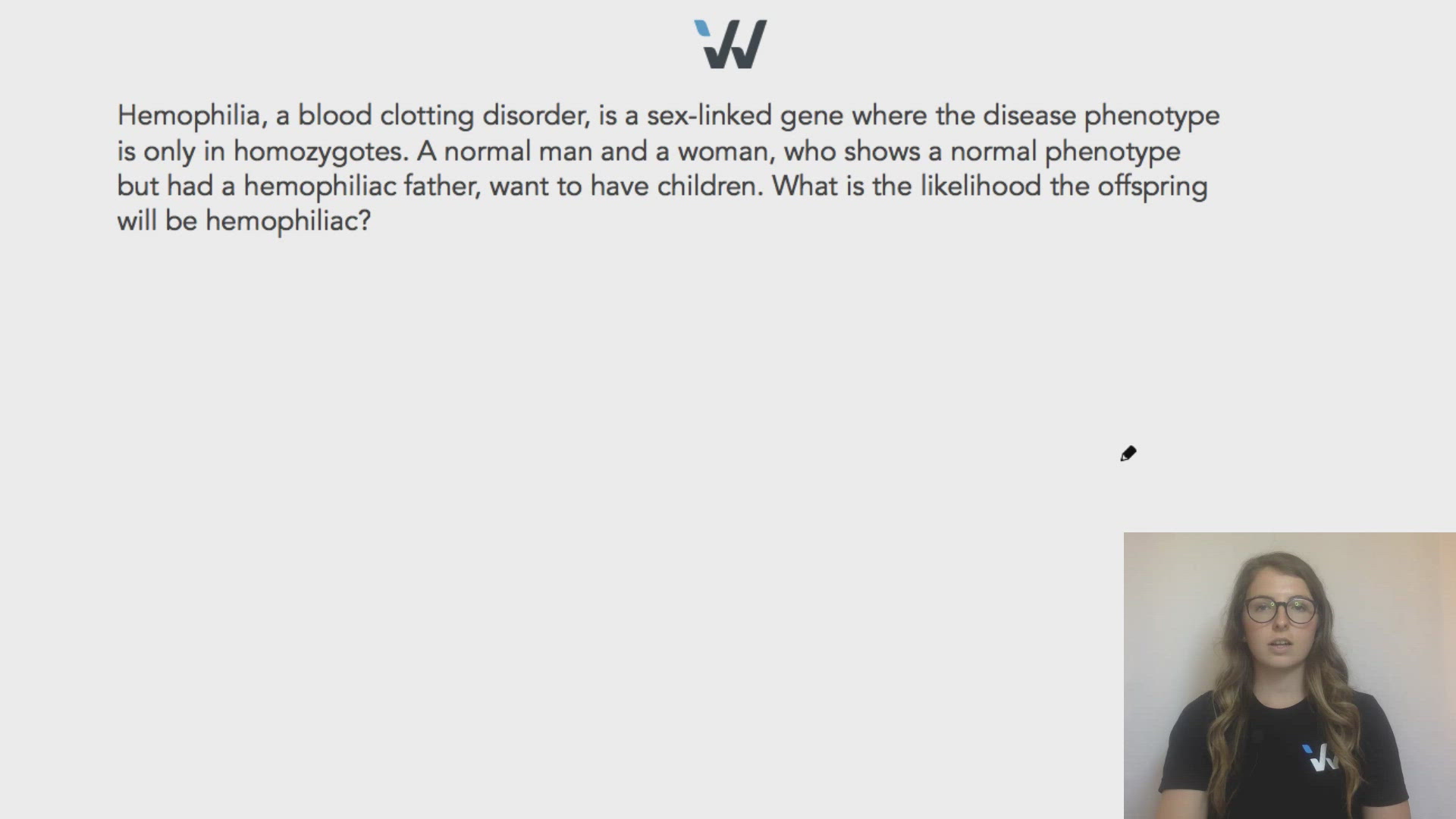
You have true breeding lines of Drosophila, those with white eyes and those with red eyes. If the red eye allele is X-linked dominant to the white eye allele, use reciprocal crosses to support that this is true.
0:00 / 0:00
Example: Sex-linked Traits
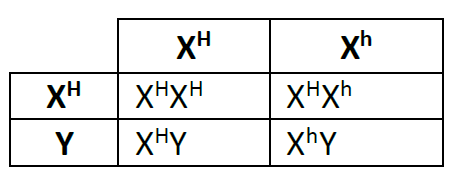
Hemophilia, a blood clotting disorder, is a sex-linked gene where the disease phenotype is only in homozygotes. A normal man and a woman, who shows a normal phenotype but had a hemophiliac father, want to have children. What is the likelihood the offspring will be hemophiliac?
If you were to draw the Punnet square: ¼ of offspring (or 25% chance) are hemophiliac
0:00 / 0:00

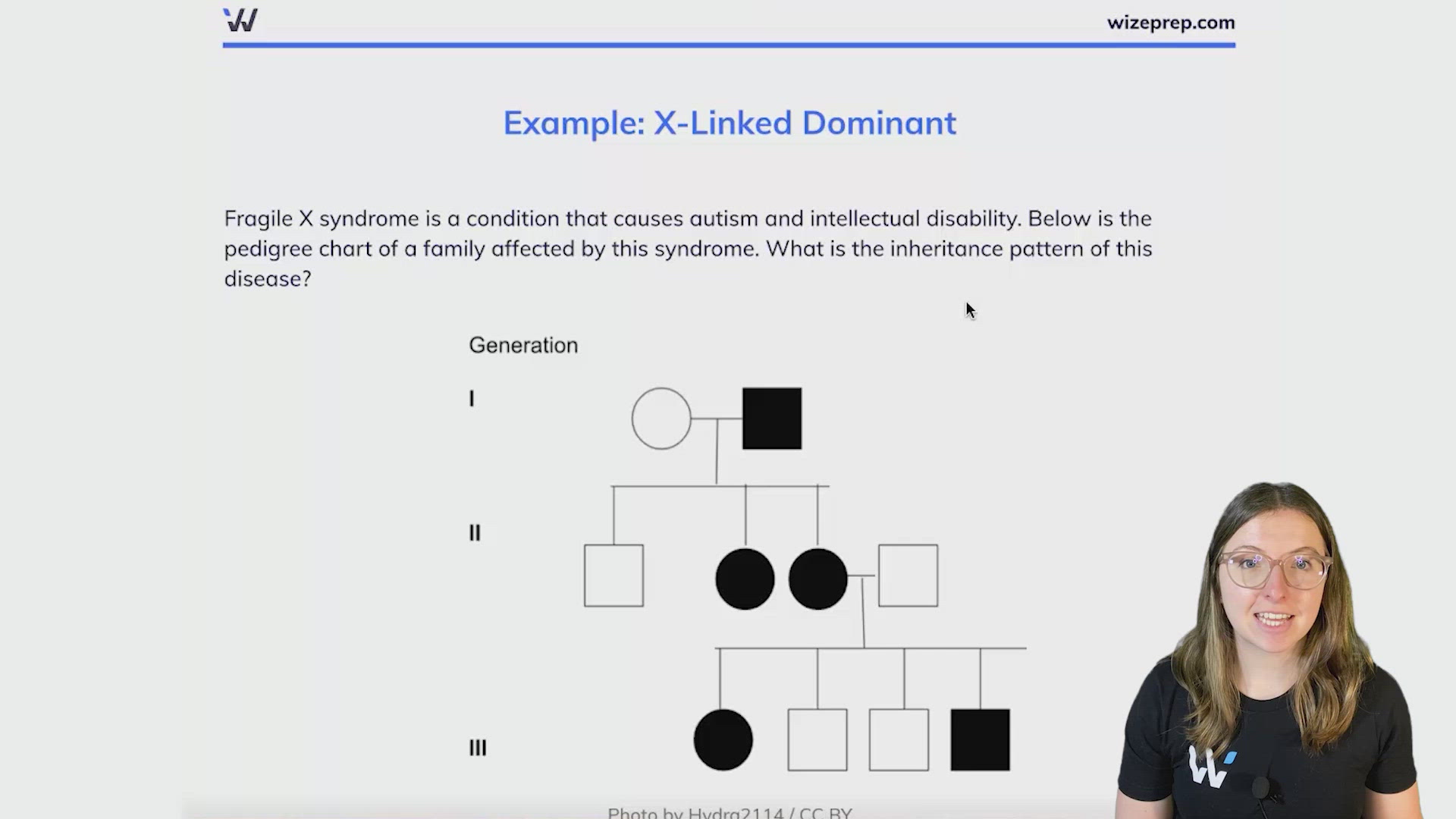
X-linked Dominant.
Notice that males and females are affected equally.
Affected males always pass it on to their daughters.
Affected females can pass it on to both daughters and sons equally.
Practice: Type of Inheritance
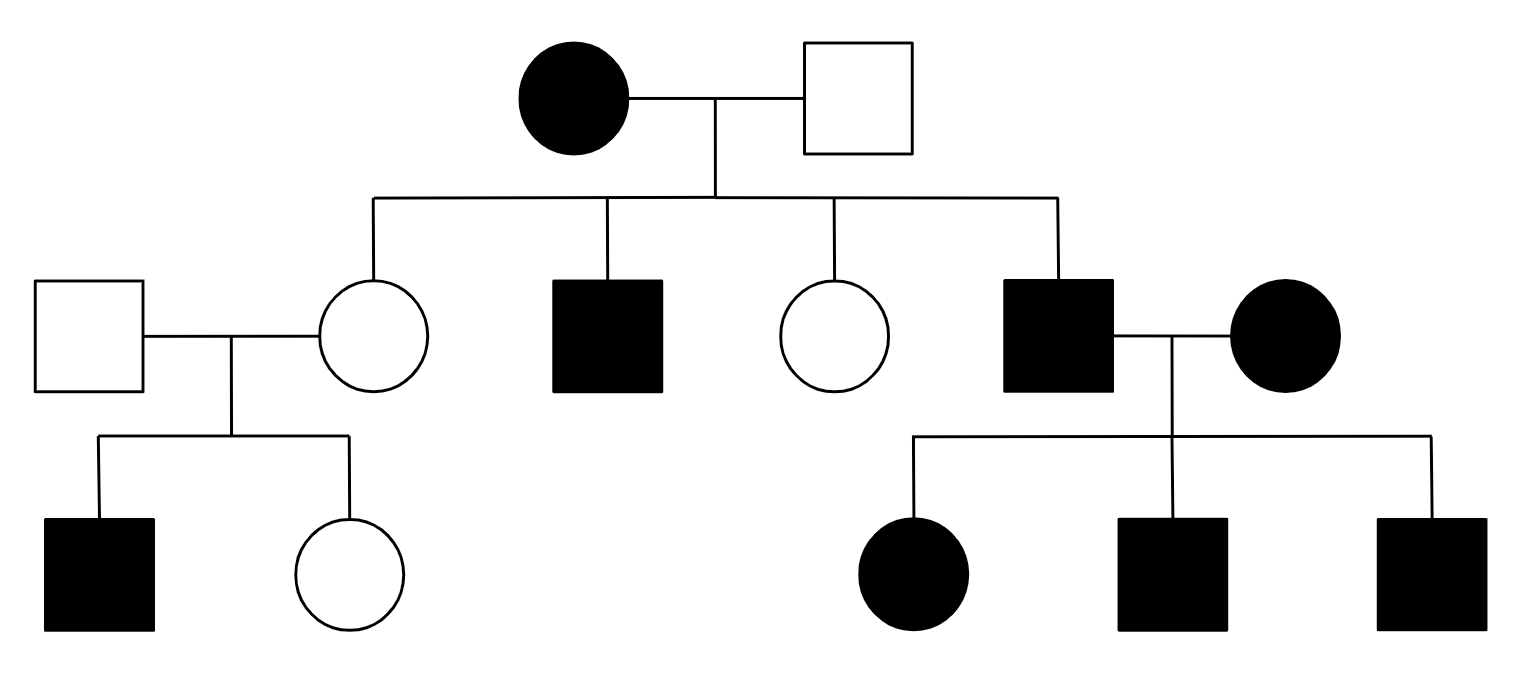
What type of inheritance pattern is shown in the following pedigree (individuals with the phenotype are shown in black)?

Practice: AD, AR or X?
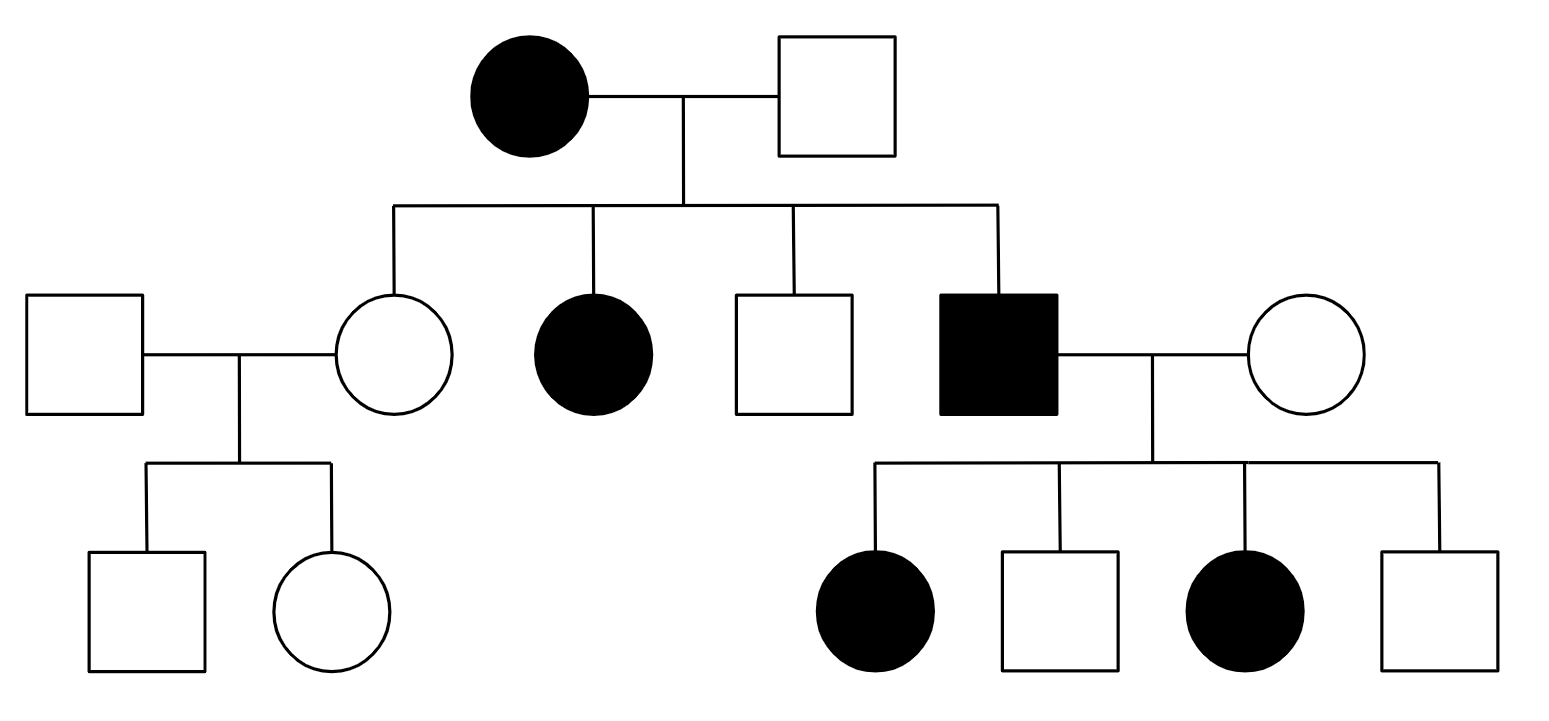
Identify if pedigree is autosomal dominant, autosomal recessive, or X-linked:

Practice: Type of Inheritance
Consider the following pedigree (black / white represents carriers):
This is a 3 part question.

What type of inheritance is the disease shown in this pedigree undertaking?