Wize High School Grade 11 Biology Textbook > Genetics of Inheritance
Inheritance of Two Traits
0:00 / 0:00
Monohybrid vs. Dihybrid Crosses
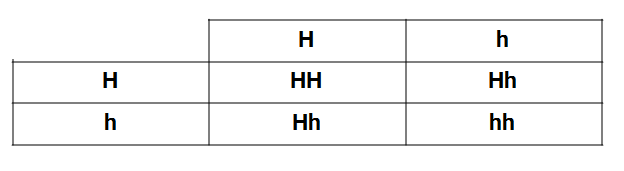
Make a Punnet Square for a Hh x Hh monohybrid cross
- Separate alleles into separate gametes
- In the boxes combine the gametes as if fertilization had happened
Make a Punnet Square for a dihybrid cross of HhRr x HhRr
Hh = heavy, hh = light, RR, Rr = round, rr = long

What are the phenotypes?
Heavy & round =
9 (HHRR, HhRR, HHRr, HhRr)
Heavy & long =
3 (HHrr, Hhrr)
Light & round =
3 (hhRR, hhRr)
Light & long =
1 (hhrr)
0:00 / 0:00
Product Rule in Genetics
In a cross between two flowers of the same genotype AaBb, where gene A encodes for one characteristic and gene B for another. Capital letter (A or B) represents the dominant allele, such that AA or Aa will produce the same effect. Calculate the probability of having aabb offspring. (Note: the probability of getting aa is 1/4 and the probability of getting bb is also 1/4).
If you know about Punnett square already you should be able to calculate that Aa x Aa = 1 AA, 2 Aa and 1 aa, so overall aa = 1/4 of the possibilities. This is the exact same for the B gene.
Therefore, in order to get both: Paa x Pbb = 1/4 x 1/4 = 1/16
0:00 / 0:00
Example: Punnet Square Dihybrid Crosses
Assume the following dihybrid crosses where for a particular gene, A represents the dominant allele and a represents the recessive. For another gene, B is the dominant and b is the recessive.
1. State the resulting genotypes from the following crosses.
2. State the ratios of genotypes (Ratios usually go from highest to lowest e.g. 3:2:1 not 1:3:2 or 1:2:3)
3. State the ratios of phenotypes
Cross 1: AaBb x AaBb
1. AABB, AABb, AAbb, AaBB, AaBb, Aabb, aaBB, aaBb, aabb
2. 4:2:2:2:2:1:1:1:1 (AaBb:AaBB:Aabb:AABb:aaBb:AABB:aabb:aaBB:AAbb)
3. 9:3:3:1 (both dominant features:only A dominant:only B dominant:both recessive)
Cross 2: aabb x AaBb
1. AaBb, Aabb, aaBb, aabb
2. 1:1:1:1
3. 1:1:1:1
Practice: Determining Generational Genotypes
Consider a cross between two true-breeding zebrafish strains. The female parent has stripes (dominant) and a short tail fin and the male is spotted with a long tail (dominant) fin. All F1 progeny are striped with long tail fins.
Use S and s to represent the body patterning alleles and T and t to represent the tail fin alleles. Let S is stripes and s is spots, while T is long tail and t is short tail.
a) What are the genotypes of the parents?
b) What gametes can they produce?
c) What is the genotype of the F1 generation?
d) What type of dominance is this?
Practice: Dihybrid Testcross
Consider a cross between two true-breeding zebrafish strains. The female parent has stripes (dominant) and a short tail fin and the male is spotted with a long tail (dominant) fin. All F1 progeny are striped with long tail fins.
Use S and s to represent the body patterning alleles and T and t to represent the tail fin alleles. Let S is stripes and s is spots, while T is long tail and t is short tail.
You perform a testcross using a female zebrafish (sstt genotype) with SsTt genotype male. What are the genotypes and phenotypes produced?
Practice: Two Trait Crosses
In cats, big ears are dominant over short ears, and the gene is autosomal. Another gene controls eye color, and is X-linked. "E" gives brown eyes, "e" gives blue eyes, and Ee gives green eyes.
Brown eyed male with the homozygous genotype for big ears is mated with a female with short ears and green eyes. What are the possible kittens that could be produced?
Note: X-linked traits are on the X chromosome. Females have two X chromosomes while males have one X chromosome and one Y chromosome.