Wize High School Grade 11 Biology Textbook > Genetics of Inheritance
Inheritance of a Single Trait
Punnett Square Rules
Example: Punnet Square
Example: Sum Rule in Genetics
Incomplete Dominance and Co-Dominance
Example: Incomplete vs Co-dominance
Blood Types
Practice: Probability in Genetics
Practice: Probability of Sickle Cell Anemia
Practice: Cystic Fibrosis Phenotype Probability
Practice: Possible Blood Types
Popular Courses
Find My Course
0:00 / 0:00
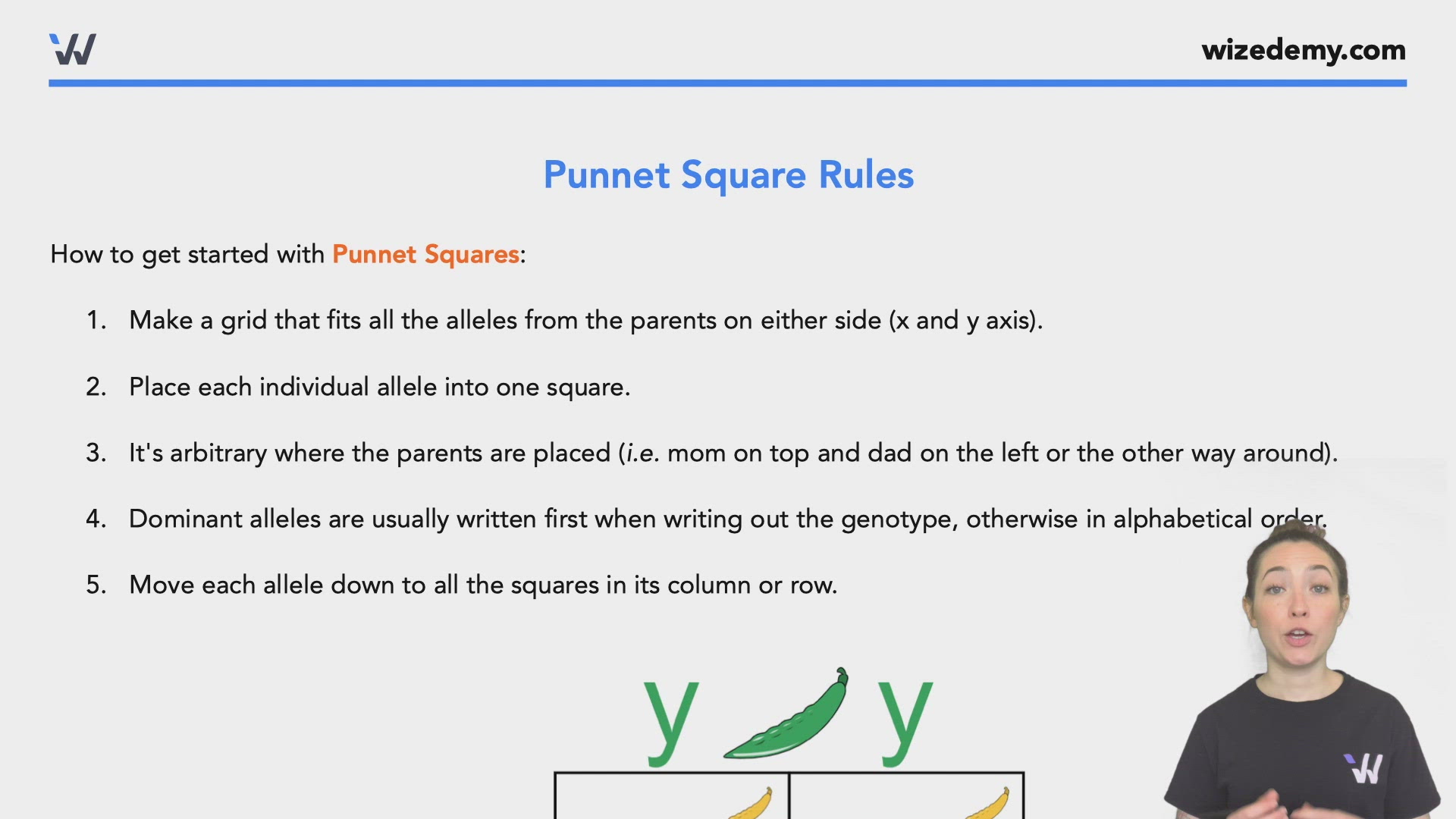
Punnett Square Rules
How to get started with Punnett Squares:
- Make a grid that fits all the alleles from the parents on either side (x and y axis).
- Place each individual allele into one square.
- It's arbitrary where the parents are placed (i.e. mom on top and dad on the left or the other way around).
- Dominant alleles are usually written first when writing out the genotype, otherwise in alphabetical order.
- Move each allele down to all the squares in its column or row.

Punnet Squares to Determine Offspring Probability
Based on the Punnet square shown above, determine the ratio of yellow to green beans.
1:1 because you have 2/4 genotypes that result in yellow and 2/4 that result in green
Therefore, 2:2 = 1:1 ratio of phenotypes
Ratios for genotype is also 1:1 (Yy:yy)
0:00 / 0:00
Example: Punnett Square
Part A.
Assume the following monohybrid crosses where for a particular gene, A represents the dominant allele and a the recessive allele. The dominant allele shows complete dominance. State the possible genotypes resulting the following crosses:
A. AA x aa
B. Aa x aa
C. AA x Aa
D. Aa x Aa
A. Aa
B. Aa, aa
C. AA, Aa
D. AA, aa, Aa
Part B.
Assume that the dominant allele results in green peas and the recessive in yellow peas. What is the proportion of the phenotypes based on the same crosses shown in Part A. (Ratios are normally written dominant:recessive).
A. 1:0
B. 1:1
C. 1:0
D. 3:1
0:00 / 0:00
Example: Sum Rule in Genetics
Both parents have a "Bb" genotype. What is the probability of the offspring having the dominant phenotype?
Offspring showing the dominant phenotype could be BB OR Bb, so we need to use the sum rule. What are the possible ways we could get offspring with the dominant phenotype?
1. Mother contributes B allele and father contributes b allele (offspring are Bb), OR
2. Mother contributes b allele and father contributes B allele (offspring are bB), OR
3. Both mother and father contribute B allele (offspring are BB).
These three events are mutually exclusive, because only one fertilization even can occur at a time. The probability of each of the above events is 1/4 (we can determine this using the product rule). To determine the probability of the offspring with the dominant phenotype, we add the three individual probabilities together:
(1/4) + (1/4) + (1/4) = 3/4

0:00 / 0:00
Incomplete Dominance and Co-Dominance
Combinations of alleles (genotype) result in different traits or physical features (phenotype) being expressed.
- Remember that when one allele masks the other, the allele that is seen in the phenotype is called dominant. The other allele is called recessive.
- Sometimes expression is not as cut and dry, resulting in incomplete dominance or co-dominance phenotypes.
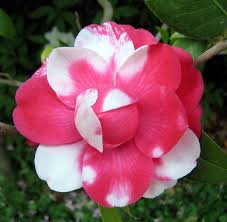
Incomplete Dominance
- Neither allele is dominant nor recessive.
- Both traits come together to contribute equally to an intermediate trait.
- Sometimes not an obvious mixture of the two traits. Example: In flowers, allele R encodes Red and allele r encodes white. What phenotype might result from a heterozygous genotype Rr?Pink

Co-Dominance
- Neither allele is dominant nor recessive.
- Both traits are expressed, not in a mixture but as a hybrid. Example: consider the previous example of flower color alleles. If co-dominance is occurring, then the Rr genotype results in both red and white showing up.
0:00 / 0:00
Example: Incomplete vs Co-dominance
Coat color in a species of mice is controlled by a gene that produces a brown pigment giving the mice a brown coat. This gene has two alleles: C which is a functional allele, and C' which is a mutated allele that cannot produce the pigment. What kind of dominance could you see in this scenario? And what would the coat color phenotypes be?
You could see either complete or incomplete dominance.
1) With complete dominance you would see brown and white mice.
2) With incomplete you would see brown (CC), white (C'C') and an intermediate tan/beige (CC').
Petal color in a species of peony is controlled by a gene that produces pigments ranging from blues to reds. This gene has two alleles: Xr which produces a reddish pigment and Xb which produces a blueish pigment. What kind of dominance could you see in this scenario? And what would the coat color phenotypes be?
You could see either complete dominance or co-dominance.
1) With complete dominance, you would see red and blue petals.
2) With co-dominance, you would see all red, all blue or red/ blue hybrid.
0:00 / 0:00
Blood Types
Sometimes, there is more than one allele coding for a particular trait. A classic example is blood types. A person can have:
- Type A
- Type B
- Type AB
- Type O
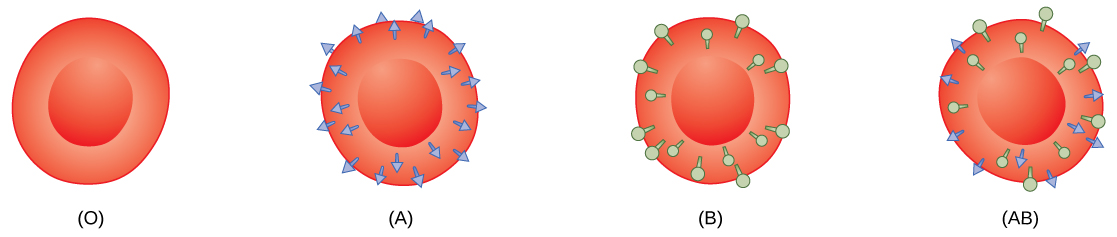
These blood types are determined by the type of carbohydrate added to a protein on the surface of red blood cells, and there are three different enzymes (encoded by three different alleles) responsible for adding this carbohydrate:
- IA adds "A" type carbohydrate
- IB adds "B" type carbohydrate
- i does not add a carbohydrate
Blood type is determined by which of these three alleles a person has:
- IAIA OR IAi will have type A blood ("A" type carbohydrates)
- IAIB will have type AB blood ("A" and "B" type carbohydrates)
- IBIB OR IBi will have type B blood ("B" type carbohydrates)
- ii will have type O blood (no carbohydrates)
Practice: Probability in Genetics
Both parents have the genotype Bb. What is the probability of offspring showing the recessive phenotype?
Practice: Probability of Sickle Cell Anemia
Sickle cell anemia is a recessive trait in humans. The gene that causes this disease is not located on the sex chromosomes. In a cross between a father who has sickle cell anemia and a mother who is heterozygous for the gene, what is the probability that their children will have the normal phenotype?
Practice: Cystic Fibrosis Phenotype Probability
Cystic fibrosis is a recessive trait in humans. The gene that causes this disease is not located on the sex chromosomes. In a cross between a father who has cystic fibrosis and a mother who is heterozygous for the gene, what is the probability that their first three children will have the abnormal phenotype?
Practice: Possible Blood Types
A child finds out that he is blood type O and his mother is blood type B. He claims that his father cannot be bloodtype AB.
Is his claim true or false?