Wize University Biology Textbook > Overview of Animals
Overview of Animals
Popular Courses
Biology
General Course
General Biology
University Study Guides
Grade 12 Biology
Canada High School
DAT
General Course
High School Biology
US High School
Grade 11 Biology
Ontario High School
Grade 11 Biology
Canada High School
BIO 1131
University of Ottawa
BIO120H1
University of Toronto
General Biology
University Study Guides
BIOL 108
University of Alberta
Biology 20
Alberta High School
BIOL 111
McGill University
BIOL 184
University of Victoria
BIOL*1070
University of Guelph
BIOL 1201
Western University
BISC 101
Simon Fraser University
Life Sciences 11
British Columbia High School
BIOL 1011
Dalhousie University
BIOL 1P91
Brock University

0:00 / 0:00
Overview of Animals
Animals represent a massive radiation of mobile creatures that we interact with every day, from worms to whales.
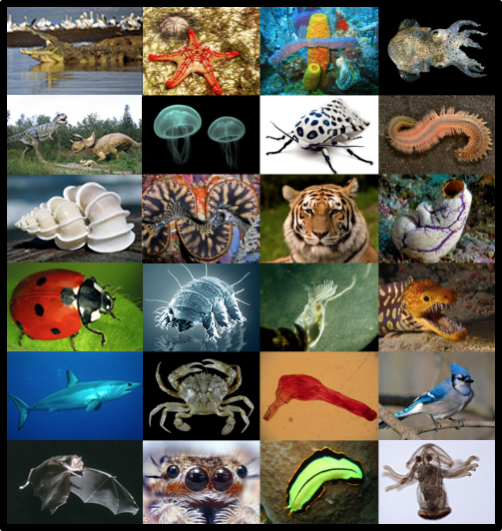
- All animals are multicellular eukaryotes
- No cell walls
- Collagen: protein holds bodies and tissues together
- Tissues: Group of cells that function together to perform a specific task
- Unique animal tissues: Nervous Tissue and Muscle Tissue
- All chemoheterotrophic (get energy by breaking down other cells)
- Sexual reproduction
- motile haploid sperm
- non-motile haploid egg
- Egg is much larger than sperm
0:00 / 0:00
Reproduction and Embryonic Development
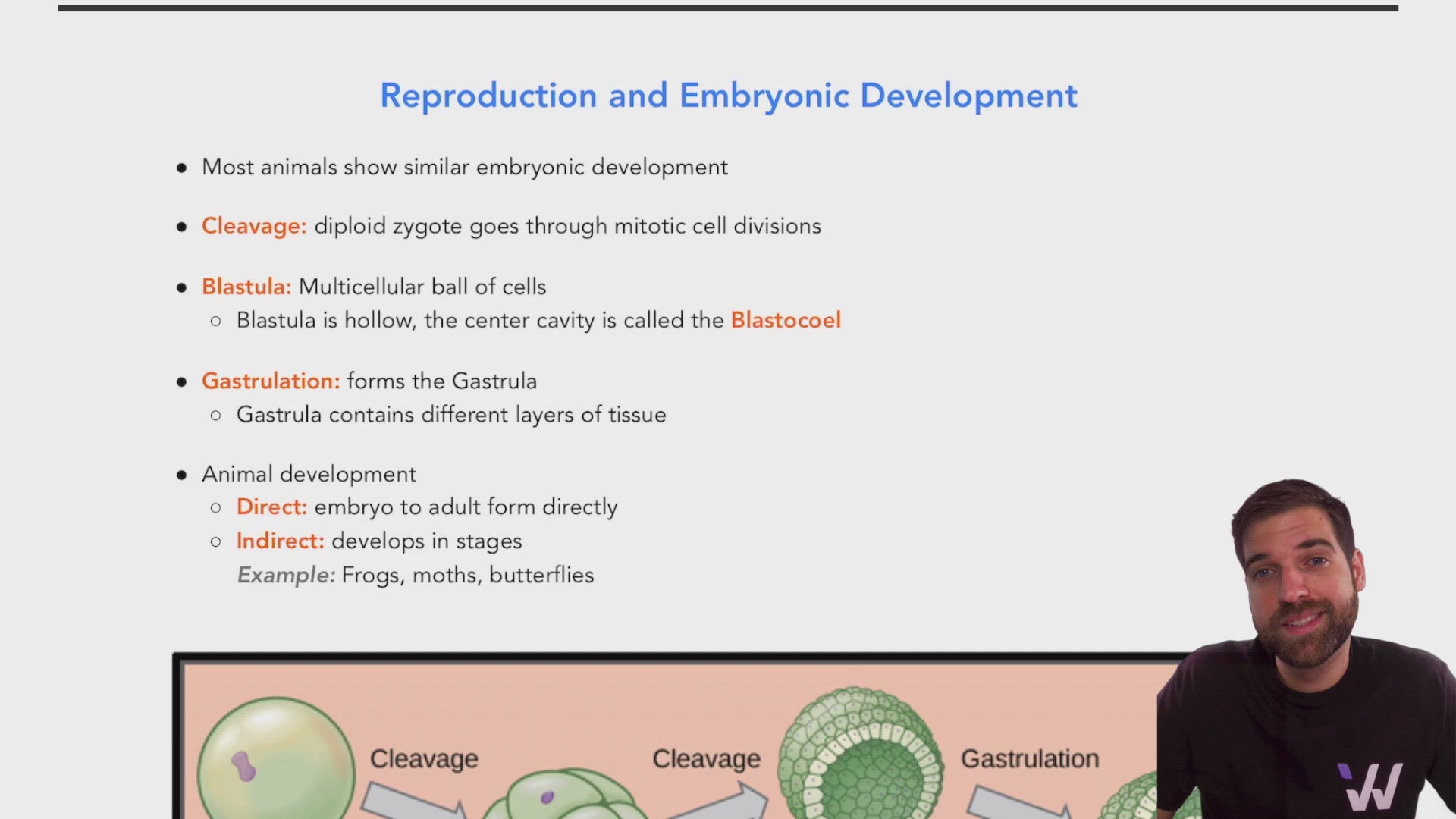
- Most animals show similar embryonic development
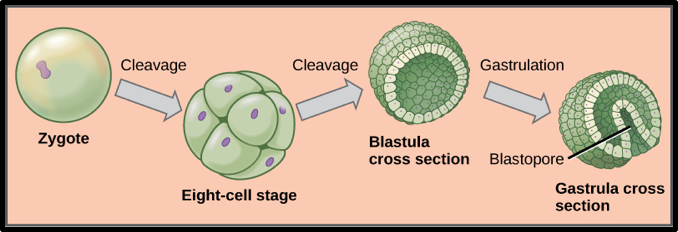
- Cleavage: diploid zygote goes through mitotic cell divisions
- Blastula: Multicellular ball of cells
- Blastula is hollow, the center cavity is called the Blastocoel
- Gastrulation: forms the Gastrula
- Gastrula contains different layers of tissue
- Animal development
- Direct: embryo to adult form directly
- Indirect: develops in stages Example: Frogs, moths, butterflies
Animal Overview
Which of the following are true for all animal cells? (Select all that apply)
0:00 / 0:00
Cell Structure and Specialization
Eumetozoa
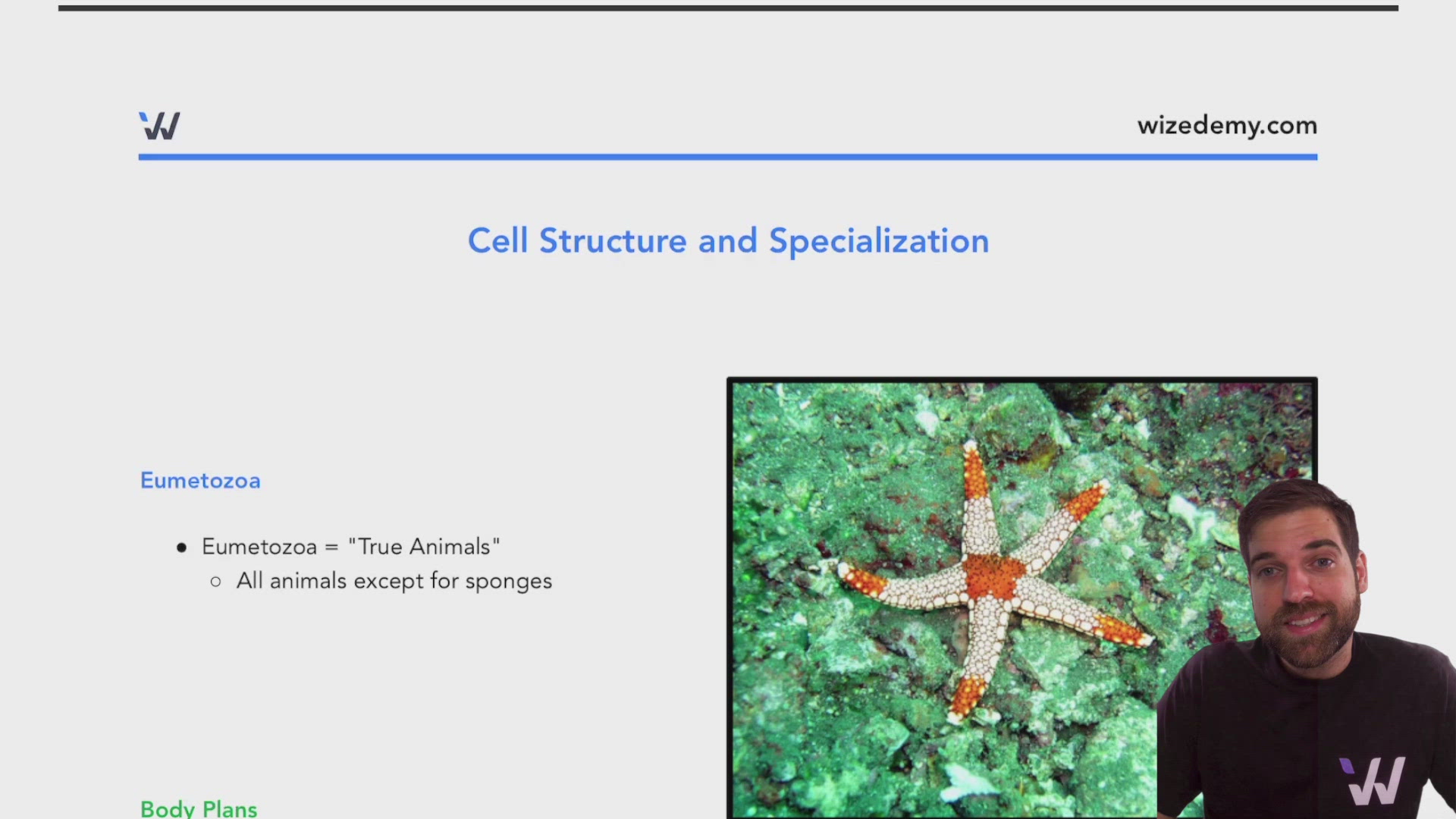
- Eumetozoa = "True Animals"
- All animals except for sponges
Body Plans
- Symmetry
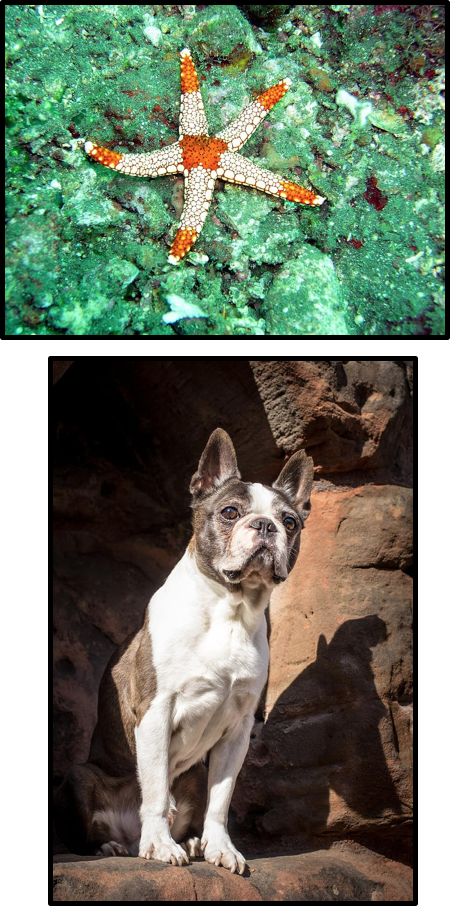
- Radial: No front/back or left/right Example: Sea Star, Sea Urchin
- Bilateral: Has a left and right side, both sides are mirrored across the center line (chiral)
- Typically active movement
- Have Central Nervous System (CNS)
- Have directionality:
- left / right
- dorsal / ventral (bottom / top)
- posterior / anterior (back / front) Example: Humans, dogs, squid etc.
- Cephalization: development of a head (or CNS)
Embryonic Development
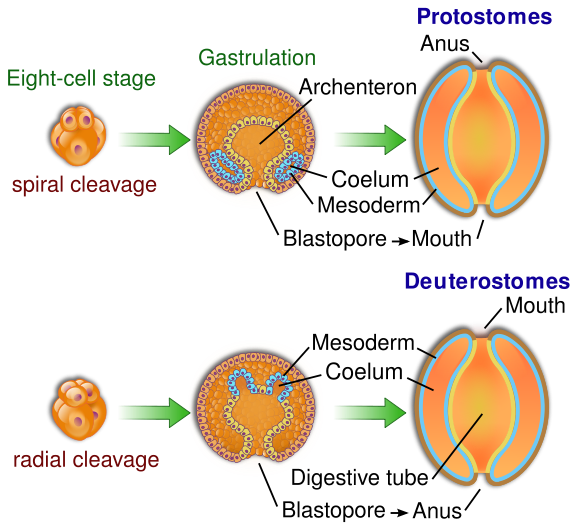
- Protostomia: First fold becomes the mouth
- Dueterostomia: Second fold becomes the mouth
Cell cleavage
- Protostomes: New cells develop in spiral pattern = Spiral Cleavage
- Determinant cells: Cells are already differentiated and WILL become a part of the embryo's body plan
- If you remove one cell, the embryo will be missing that body part
- Deuterosomes: New cells develop in radial pattern = Radial Cleavage
- Indeterminate cells: Call are NOT differentiated.
- Cells can be split / removed and embryo will make more

Germ Layer
- The development of tissues
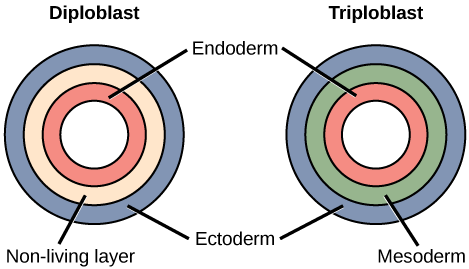
- 3 types of tissue layers
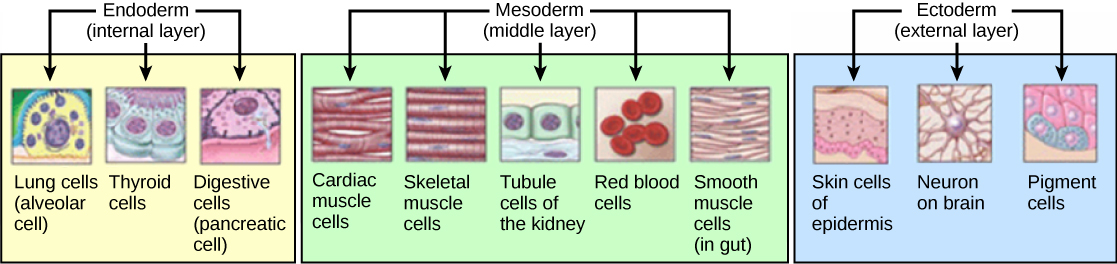
- Endo: "inner" gastrointestinal tract (GI tract)
- Meso: "middle" muscles and organs
- Ecto: "outer" outer protection (skin, nerves)
- Radiata: only 2 cell layer
- Diploblastic
- Endo and Ecto (missing the Meso layer)
- Bilateria: 3 cell layers
- Triploblastic
- Endo, Meso and Ecto
Animal Embryo Development
What is the first step in animal embryonic development?
Animal Symmetry
Fill in the blanks.
Starfish have ______________ symmetry, whereas frogs have _______________ symmetry.
Animal Development
During gastrulation in _________________ the second fold becomes the _____________________.