Wize University Biology Textbook > Craniates (Developed Heads)
Gnathostomes (Jawed Fish)
Popular Courses
Biology
General Course
General Biology
University Study Guides
Grade 11 Biology
Ontario High School
Grade 11 Biology
Canada High School
DAT
General Course
General Biology
University Study Guides
BIOL 108
University of Alberta
Biology 20
Alberta High School
BIOL 111
McGill University
BIOL 1201
Western University
Life Sciences 11
British Columbia High School
BIOL 1P91
Brock University
BLG 144
Toronto Metropolitan University
BIOL 331
University of Calgary
BIOL 1020
University of Manitoba
BIOA01H3
University of Toronto
BISC 102
Simon Fraser University
BI110
Wilfrid Laurier University
BIO220H1
University of Toronto
BIOL 201
University of Alberta

0:00 / 0:00
Gnathostomes

Infraphylum Gnathostomes
- Jawed fish
- Gnath = "jaw", stoma = "mouth"
- Evolution of 2 pairs of fins
- Bigger brain
- Enables more complex movements
- More duplications of Hox genes
- 2 x 2 = 4 clusters of Hox genes
- Added genetic diversity
- Jaws: enabled diverse feeding behavior
- Larger Brain
- Improved vision and smell
- Sharks lost hard skeleton
- Reverted to cartilage
- Evolution of jaws
- Modified 2 pairs of skeletal rods previously used to support pharyngeal slits
- More ways to get food
- Posterior slits became specialized for gas exchange
- Became gill slits
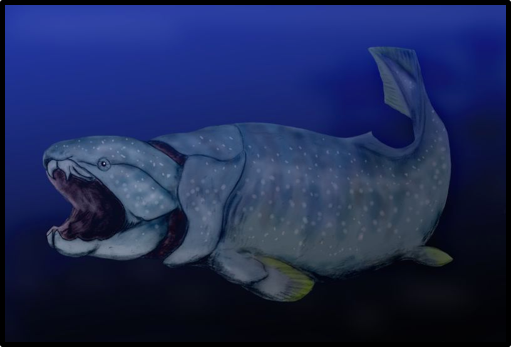
Class Chondrichthyes
- Cartilaginous fish
- Chondro = "cartilage", ichthys = "fish"
- Endoskeleton made out of cartilage
- Do have bony teeth (calcified)
- Cartilaginous skeleton
- Not a primitive character
- Character is derived
- Evolved from ancestors with bony skeletons
- Development of most vertebrates
- Skeleton (cartilaginous) becomes ossified (bony)
- Cartilage is replaced by calcium phosphate
- Cartilage ossifies as embryo develops
- Chondrichthys skips this process
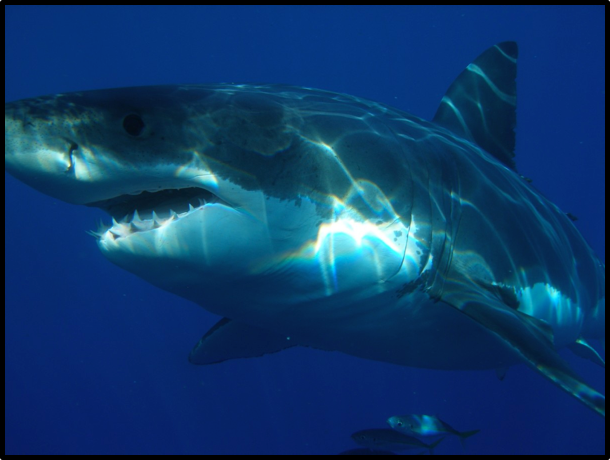
Sharks
Swimming
- propulsion comes from the tail
- Lacks gas-filled swim bladder
- Buoyancy from oil in liver
- Must use muscles to gulp water if not in motion
Skin
- Rough due to dermal placoid scales
- Dermal denticles
- Hydrodynamic
- Scales are homologous to vertebrate teeth
- Unclear which came first
Teeth
- Continuously replaced (conveyor belt of teeth)
- Common in fossil records
Sharks (Continued)
Reproduction
- Copulation
- Claspers: male pelvic fins modified for copulation
- Internal fertilization
- Progeny production
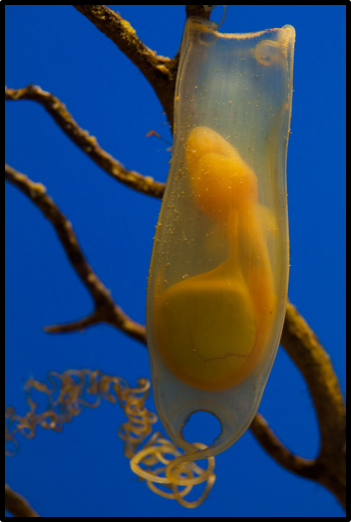
- Oviparous: Lays eggs
- Ovoviviparous: Eggs hatch inside female
- Viviparous: Live birth
- Eggs protected in leathery egg case
Nostrils
- Smelling (not gas exchange)
- Detect changes in electrical field generated by other animal muscle movements
- Uses pores around the head
- Detects vibrations in water
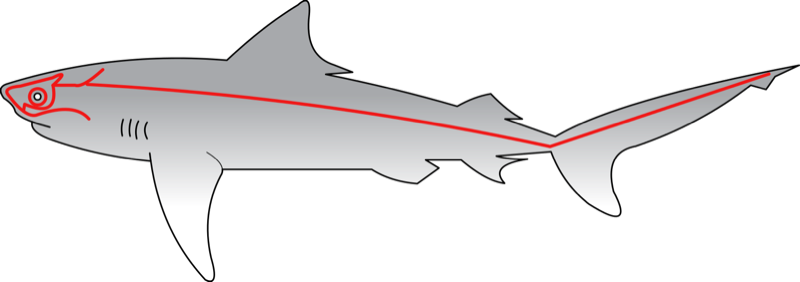
- Uses Lateral Line
- Lateral Line: pores that detect disturbances in the water
- Exists in bony fish as well
Practice: Gnathostomes
Which of the following resulted from a duplication of Hox genes in Gnathostomes? (select all that apply)
Practice: Gnathostomes
Chondrichthyes have a __________ skeleton that is a(n) ______________ trait.
Practice: Gnathostomes
__________ females lay eggs, whereas ____________ females give live birth.