Wize University Biology Textbook > The Scientific Method
The Scientific Method
Popular Courses
Biology
General Course
General Biology
University Study Guides
BIOLOGY 1002B
Western University
DAT
General Course
High School Biology
US High School
Grade 11 Biology
Ontario High School
Grade 11 Biology
Canada High School
BIO 1131
University of Ottawa
BIOLOGY 1M03
McMaster University
General Biology
University Study Guides
BIOL 108
University of Alberta
BIOL 130
University of Waterloo
SC/BIOL 1000 3.00
York University
Biology 20
Alberta High School
BLG 143
Toronto Metropolitan University
SC/BIOL 1001 3.00
York University
BIOL 1201
Western University
Life Sciences 11
British Columbia High School
BIOL 1P91
Brock University
BS 161
Michigan State University
0:00 / 0:00
The Scientific Method
This is the process scientists use to understand everything in the universe. Using this system we can guard against false conclusions.
Scientific Approach
- Observations lead to questions
- 2 types of questions
- Proximate:
- Surface level - usually about mechanisms
- "How" questions
- Ultimate:
- Deeper level - usually about evolutionary reasons
- "Why" questions
- Answer questions using
- Observation: No manipulation
- Experimentation: Controlled studies
- Studies designed to test hypotheses
- Falsifiable: we can test them and accept or reject the hypothesis
- Data can support hypotheses, but never prove them
Scientific Method
- The process scientists use to understand the the world
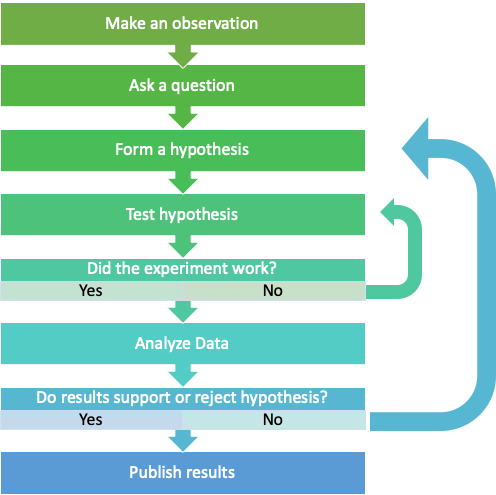
Example: Scientific Method
Applying the Scientific Method
When walking in the woods, you notice that two types of flowers (a red flower and a blue flower) are always found growing next to each other.
Using the Scientific Method, develop a hypothesis about the observation, then design an experiment to test that hypothesis.
1.) Observation
Two flowers are always found growing next to each other
2.) Question
Do the two flowers need each other to survive and grow?
3.) Hypothesis
The two flowers are always found next to each other because they rely on each other to survive.
4.) Test the hypothesis
Plant the flowers in the forest using three different treatments:
a.) Plant the red flower alone
b.) Plant the blue flower alone
c.) plant both flowers together
Identify which treatment has the highest survival.
Example: Scientific Method
After walking through the garden you notice that the bees are all hovering around one type of purple flower.
This represents a(n) _____________.
- Hypothesis
- Analysis
- Observation
- Experiment
Solution: 3.) Observation
Practice: Hypotheses
A hypothesis needs to be __________________.
Practice: Scientific Method
After analyzing data from an experiment, you determine that the experiment had failed.
What should be your next step?