Wize University Biology Textbook > Lab Techniques for Biology
Plasmids & Restriction Enzymes
Popular Courses
MCAT
General Course
AP Biology Exam Prep Course
AP Exam Prep
Biology
General Course
General Biology
University Study Guides
BIOLOGY 1002B
Western University
BIOL 102
Queen's University
Grade 12 Biology
Canada High School
DAT
General Course
High School Biology
US High School
BIOL 200
McGill University
General Biology
University Study Guides
SC/BIOL 1000 3.00
York University
BIOL 311
University of Calgary
BIOL 112
McGill University
HMB265H1
University of Toronto
BIOL 1010
Dalhousie University
BIOL 1010
Dalhousie University
BIOL-1101
University of Windsor
BIO230H1
University of Toronto
BIOL 1201
Western University

0:00 / 0:00
Overview of Gene Cloning
Gene cloning can be done when scientists want a gene to be expressed in a bacterial host. This is done in a series of steps:
- Amplify gene of interest
- Put gene in plasmid
- Put plasmid in bacteria
- Bacteria expresses gene
- Purify protein

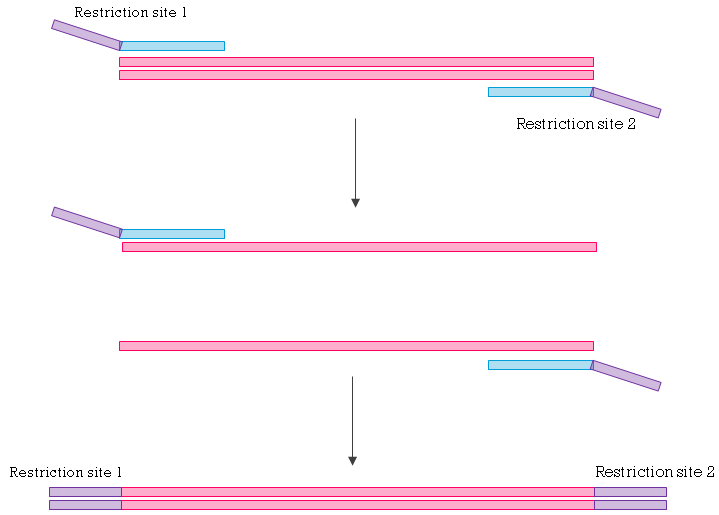
Step 1: PCR with restriction sites
Restriction sites are sequences of DNA that are recognized by specific enzymes (endonucleases). These sites can be added to the gene of interest by designing primers.
- Primers partly match the DNA to be amplified.
- The "hanging end" has the sequence we want to introduce and ends up amplified during PCR.
Step 2: Digestion and ligation
Plasmid and PCR product are cut with restriction enzymes or endonucleases (REs).
- Digestion with restriction enzymes creates complementary sticky ends.
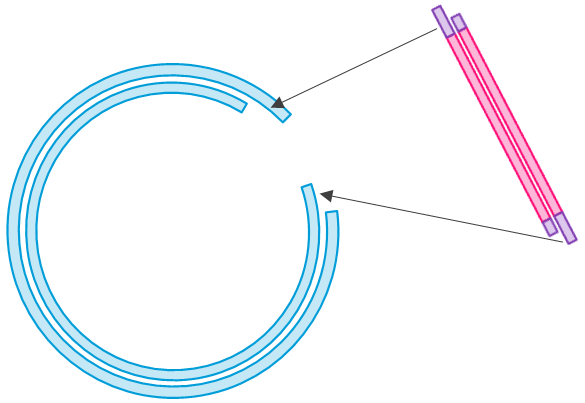
- DNA ligase sticks them together.

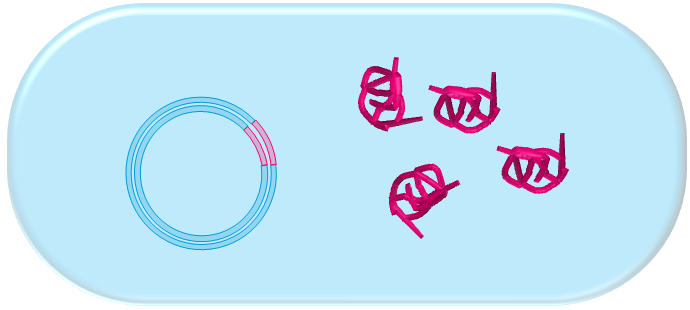
Steps 3 & 4: Introduction of DNA in bacteria and gene expression.
Plasmids are inserted in bacterial cells.
- Bacteria transcribe and translate the gene.
- Protein is produced and can be purified.
0:00 / 0:00
Plasmids
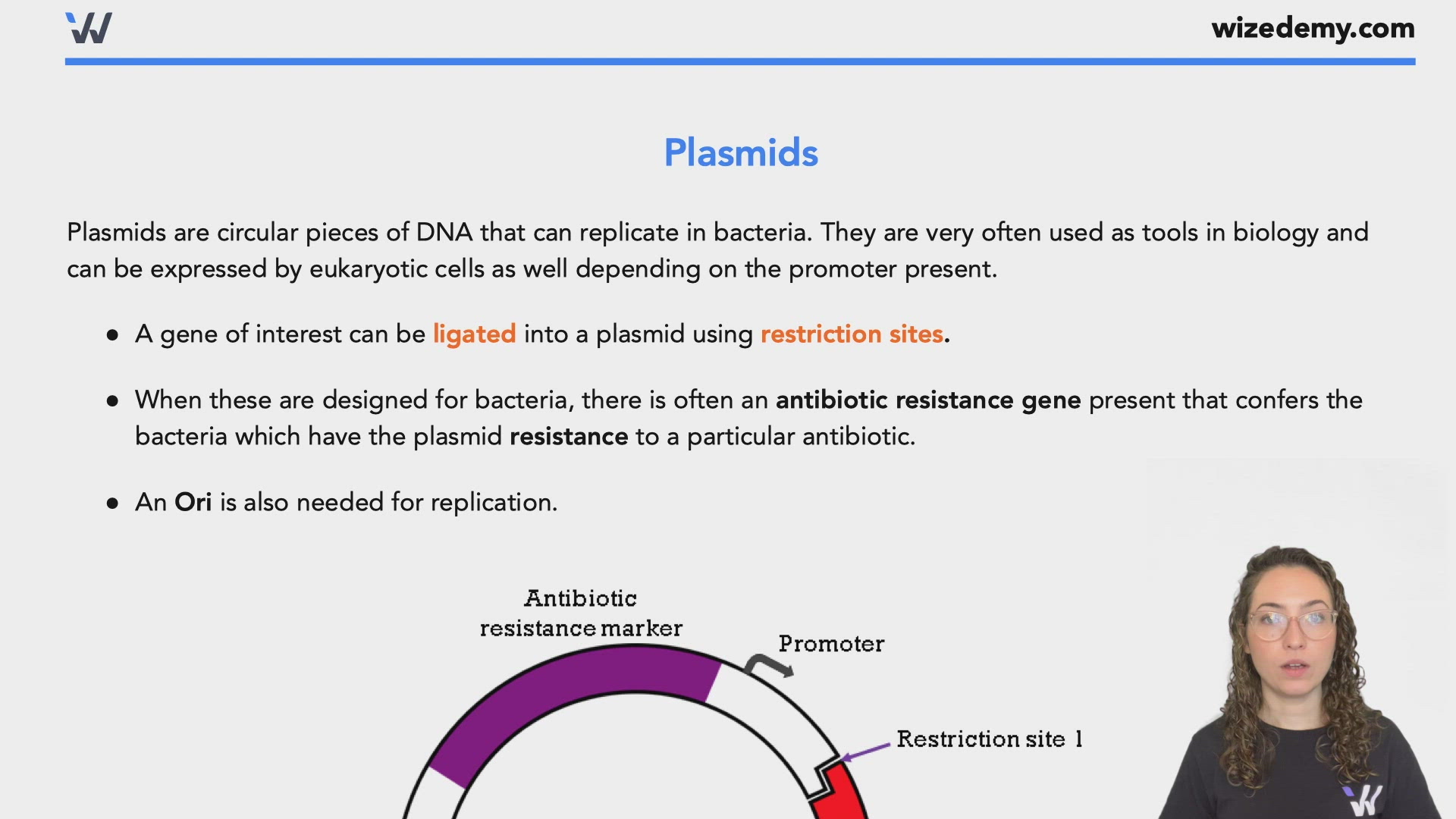
Plasmids are circular pieces of DNA that can replicate in bacteria. They are very often used as tools in biology and can be expressed by eukaryotic cells as well depending on the promoter present.
- A gene of interest can be ligated into a plasmid using restriction sites.
- When these are designed for bacteria, there is often an antibiotic resistance gene present that confers the bacteria which have the plasmid resistance to a particular antibiotic.
- An Ori is also needed for replication.

0:00 / 0:00
Restriction Enzymes or Endonucleases (REs)
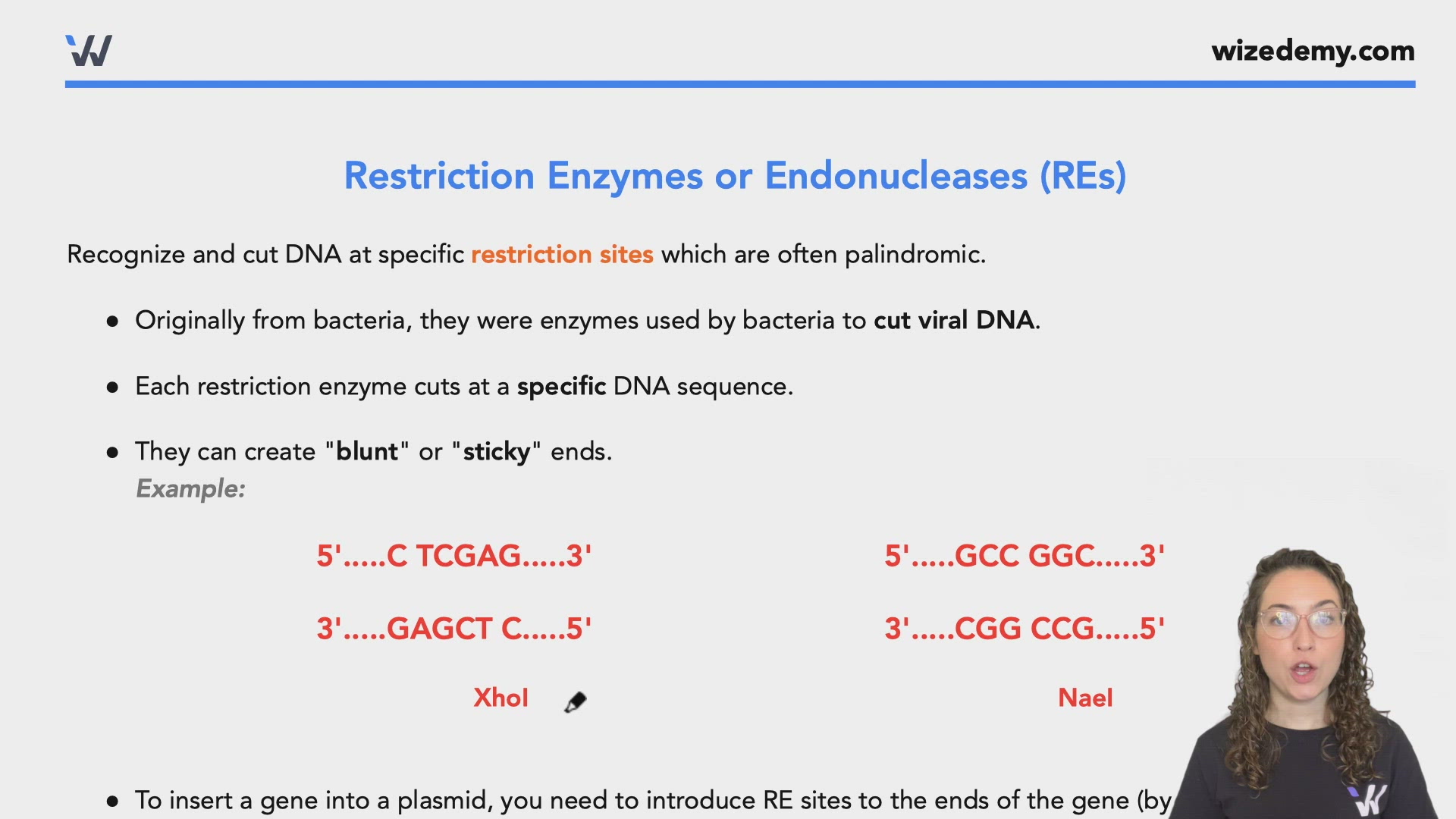
Recognize and cut DNA at specific restriction sites which are often palindromic.
- Originally from bacteria, they were enzymes used by bacteria to cut viral DNA.
- Each restriction enzyme cuts at a specific DNA sequence.
- They can create "blunt" or "sticky" ends. Example:
5'.....C TCGAG.....3' 5'.....GCC GGC.....3'
3'.....GAGCT C.....5' 3'.....CGG CCG.....5'
XhoI NaeI
- To insert a gene into a plasmid, you need to introduce RE sites to the ends of the gene (by PCR).
- These sites must match RE sits in the plasmid of interest.
- Complementary sequences will be fused by DNA ligase.

Extra Practice
Plasmid
What will the following plasmid not be able to do?
https://en.wikipedia.org/wiki/File:PBR322_plasmid_showing_restriction_sites_and_resistance_genes.jpg. Jfitz1974. This work is licensed under the Creative Commons Attribution-ShareAlike 3.0 License.