Popular Courses
MCAT
General Course
AP Biology Exam Prep Course
AP Exam Prep
Biology
General Course
General Biology
University Study Guides
BIOLOGY 1002B
Western University
Grade 12 Biology
Canada High School
DAT
General Course
High School Biology
US High School
BIOL 200
McGill University
General Biology
University Study Guides
SC/BIOL 1000 3.00
York University
BIOL 311
University of Calgary
BIOLOGY 2581A/B
Western University
BIOL 112
McGill University
HMB265H1
University of Toronto
BIOL 1010
Dalhousie University
BIOL-1101
University of Windsor
BIO230H1
University of Toronto
BIOL 1201
Western University
BIOL 202
McGill University
0:00 / 0:00
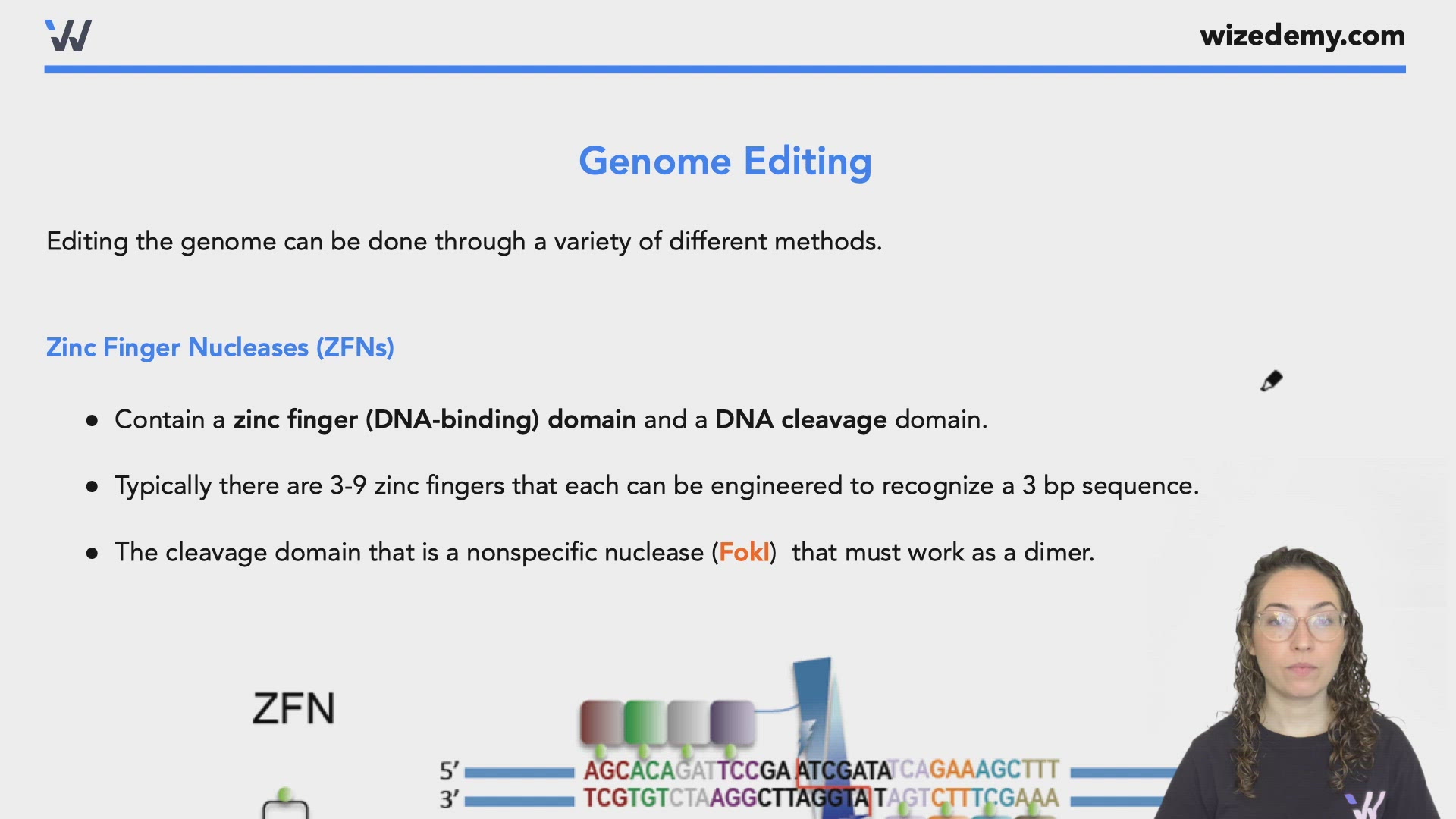
Genome Editing
Editing the genome can be done through a variety of different methods.
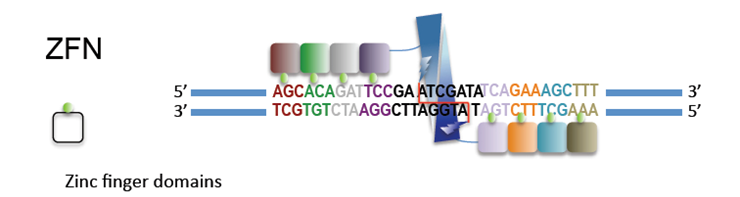
Zinc Finger Nucleases (ZFNs)
- Contain a zinc finger (DNA-binding) domain and a DNA cleavage domain.
- Typically there are 3-9 zinc fingers that each can be engineered to recognize a 3 bp sequence.
- The cleavage domain that is a nonspecific nuclease (FokI) that must work as a dimer.
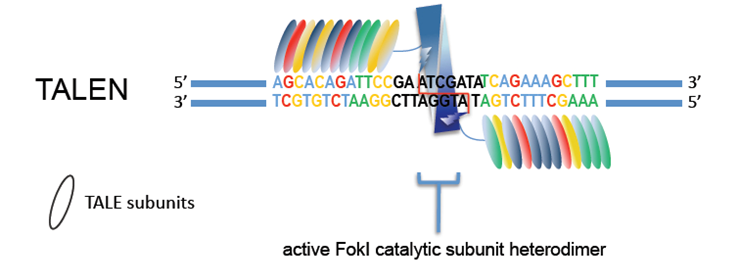
Transcription Activator-Like Effector Nucleases (TALENs)
- Consist of the TAL effector DNA-binding domain and a DNA cleavage domain.
- The TALE DNA binding domain has a conserved 33 -34 amino acid region that has a variable 12th and 13th position.
- This allows it to bind specifically to the DNA.
- Each TALE binds a single nucleotide.
- The cleavage domain has the nonspecific nuclease (FokI).
CRISPR-Cas9
- Derived form bacterial defense mechanisms.
- Clustered Regularly InterSpaced Palendromic Repeats (CRISPR).
- A single-guide RNA (sgRNA) is often used which has a target sequence and a Cas9 interacting sequence.
- The target sequence is preceded by a PAM sequence.
- PAM = protospacer adjacent motif.
- The sgRNA binds specifically to a region of the genome and Cas9 makes a double stranded break.
0:00 / 0:00
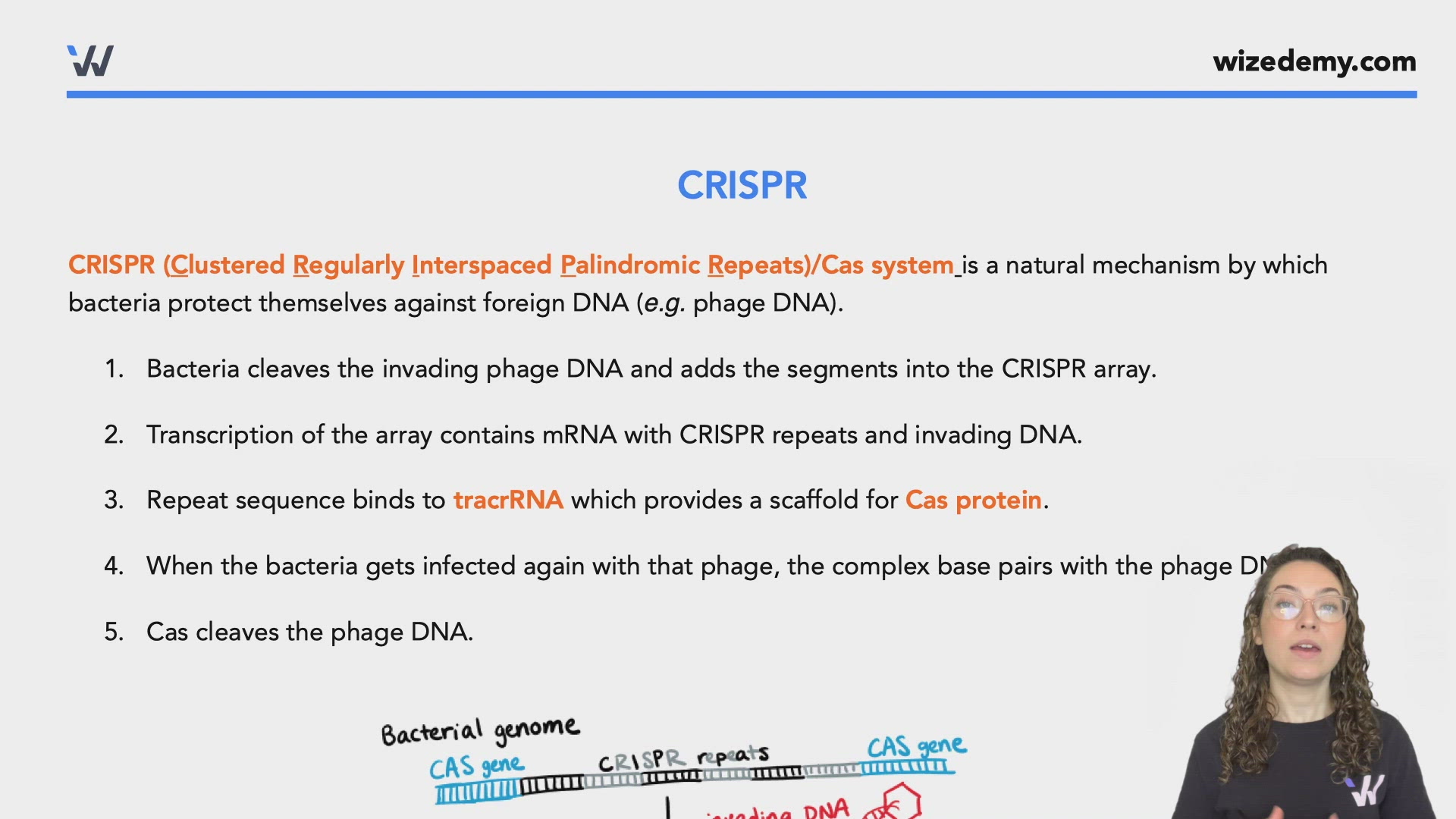
CRISPR
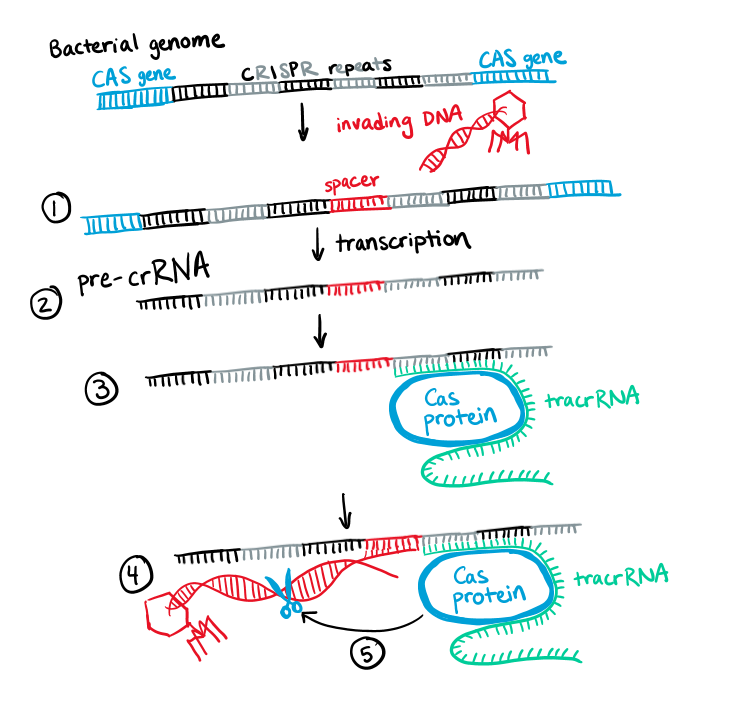
CRISPR (Clustered Regularly Interspaced Palindromic Repeats)/Cas system is a natural mechanism by which bacteria protect themselves against foreign DNA (e.g. phage DNA).
- Bacteria cleaves the invading phage DNA and adds the segments into the CRISPR array.
- Transcription of the array contains mRNA with CRISPR repeats and invading DNA.
- Repeat sequence binds to tracrRNA which provides a scaffold for Cas protein.
- When the bacteria gets infected again with that phage, the complex base pairs with the phage DNA.
- Cas cleaves the phage DNA.
Researchers have adapted the system to be able to work in eukaryotic systems to cleave the genome at specific sites.
- Cas9 - engineered version of the Cas endonuclease.
- Guide RNA - engineered to bind to Cas9 and to a specific site on genomic DNA (site of choice).
- This site can be any gene the researcher chooses to inactivate or replace!
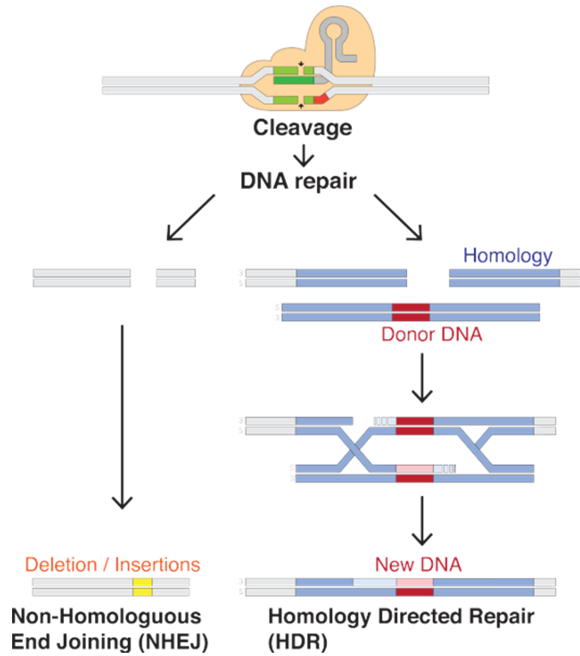
- When Cas9 and the guide RNA are both expressed in cells, Cas9 will cleave the DNA at the targeted site.
- The DNA will often repair itself through Non-Homologous End Joining, resulting in the loss of a few base pairs.
- Can cause a deletion or frameshift which inactivates the gene.
- Genes can also be introduced if the cell repairs itself through Homology Directed Repair (HDR) mechanism.
- Add segments that match the sequences flanking the cleavage site.
- When the DNA is cleaved, homologous recombination will insert the donor DNA sequence into the cleavage site during DNA repair.
Practice: CRISPR
The CRISPR/CAS9 system is an adaptation of which natural phenomenon?
Practice: CRISPR Applications
Your friend mentions to you that she is using the CRISPR/Cas9 to study a specific gene, but before you can learn exactly what she is doing, she has to leave for class. What are the possible things your friend could be using the CRISPR/Cas9 system for? (Select all that apply)