Popular Courses
Find My CourseNucleus
The nucleus is the largest organelle in all eukaryotic cells and can be easily seen when using a light microscope. Its function is two-fold:
- to house and protect the cell's genetic material and
- to control the cell's activities through regulating gene expression, a role that has earned it the nickname the brain of the cell!
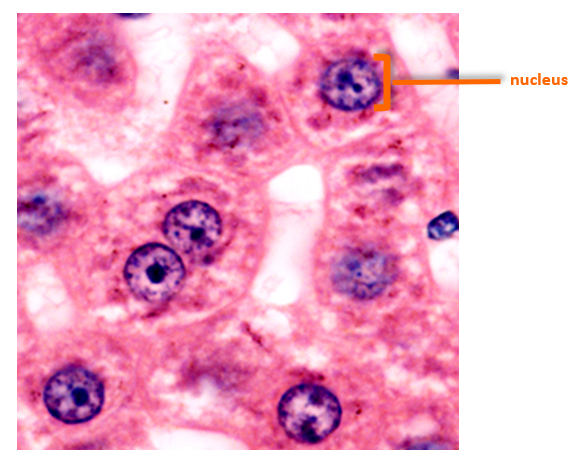
The nucleus consists of 4 main parts: nuclear envelope, nuclear pores, genetic material and the nucleolus.
Nuclear Envelope
The nuclear envelope is a double membrane, consisting of an outer and an inner membrane, separated by a space of about 20-40nm wide. The nuclear envelope helps to maintain the internal environment of the nucleus.

- Both membranes are phospholipid bilayers.
- The outer membrane makes contact with the gel-like substance outside of the nucleus, the cytosol.
- The outer membrane is studded with ribosomes on its cytoplasmic side.
- The inner membrane makes contact with the semi-solid substance inside of the nucleus, the neoplasm.
- The inner membrane is followed by a meshwork of protein filaments, called the nuclear lamina. This structure gives mechanical support to the nucleus, helping it to maintain its shape.
Nuclear Pores
The entire nuclear envelope is perforated with minute holes called nuclear pores. The nuclear pores are needed in order to help regulate what goes in and out of the nucleus.

- At these sites, the outer and inner membrane are fused together so that molecules like enzymes or the mRNA (macromolecule), can move from the neoplasm into the cytoplasm and vice versa.
- Nuclear pores are selective. This selective nature is due to an elaborate protein structure called the pore complex that lines each pore and only allows specific molecules to enter or exit the nucleus as needed.
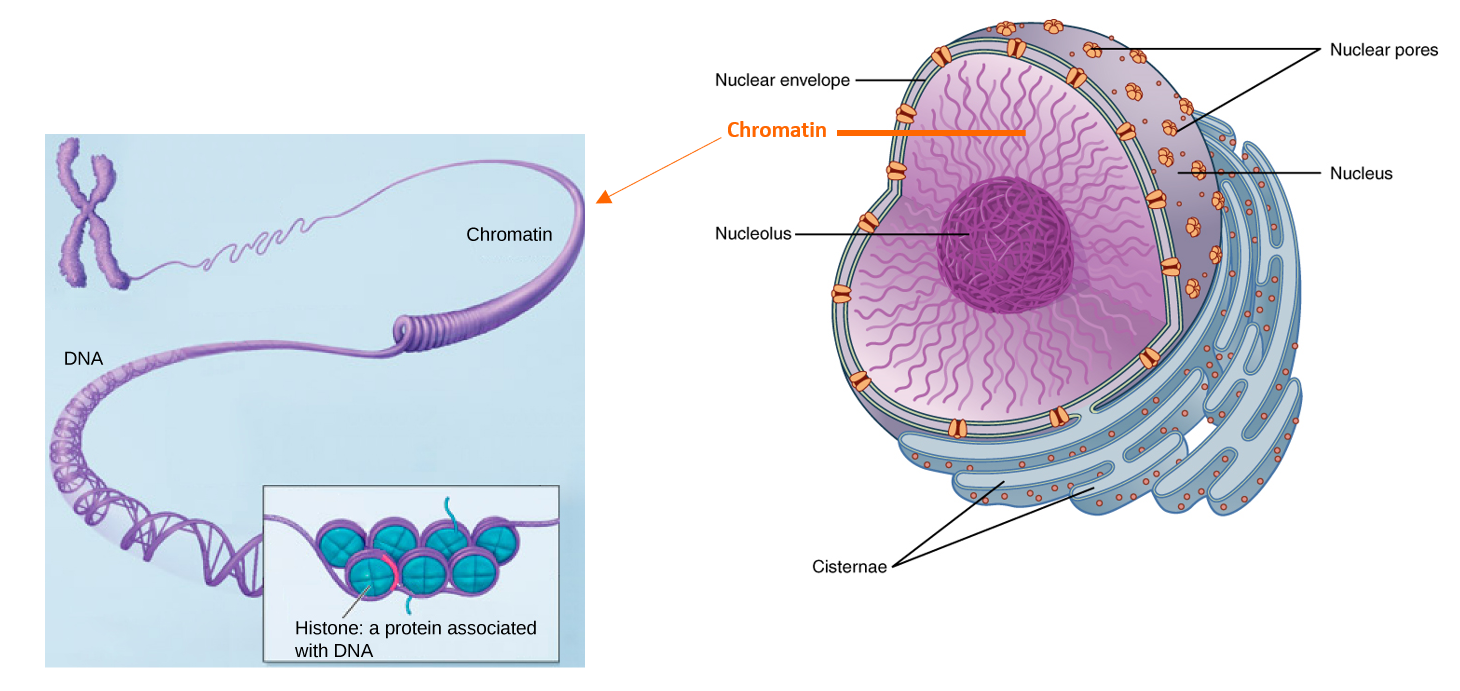
- A single DNA molecule will be associated with proteins, some helping to coil it and organize it into units called chromosomes.
- The appearance of chromosomes varies depending on what stage of the cell cycle the cell is in.
- For most of the cell's life, individual chromosomes can not be identified, and the unraveled mass is called chromatin.
- It is only right before cellular division that individual chromosomes can be identified, as they will become super condensed in preparation for that process.
- The number of chromosomes that is contained in a nucleus is specific for each eukaryotic species.
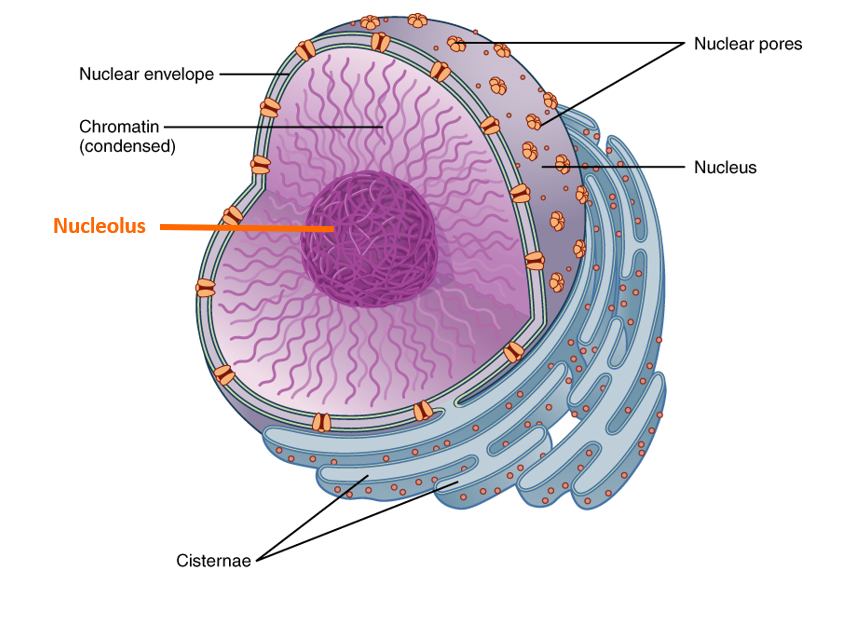
- Within the nucleolus, some sections of DNA code for a type of structural RNA called ribosomal RNA (rRNA), which will be synthesized here.
- rRNA synthesis is vital as it will will combine with proteins, that have been imported from the cytoplasm, to form the ribosomal subunits. These subunits will later exit through the nuclear pores to go to the cytoplasm, where they will form a complete ribosome.
- Typically cells only have one nucleolus, however the number of nucleoli a cell has depends on the species and the cell cycle stage it is in.
Practice: Nucleus
Ribosomal RNA (rRNA) is synthesized in which part of the nucleus?
Practice: Nuclear Pores
Which one of the following macromolecules leaves the nucleus of a eukaryotic cell through the nuclear pores?