Popular Courses
Find My CourseCell Membrane
The cell membrane or plasma membrane plays the vital roles of separating the cell interior from the exterior, and in determining what can enter and leave the cell. It's plays such an essential role it can be found in every single cell, whether it be prokaryotic or eukaryotic.

The cell membrane is composed of various molecules including lipids, cholesterol, proteins and carbohydrates, which are synthesized and modified in the endoplasmic reticulum and golgi apparatus, respectively.
Cell Membrane Structure: Components and Their Roles
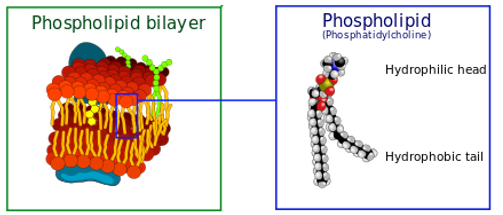
- Lipids: Phospholipids are the most abundant type of lipid found in a cell membrane. They are the main building block.
- Each phospholipid has 3 parts: phosphate head, glycerol backbone, and fatty acid tails

- Phosphate heads are polar and hydrophillic (water loving)
- The glycerol backbone is what holds the FA tails to the phosphate head
- Fatty acid tails are non polar and hydrophobic (water fearing) hydrocarbon chains.
- Hydrocarbon chains can be unsaturated ( having a kink in their chain) or saturated chains (do not have a kink in their chains). This will affect how closely the phospholipids sit next to one another.
- Phospholipids are amphiphatic:
- When a molecule has a hydrophillic and hydrophobic region, it is said to be amphiphatic.
- The cell membrane is a phospholipid bilayer, this forms due to their amphiphatic property.
- The hydrophillic phosphate heads will want to face water, and the hydrophobic fatty acid tails will want to stay away from water

- Remember, water can be found both inside the cell as part of the intracellular fluid and outside of the cell as part of the extracellular fluid.
- To satisfy the amphiphatic nature of phospholipids, they arrange themselves into two adjacent layers:
- The fatty acid tails of one layer will face the fatty acid tails of the other layer.
- The phosphate heads will be facing outward; with the phosphate heads of one layer facing the extracellular fluid and the phosphate heads of the other layer facing the intracellular fluid.
- This arrangement of the phopholipids causes the cell membrane to have a hydrophobic interior.
- This space will exclude any watery intracellular or extracellular fluid
- The role of phospholipids in the cell membrane:
- Contribute to the selective permeable nature of cell membranes, as they only allow the passive movement of some molecules.
- Steroid Cholesterol: Composed of 4 fused carbon rings, making it very stable. It can be found randomly distributed throughout the cell membrane.
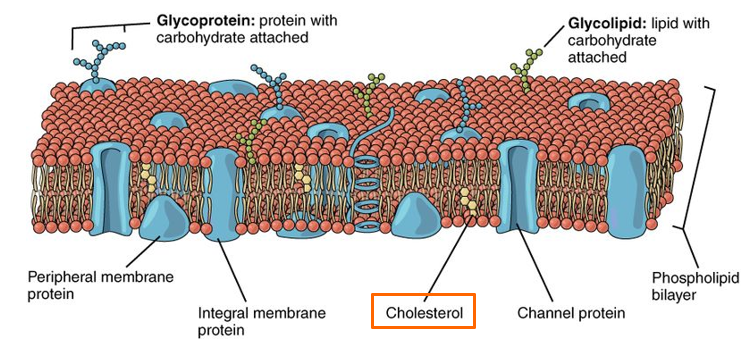
- The role of cholesterol in the cell membrane:
- Helps regulate what enters and exists the cell by functioning as fluidity buffers
- Key players in maintaining cell membrane fluidity and structure, which can be affected by a number of environmental factors, such as temperature.
- Lowtemperatures stiffen the membrane; whereashightemperature make the cell membrane too fluid.
- Cholesterol holds the phospholipids together so that they don’t separate too far when it's hot, and prevents the phospholipids from getting too close when it's cold.
- Plant cell membranes have low levels of cholesterol, as compared to animal cells. However, they do have a related steroid lipid that serves the same purpose.
- Proteins: Most cell membranes comprise of approximately 50% (or less) protein.
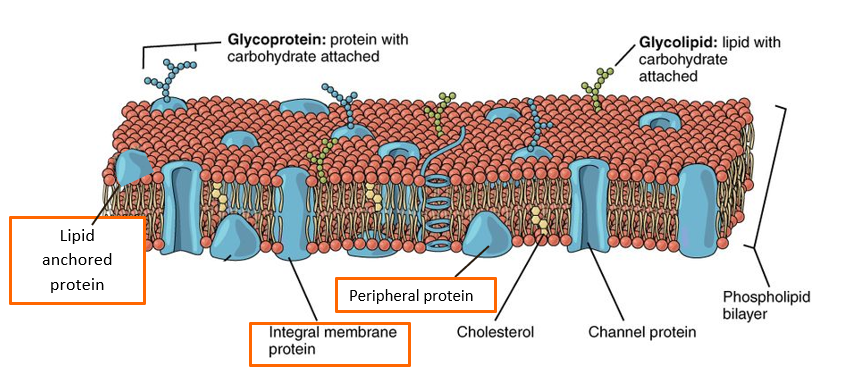
- There are 3 main types of membrane proteins:
- Integral or Transmembrane proteins
- These proteins are integrated within any part of the cell membrane
- Peripheral proteins
- Appear on the periphery, sitting on-top of the cell membrane either on a phosphate heads or integral protein.
- Can be on either side (intracellular or extracellular).
- Lipid anchored proteins
- Proteins that covalently attach to the cell membrane via lipid anchors.
- The role of proteins in the cell membrane:
- Act as receptors
- Help with the transport of molecules in and out of the cell
- Carbohydrates: Carbohydrate molecules are present only on the outer surface of the cell membrane.

- Glycolipids
- Carbohydrate chain covalently bonded to lipids.
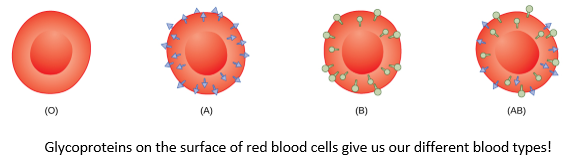
- Glycoproteins
- Carbohydrate chain covalently bonded to proteins.
- More commonly seen.
- Vary significantly from specie to specie, and even from cell to cell (within the same organism!)
- The role of carbohydrates in the cell membrane:
- Cell recognition.
- Example: ABO blood grouping
- Cell adhesion (holding cells together)
Fluid Mosaic Model
The fluid mosaic model was discovered in 1972. It gets its name due to its two properties; its fluid nature and its mosaic appearance.
- Fluid nature: Membranes are not static, they are dynamic! Think of the membrane to be like your skin, it's a solid but it can still move!
There are 3 main factors that enable the cell membrane to be fluid:
- The weak hydrophobic interactions between the lipids, proteins and carbohydrates. This enables movement.
- The degree of saturation of the fatty acid tails; the more unsaturated fatty acid tails there are, the less compact the phospholipids will be.
- The cholesterol content since they function as fluidity buffers.
- Mosaic appearance: What would a top view of the cell membrane look like?
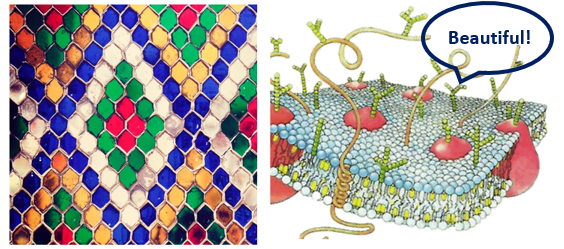
Incredible pieces of art can be made simply by bringing together small pieces of tile, stone or glass, like the picture shown above. Scientists believe that the cell membrane is one of nature's mosaic master piece
Practice: Fluid Mosaic Model
Which of the following would cause an increase in membrane fluidity?
Practice: Cell Membrane Composition
Answer each question by writing the correct term beneath it:
Practice: Cholesterol
Which statement best describes how cholesterol affects cell membrane fluidity?