Wize Grade 12 Biology Textbook > Cell Components: Structure and Function
External Components
Popular Courses
Find My CourseExtracellular Components
So much can be said about the fascinating world that exists inside the cell, but what about outside the cell? Remember most cells come together to form multicellular organisms, and this is where the extracellular components play a significant role.
Plant cells
What does fungi, prokaryotes and plants all have in common?
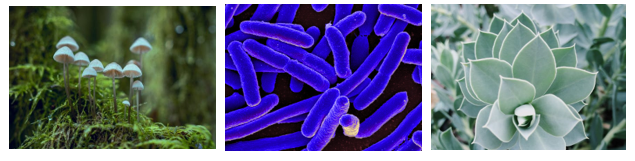
A cell wall; however, its chemical composition varies from specie to specie. The cell wall is a tough, rigid layer that is composed of polysaccharides (carbohydrates), glycoproteins, and elastic material. It surrounds the cell membrane to provide structural support and protection. This structural component is not seen in animal cells and is a distinguishing feature between animal and plant cells.
Cell Wall Structure
- All plant cell walls contain 2 layers: middle lamella and the primary cell wall
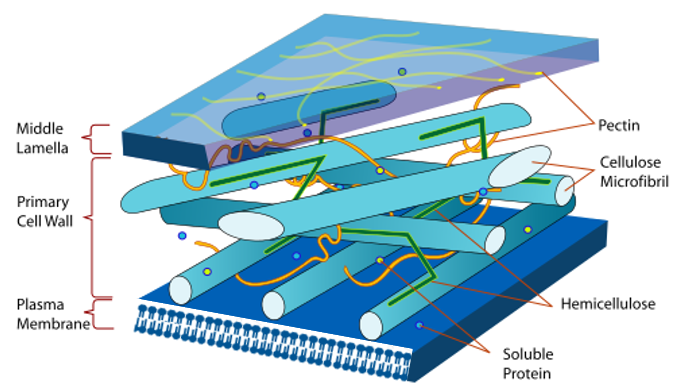
- Middle lamella: Rich in the sticky polysaccharide pectin. This layer helps to "glue" adjacent plant cells together. It is situated outside the primary cell wall.
- Primary cell wall: Rich in the structural polysaccharide cellulose. This layer is laid down during cell division. It is usually thin, flexible and is capable of growth.
- In some cases, mature plant cells strengthen their primary cell wall by secreting a hardening substance into it, or in some cases they may add a third layer known as the secondary cell wall.
- Secondary cell wall: This layer is not seen in all plants. It is rich in cellulose and is usually deposited as laminated layers in between the cell membrane and primary cell wall.
Cell Wall Function
- Mechanical support:
- The secondary cell wall is mainly responsible for this, making plants very hard and rigid.
- Structural support:
- The primary cell wall is mainly responsible for this.
- In addition to the internal built up turgor pressure, the primary cell wall plays a role in giving the plant cell its actual shape, and the overall plant upright posture.
- Enables communication between adjacent plant cells:
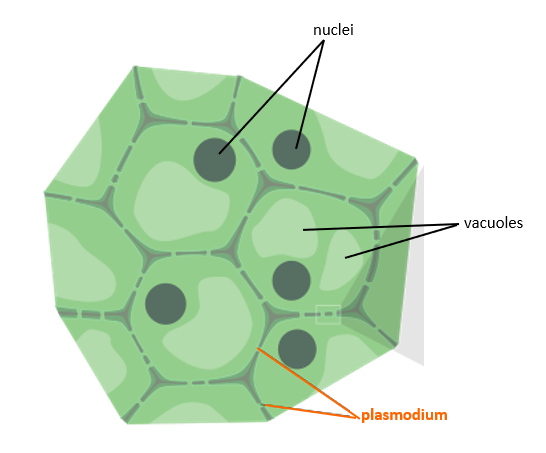
- The cell wall is perforated with holes called plasmodesmata, which is thought to regulate the passage of nutrients and the exit of waste.
Animal Cells
Why don't animal cells have cell walls?

Cell walls make cells tough and rigid. If animal cells were to have cell walls our skin might become rigid and it might break when you come to sit down! Although animal cells do not have a cell wall, they have their own unique system which allows them to connect and communicate with each other. This system is known as the extracellular matrix (ECM).
ECM Structure:
Most animal cells secrete molecules into the extracellular space, which in-turn creates a complex meshwork of proteins and carbohydrate containing molecules called the extracellular matrix.
- Main components of the ECM:
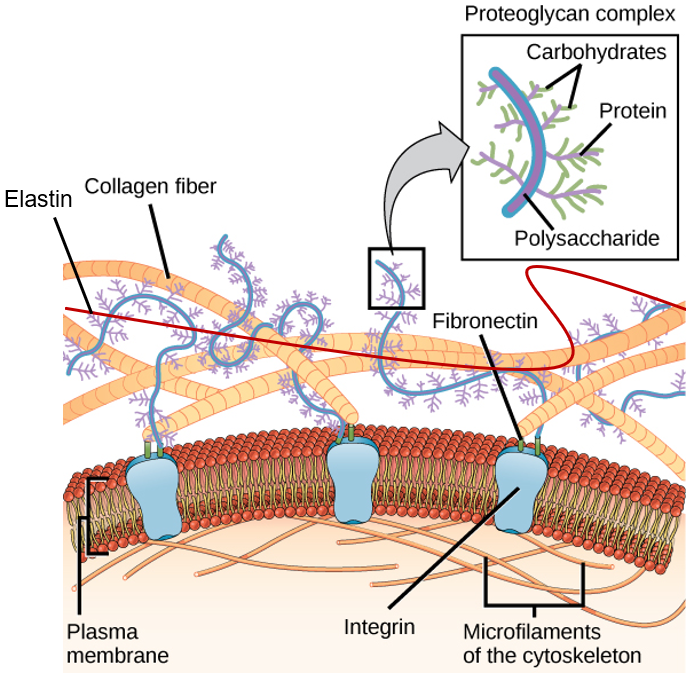
- Glycoproteins: Proteins with covalently bonded short chain carbohydrates (primarily consist of protein).
- Collagen
- Most abundant (40% of the total protein in the human body!)
- Forms strong, insoluble fibers
- Provides tensile strength
- Fibronectin
- Soluble and multiadhesive (can bind to multiple proteins)
- Act as bridges.
- Fibronectin attaches the ECM to transmembrane proteins named integrins. On the cytoplasmic side, integrins are attached to components of the cytoskeleton. In this way the cell's external environment is connected to its internal environment.
- Proteoglycans: Many carbohydrate chains covalently attached to a small core protein (primarily consist of carbohydrates).
- Proteoglycan Complexes can form when hundreds of proteoglycan molecules attach to a single long polysaccharide molecule via noncovalent bonds.
- Elastin: This protein will bind with several other protein types to form insoluble fibers.
- Provide elasticity and resilience
ECM Function:
- Enables animal cells to attach to each other as well as communicate with each other
- This is possible because integrins essentially anchor the cell to the ECM and are able to transmit signals (chemical and mechanical) between the ECM and the cytoskeleton. This property enables the cell to respond appropriately.
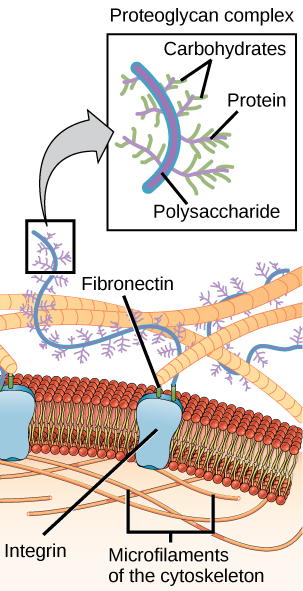
- Gives tissues strength and structural integrity
- Collagen is a key player here
- Supports and protects cell membrane
Practice: Cell Wall
Match the definition with the correct term.
A.
May sometimes be added for extra strength
B.
Contains pectin to help adjacent plant cells adhere to one another
C.
Always present, contains cellulose for structural support
Primary cell wall
Secondary cell walls
Middle lamella
Practice: Extracellular matrix
Which ECM component gives tissues elasticity?
Practice: Extracellular Matrix (ECM)
Which transmembrane protein plays an essential role in cell communication?