Wize Grade 12 Biology Textbook > Transport Across Membranes
Passive Transport: Osmosis
Osmosis
Osmosis is a passive transport process in which there will be a net movement of water across a selectively permeable membrane, from an area of lower solute concentration to an area of higher solute concentration.

Reasons Osmosis Occurs:
- Water (solvent) molecules will be blocked from passing across the selectively permeable membrane by the larger solute particles.
- Attractive forces between charged solute and the polar water
Tonicity and Cell Behaviour
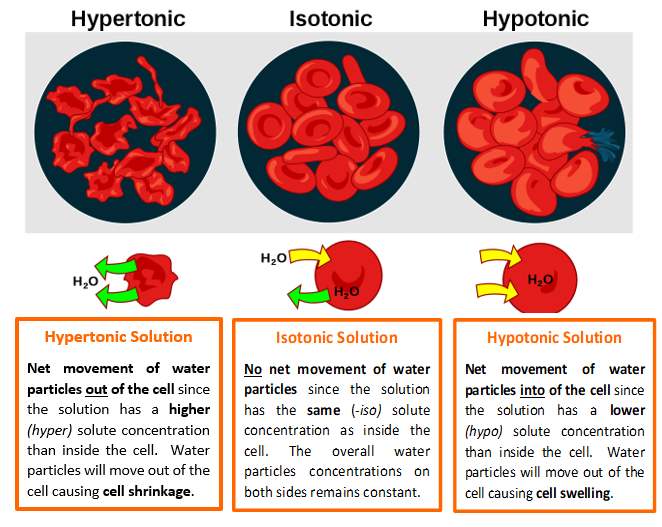
Tonicity is a term that describes the ability of a surrounding solution to cause a cell to gain or lose water. This depends on the concentration of solutes dissolved in solution (and cannot pass the membrane) relative to the concentration of solutes inside the cell.
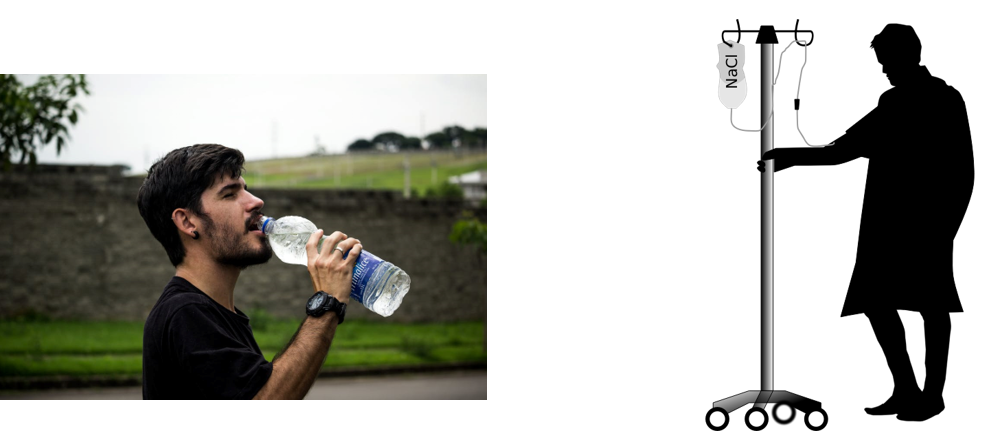
If you were to drink too much water or be put on a saline drip that had an excessively high saline concentration, how do you think your cells might be affected?
Cells without Cell Walls (animal cells)
Cells with Cell Walls (plant cells)

- Healthy plants vs. unhealthy plants
- The healthy state for most plant cells is to have turgidity and appear firm
- A lot of house plants (not woody) depend on this mechanism to provide mechanical support
- The unhealthy state for most plant cell is to be flaccid and appear wilted.
Osmoregulation
Osmoregulation is the control of solute concentrations and water balance. This is important for survival as it ensure homeostasis is maintained.
- Luckily, the cells of most land animals are bathed in an extracellular fluid that is isotonic to the cells.
- In hypertonic or hypotonic environments, organisms that do not have cell walls must have other adaptations for osmoregulation.
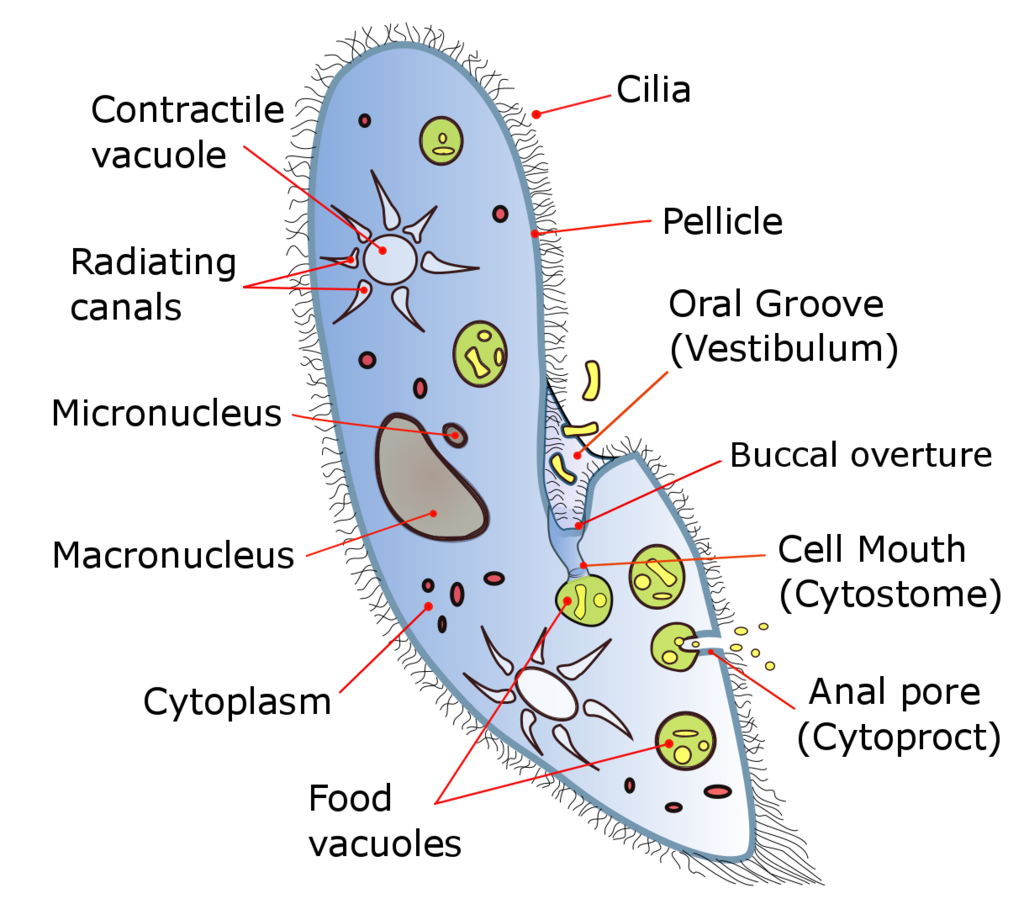
- Example: Paramecium living in fresh water have contractile vacuoles
- Example: Some microorganisms live in hypersaline (excessively salty) environments, they are halotolerant [-halo= slat]. They have a type of salt alert system that uses sponge-like molecules to prevent water loss.
Example: Osmosis
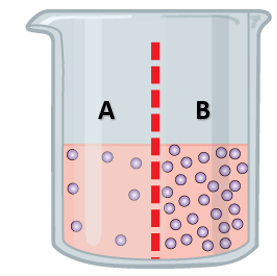
In the beaker below you have two solutions, solution A and solution B, separated by a selectively permeable membrane (red-dashed line). The purple particles represent the solute and the pink liquid represents the solvent.
- In which direction will the net movement of the solvent be?
- What will happen to the concentrations of solution A and solution B?
- Suppose you were to remove the selectively permeable membrane:
- how would this affect the net movement of the solvent?
- How would this affect the net movement of the solute?

Mark Yourself Question
- Grab a piece of paper and try this problem yourself.
- When you're done, check the "I have answered this question" box below.
- View the solution and report whether you got it right or wrong.
Practice: Tonicity
One measure of soil quality is mineral content. Upon investigating this parameter at a nearby farmland you discover that the soil salinity (salt content) is higher than what is recommend for healthy crop growth. Drawing back on your knowledge about tonicity, explain how soil salinity may hinder crop growth?
Practice: Tonicity
When placed in a solution of 20% water 80% salt, what would happen to an animal cell that is 80% water?
Example: Osmosis
The graph below shows the change in mass of five dialysis bags constructed from a semipermeable membrane. Each bag is filled with concentrations of unknown sucrose and then placed in separate beakers containing an initial concentration of 0.8 M. Masses of each bag was taken at 15 minute intervals. Using the graph, answer the following questions
- Which line in the graph represents the bag that contained a solution isotonic to the 0.6 M solution at the beginning of the experiment?
- Which line in the graph represents the bag with the lowest initial concentration of sucrose?
- Which line or lines in the graph represent(s) bags that contain a solution that is hypertonic at 55 minutes?
ADD GRAPH