Wize Grade 12 Biology Textbook > Transport Across Membranes
Bulk Transport: Exocytosis and Endocytosis
Popular Courses
Find My CourseExocytosis and Endocytosis
At times cells may need to transport substances in bulk. This would be problematic for the small and delicate transport proteins. Luckily the cell has two mechanisms in place for these types of transportation needs; exocytosis and endocytosis.
Exocytosis
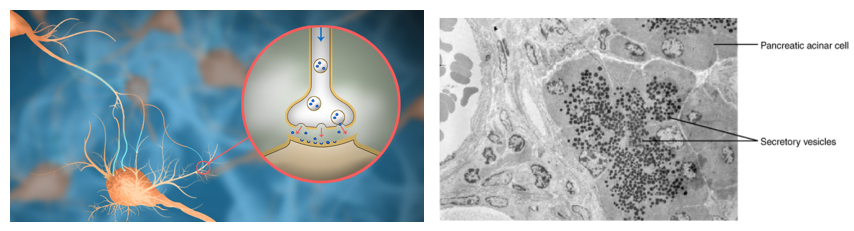
The active transport of substances such as waste material, signalling proteins and neurotransmitters to the external [-exo] environment.

Exocytosis Process:
- Vesicles carrying the substance that will be secreted will be guided by microtubules of the cytoskeleton to the cell membrane.
- When the vesicle membrane and cell membrane come into contact, the two membranes fuse causing the contents of the vesicle to spill out of the cell, and the vesicle membrane to become part of the plasma membrane.
Example: Neurons secreting neurotransmitters (below left) and pancreatic cells secreting digestive enzymes (below right)
Endocytosis
The general name given for the active transport of substances into the internal [-endo] environment of a cell.

Endocytosis Process:
- A small area of the cell membrane will sink inward to form a pocket.
- As the pocket deepens, it pinches in, forming a vesicle containing material that had been outside the cell. In many cases, the parts of the cell membrane that form vesicles are lined on their cytoplasmic side by a layer of coat protein. The vesicles that form are said to be “coated.”
3 types of endocytosis:
- Phagocytosis
- Pinocytosis
- Receptor mediated endocytosis

Phagocytosis [cell eating]
- Large particles will be transported into the cell by forming a food vacuole.
- The food vacuole will then fuse with a lysosome which will proceed to breakdown the vesicle contents into their basic blocks which can be recycled back into the cell
- Example: Macrophages (white blood cells) carry out phagocytosis to engulf an entire bacterial cell
- Example: Unicellular eukaryotes, such as amoebas, carry out phagocytosis to consume their prey.
Pinocytosis [cell drinking]
- Droplets of extracellular fluid will be transported into the cell by forming a coated vesicle.
- Example: Kidney cells use pinocytosis to separate nutrients and fluids from the urine that will be expelled from the body.
- Example: Plants absorb nutrients from the ground by the process of pinocytosis
Receptor-mediated endocytosis
- A form of endocytosis which is specific. Here the cell surface will have receptor proteins which will be used to engulf a specific, target molecule that may not be present in high concentrations in the extracellular fluid.
- Sometimes pathogens such as viruses can "trick" the cell surface receptors and gain entry into via this mechanism .
- Example: Cholesterol is taken into human cells for membrane synthesis by receptor-mediated endocytosis.
Receptor-mediated Endocytosis
What if the cell-surface receptor has been mutated, how would the target molecule be able to enter the cell? Let's examine the case of the receptor-mediated endocytosis of cholesterol
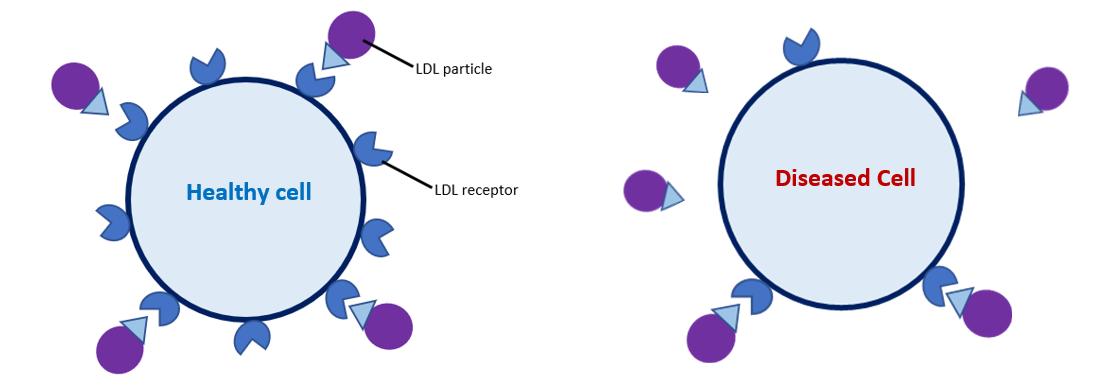
- Cholesterol travels in the blood in particles called low density lipoproteins.
- Typically LDL particles will bind to LDL cell receptors and the cholesterol will be taken in by receptor-mediated receptors for membrane synthesis and synthesis of other steroids.
- If there is a defect in the LDL receptor proteins or if its missing from the cell surface, the cholesterol will not be able to enter the cell and will accumulate in the blood. This is the case in the inherited disease familial hypercholesterolemia, which is characterized by high cholesterol levels in the blood.
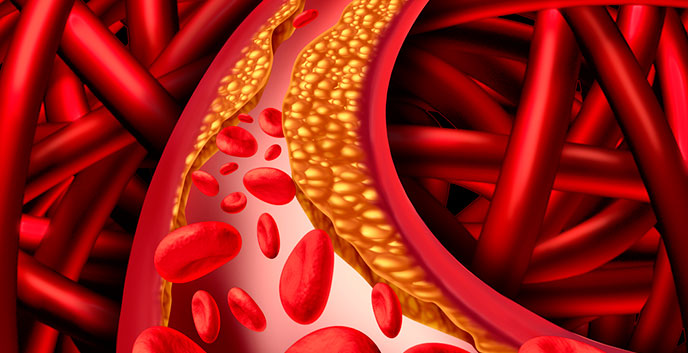
- Atherosclerosis can develop, which would ultimately impede blood flow.
Practice: Bulk Transport
Answer each question by writing the correct term beneath it:
Practice: Endocytosis
You are working with a team to design a new drug, called Zorax, for individuals suffering from hypertension. For Zorax to be effective, it can only be taken into the cytoplasm of specific target cells. Which factor will you have to keep in mind when designing Zorax to ensure that it is only enters the target cells?