Wize Grade 12 Biology Textbook > Transport Across Membranes
Primary Active Transport: Sodium-Potassium Pump
Popular Courses
Find My CourseActive Transport
Cells need to interact with their external environment in order to get what they need or to remove what they don't need. This is all done in a controlled manner by the cell membrane. The second form of transport across the membrane is active transport.

During active transport molecules move against their concentration gradient; from an area of
low
concentration to an area of high
concentration. For this type of transport, the cell does have to use some energy to move these molecules, this energy comes in the form of ATP.Sodium-Potassium Pump
The sodium-potassium pump is a carrier protein that moves sodium (Na+) and potassium (K+) ions against their concentration gradients, this in-turn plays a role in creating the cell's (animal) resting membrane potential. Since it uses ATP directly to carry out its function, it is a common example of primary active transport.

This carrier protein can be further classified as an electrogenic pump since it generates a voltage across the membrane. The main electrogenic pumps in plants, fungi and bacteria is the proton pump.
Sodium-Potassium Pump Working Mechanism
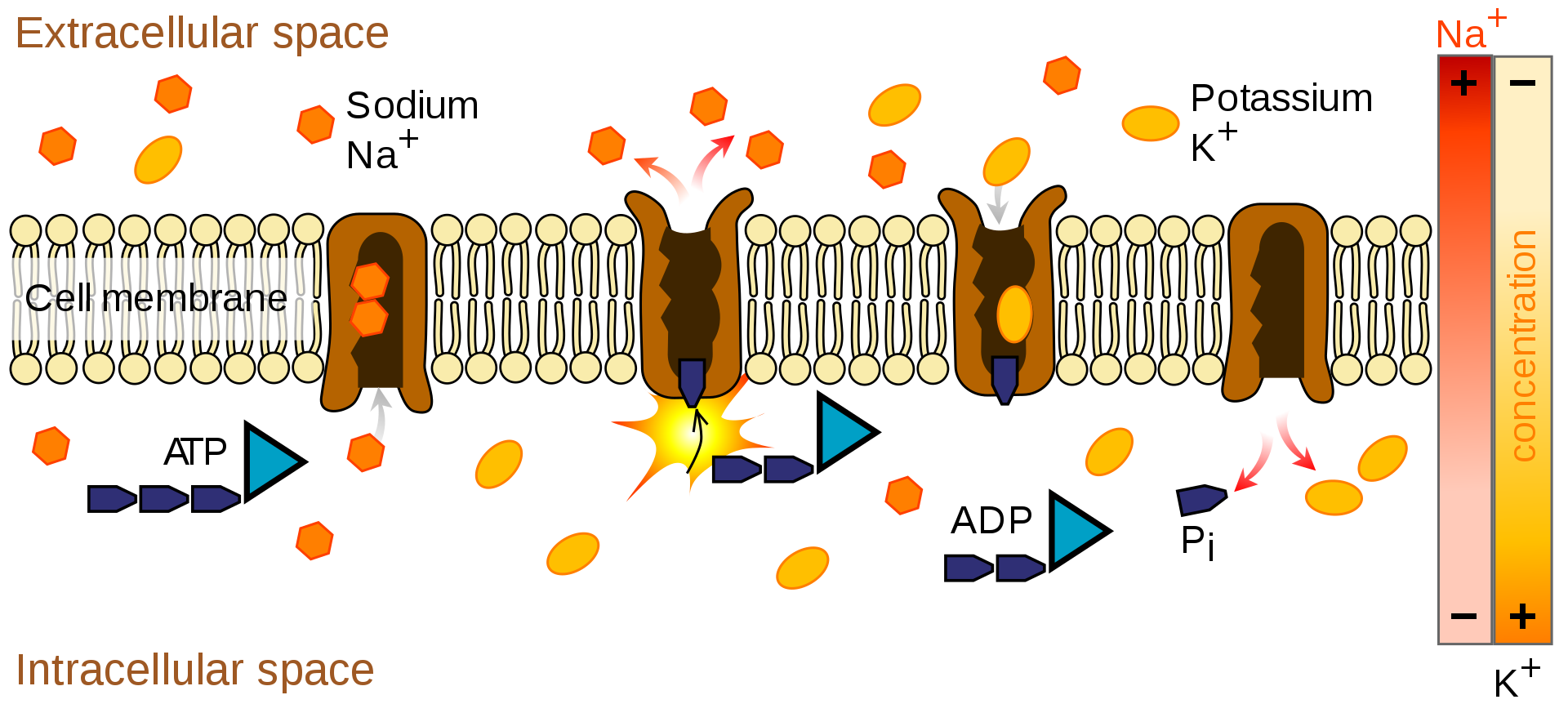
- To begin, the pump is opened on the intracellular side:
- In this state it has a greater affinity for Na+ and 3 Na+ will bind which will trigger the pump to breakdown a ATP molecule and become phosphorylated and ADP will be released.
- This phosphorylation will cause a configuration change (change in the shape) of the pump, causing the protein to now be open towards the extracellular space:
- Na+ ions will be pushed into the extracellular space
- In this state the pump has a greater affinity for K+ and 2 K+ will bind which will trigger the removal of the phosphate group
- The release of the phosphate group will cause the Na+ K+ pump to revert back to its original shape, and it will open once again to its intracellular side.
- The K+ will be dropped off into the intracellular space
- The cycle will repeat
Sodium-Potassium Pump and Resting Membrane Potential
- In each cycle 3 Na+ will exit the cell and 2 K+ will enter the cycle; therefore there is a net transfer ofonepositive charge from the cytoplasm into the extracellular fluid.
- This ultimately doesn't play a very significant role in making the cell's intracellular space more negative than its extracellular space.
- The consequence of the Na+ K+ pump means that there is specifically more Na+ outside the cell and more K+ inside the cell, this causes an electrochemical gradient.
- This means that there is not just a difference in charge (electrical gradient) across the membrane but also the actual ion types (concentration); Both ions will want to diffuse from their area of high concentration to their area of low concentration.
- Na+ will want to move from theextracellular space to theintracellular space.
- K+ will want to move from theintracellular space to theextracellular space.

- It is common for many cells to have more K+ transport (leakage) channels than Na+ leakage channels, in this way the cell membrane is more permeable to K+
- The constant leakage of K+ down their concentration gradients (from high to low) to the extracellular space contributes to a more negative charge inside the cell. This is one of the primary reasons that the resting membrane potential for most cells is negative.
Example: Primary Active Transport
The transmembrane protein, CFTR is necessary in helping to maintain the balance of salt and water on many surfaces in the body, including the surface of the lung. Briefly, when chloride ions are outside the cell, they attract a layer of water and enable the sweeping motion of the cilia that line the respiratory tract. In this way, mucus built up is prevented. In cystic fibrosis, this transmembrane protein CFTR is either defective or absent. Without the proper movement of chloride out of the cell, the mucus covering the cells will become thick and sticky, causing many of the symptoms associated with cystic fibrosis.
How would the lack of a functional CFTR in cystic fibrosis patients affect sodium ion transport and the volume of the airway surface liquid?
Practice: Primary Active Transport
A proton pump in plant cells is mainly responsible for generating a voltage across the cell membrane, what would be the most accurate classification for this type of pump?
Practice: Primary Active Transport
The movement of sodium ions out of an animal cell requires: