
0:00 / 0:00
Atoms: Composition and Structure
Subatomic Particles
- All matter is made out of atoms.
- Atoms are made of even smaller particles, known as subatomic particles.

Properties of Subatomic Particles
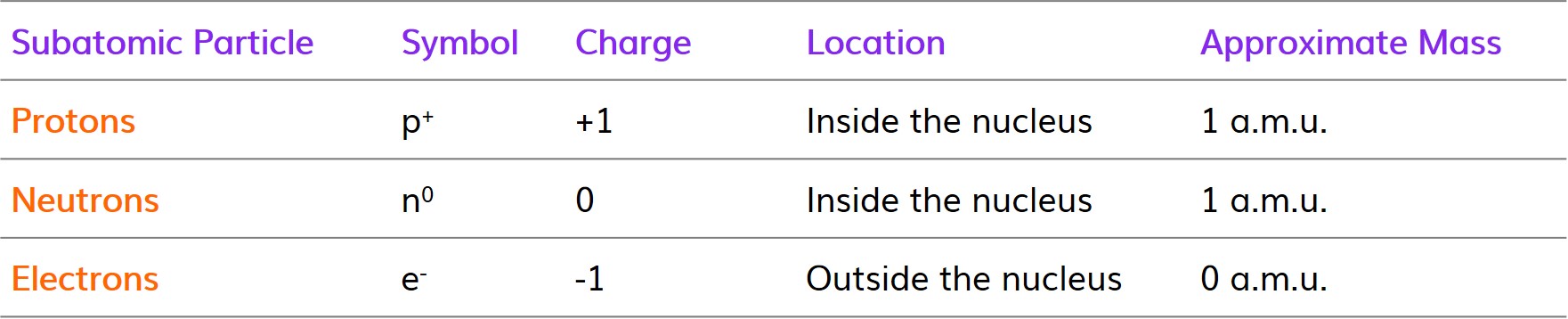
- A neutral atom will have equal numbers of protons and electrons. Example: Oxygen has eight protons inside the nucleus, so for the atom to be neutral it has to haveeightelectrons orbiting the nucleus
- An atom that has lost or gained electrons is known as an ion. Example: Oxygen can gain two electrons to form an oxide ion. Lithium can lose an electron to form a lithium ion.
- Atoms that have the same number of protons, but different number of neutrons are known as isotopes. Example: There are three stable isotopes of oxygen: oxygen-16, oxygen -17 and oxygen-18.

0:00 / 0:00
Atomic Number and Mass Number
- The number of protons in a given atoms is known as the atomic number, represented by the symbol Z.
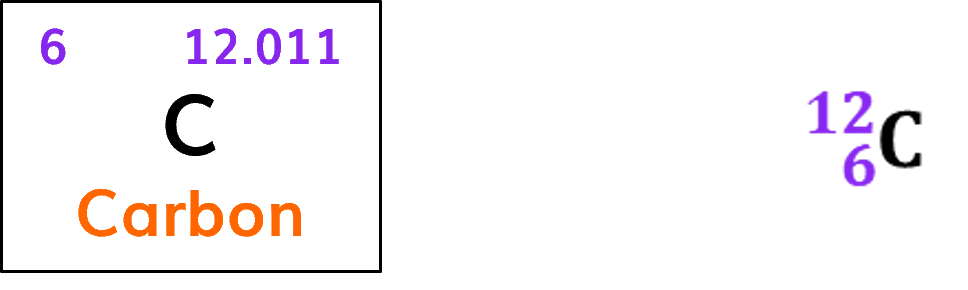
- The mass number for an atom is the sum of all particles in the nucleus.
- We use atomic mass units to measure the mass of an atom (a.m.u.). An a.m.u. is equal to 1/12th the mass of a carbon-12 atom.
- The chemical notation of an atom in the periodic table helps us determine the number of protons and neutrons inside the nucleus Example: Carbon has a mass number of 12 and an atomic number of 6, meaning it has6neutrons inside the nucleus

0:00 / 0:00
Example: Counting Subatomic Particles
How many electrons, protons and neutrons are in a 52Cr isotope?
Protons = atomic number = 24 (from a periodic table)
Electrons = atomic number = 24
Neutrons = mass number - atomic number = 52 - 24 = 28
Practice: Atoms Definitions
Connect the term with the definition
A.
Positively charged subatomic particle
B.
Subatomic particle that weighs significantly less than the others
C.
The total number of protons and neutrons in the atom
D.
The charge-neutral subatomic particle
E.
The total number of protons in the atom
Proton
Electron
Mass Number
Atomic Number
Neutron
Practice: Counting Protons and Neutrons
Fill in the blanks in the following table. Assume each atom is uncharged.
a)
b)
c)
d)
| Element | Number of Protons | Number of Neutrons |
| a) | ||
| b) | ||
| c) | ||
| d) |
Practice: Atomic Number and Mass Number
How many electrons, protons, and neutrons are in ?