
0:00 / 0:00
Introduction to Titrations
- Titrations always involve an acid reacting with a base. We perform titrations to determine the unknown concentration of an acid or a base.
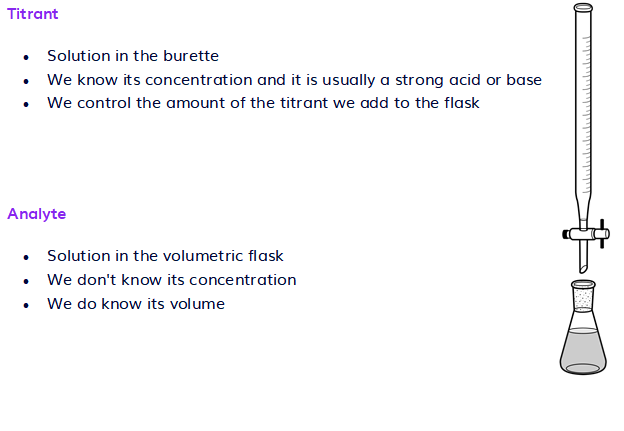
- Titrations are neutralization reactions between a titrant and analyte.
Equivalence Point and End-Point
- Once the number of moles of titrant equals the number of moles of analyte, the reaction is complete and we have reached the equivalence point
- We follow the change in pH of the analyte as titrant is added to it:
- Using a pH meter
- A sudden change in pH helps us determine when we have reached the equivalence point.
- Using an indicator
- Indicators help to show a pH change by changing the color inside the flask
- We refer to the point at which the sudden change in pH occurs or when the color of the indicator changes, as the end point of the titration.

0:00 / 0:00
Indicators
- An indicator is a weak acid or base added in a very small quantity to the analyte of a titration before the experiment begins.
- We observe the colour changes in an indicator over a small pH range.
- To pick an indicator for your acid-base titration, select an indicator whose colour changes around the pH at the equivalence point

0:00 / 0:00
Example: Titrations
What volume of 0.030 mol/L HI (aq) is required to neutralize 15mL of 0.010 mol/L Ba(OH)2 (aq)?
Use mole method:
nBa(OH)2 = 0.015 L 0.010 molL-1 = 0.00015 mols. nHI = nBa(OH)2 2 = 0.00015 mols 2 = 0.0003 mols
Volume of HI = 0.0003 mols / 0.030 molL-1 = 0.01 L (short method, just by following units)
Alternatively,
0.030 mols of HI present in 1 L solution
Hence 0.0003 mols present in 1 L 0.00030 mols / 0.030 mols = 0.01 L = 10 mL
Practice: Titrations Terms and Definitions
Match the following terms and definitions.
A.
the theoretical point at which neutralization is complete
B.
the calibrated tube that is used measure titrant
C.
the point at which indicator colour changes permanently
D.
the procedure used to determine the concentration of a solution
E.
the standardized solution of known concentration
F.
solution whose concentration is unknown
titrant
end point
equivalence point
burette
titration
analyte
Practice: Indicators
Methyl orange indicator is added to a solution with a pH of 6.4. In this solution the colour of the indicator is predicted to be:
25mL of a solution of 0.5mol/L KOH is required to neutralize 15mL of sulphuric acid. What is the concentration of the acid?