Wize High School Grade 11 Chemistry Textbook > Chemical Bonding
Intermolecular Forces

0:00 / 0:00
Molecular Polarity
- In polar covalent bonds, electrons are shared unequally between two different non-metals
- To determine if a molecule is polar, we need to look at the whole molecule, and not just the individual bonds
- If there are no polar bonds in the molecule, the molecule is non-polar! Example: O2

- If there are polar bonds that are symmetrical, the dipole moments cancel each other out so the molecule is non-polar! Example: CO2

- If there are polar bonds that are not symmetrical, the dipole moments don't cancel each other out and we are left with a net dipole moment, hence the molecule is polar! Example: H2O

0:00 / 0:00
Types of Intermolecular Forces
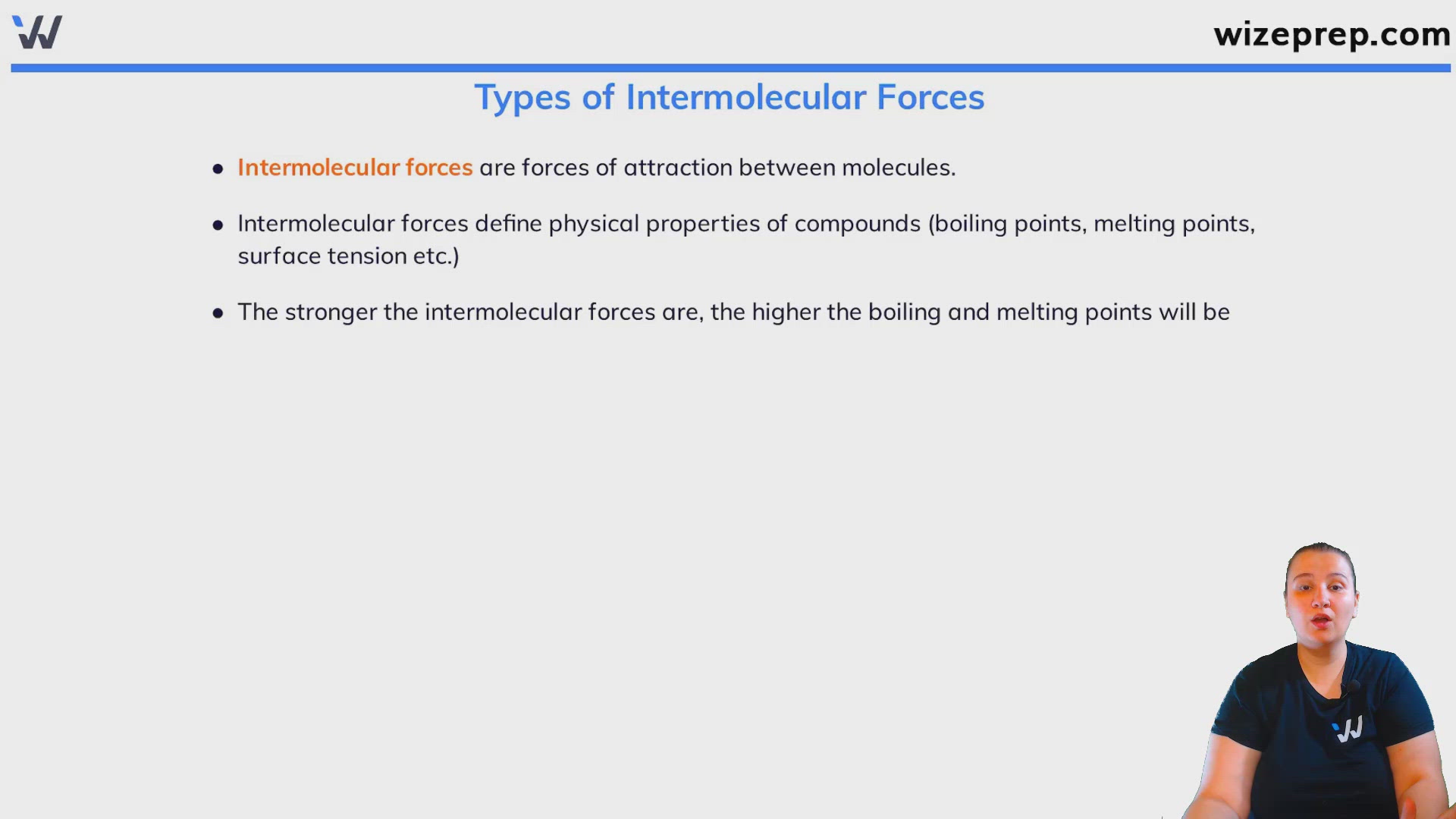
- Intermolecular forces are forces of attraction between molecules.
- Intermolecular forces define physical properties of compounds (boiling points, melting points, surface tension etc.)
- The stronger the intermolecular forces are, the higher the boiling and melting points will be
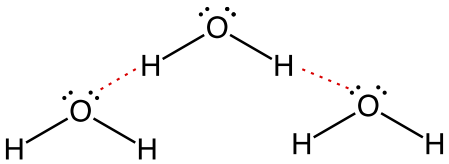
Hydrogen Bonding
- The strongest of the intermolecular forces
- Hydrogen bonded to N, O, or F is attracted to lone pairs of electrons on other N, O or F
Dipole - Dipole
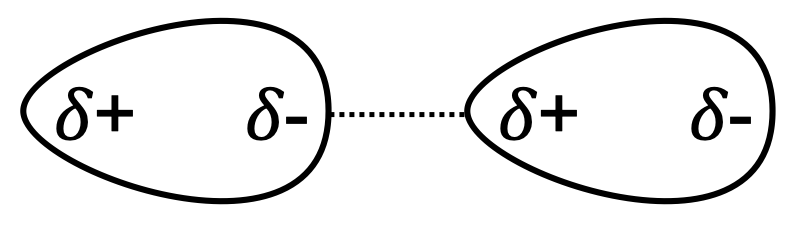
- Second strongest intermolecular force
- The more polar a molecule is, the stronger the forces
- Interaction between two polar molecules; opposite dipoles attract (δ– and δ+)
London Dispersion Forces
- The weakest of intermolecular forces.
- All molecules have London dispersion forces.
- The bigger the molecule, the stronger the forces
- Molecules interact randomly and distort each other's electron clouds, causing temporary dipoles
- Electrons randomly move around and at some point, more electrons may be on one side than the other in a non-polar molecule, creating a temporary dipole. This can happen with another non-polar molecule as well and the two can interact


0:00 / 0:00
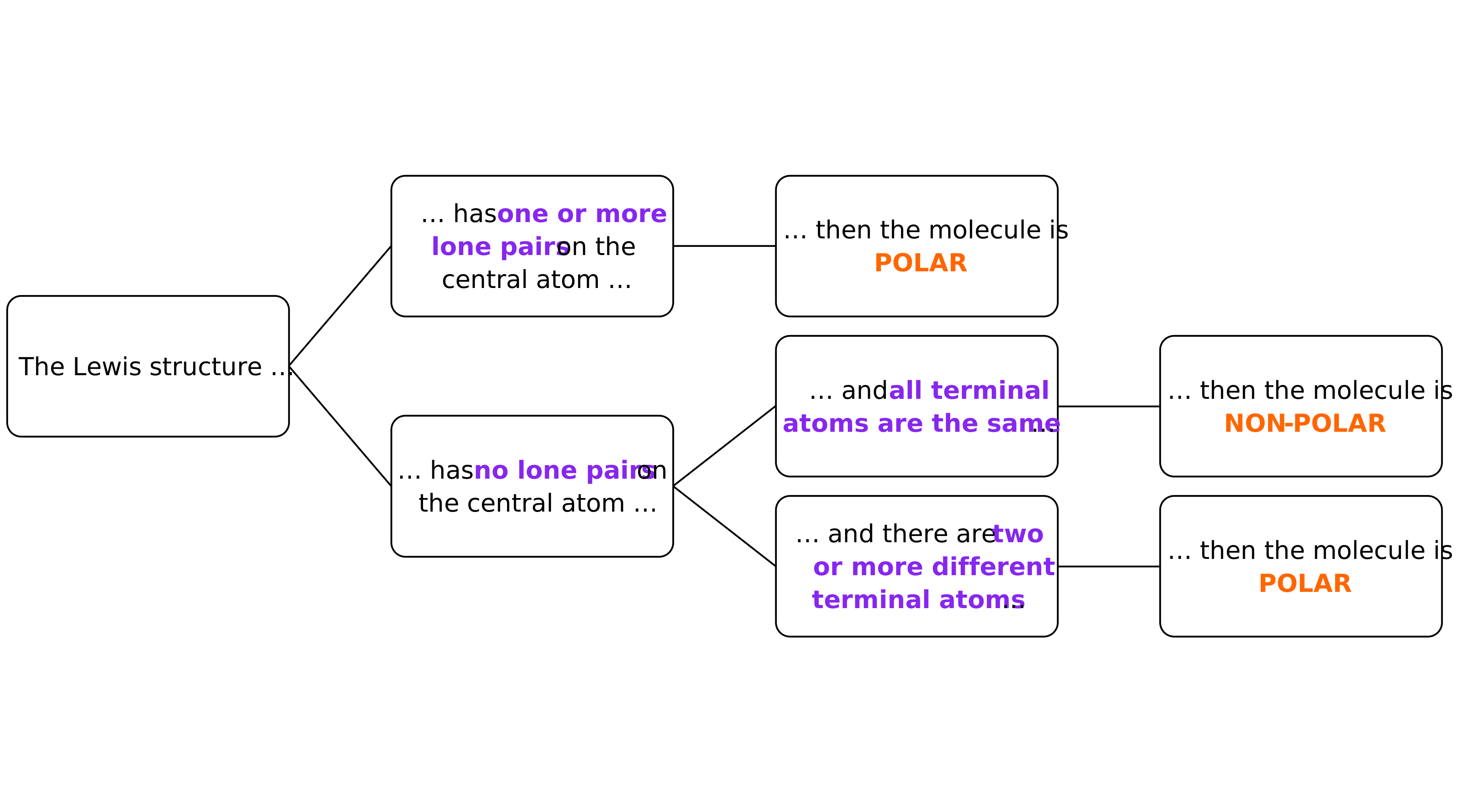
How to Determine Molecular Polarity

0:00 / 0:00
Example: Molecular Polarity
Determine if the following molecules are polar or not: CCl4 and CHCl3
CCl4 is non-polar as the molecule is symmetrical, whereas CHCl3 is polar because it is not symmetrical

0:00 / 0:00
Example: Strength of Intermolecular Forces
Determine which compound in the following pairs of molecules will have the higher melting point.
a) I2 or Br2
I2 because it will have the stronger London dispersion forces since it has more electrons than Br2.
b) HF or HBr
HF because HF has hydrogen bonding whereas HBr does not.
Practice: Intermolecular Forces and Boiling Points
Which of the following molecules would exhibit the highest boiling point based on intermolecular forces?
Practice: Molecular Polarity
Which of the following molecules is non-polar?
Describe the strongest intermolecular forces in the following compounds.
A.
London Dispersion
B.
Hydrogen Bonding
C.
Dipole-Dipole
CCl4
NH3
H2S
Practice: Comparing Boiling Points
Hexane, C6H14 (M = 86g/mol) has a boiling point of 68ºC. Ethanol, CH3CH2OH (M = 46g/mol) has a boiling point of 78ºC. Mark each of the following statements as TRUE or FALSE.
- Ethanol must have stronger intermolecular attractions, based on its higher boiling point.
- Ethanol has a higher boiling point because of greater London dispersion force
- Both hexane and ethanol have hydrogen bonding.
- Ethanol has a higher boiling point due to hydrogen bonding.