Wize High School Grade 11 Chemistry Textbook > Stoichiometry
Limiting Reagents

0:00 / 0:00
Limiting and Excess Reagents
- Anytime reactant species are in limited supply and not present in perfectly proportional amounts, a chemical reaction will have a limiting reagent
- The limiting reagent will be totally consumed before any other reactant
- The quantity of the limiting reagent available directly determines the maximum number of product molecules that can be formed
- Excess reagents are reactants that remain after the reaction is complete
How to find Limiting and Excess Reagents
- When making smores the "reaction" looks something like:

- If I had 10 graham crackers, 6 chocolate squares, and 6 marshmallows, what would be the limiting reagent?
- One way to find the limiting reagent is to use the mole ratio to figure out how much product each reagent would give you
- The questions you are asking yourself are:
- how many s'mores can I make with 10 graham crackers?
- how many s'mores can I make with 6 chocolate squares?
- how many s'mores can I make with 6 marshmallows?
- Now, to figure out the limiting reagent, look at which of reagent gives you the least amount of s'mores
6 chocolate squares can only make 3 s'mores, so the chocolate squares are our limiting reagent and will be completely used up.
- We say that the graham crackers and marshmallow are excess reagents. There will be leftover graham crackers and marshmallows.
- how many graham crackers will be used up and how many will be left over?
- how many marshmallows will be used up and how many will be left over?

0:00 / 0:00
Example: Determine the Mass of Product in a Limiting Reagent Problem
Iron and chlorine gas react to form iron (III) trichloride. If 110 g of iron and 105 g of chlorine gas are reacted, which species is the limiting reagent? What is the maximum mass of FeCl3 that can be formed?
Step 1 – Write & balance the equation.
- Is the equation given balanced?Yes
Step 2 – Calculate moles of each reactant.
1) Find moles of Fe
n=m/M
n=110/56
n=2 moles
2) Find moles of Cl2
n=m/M
n=105/70 =21/14 = 3/2
n=1.5 moles
Step 3 – Use the molar ratios of the present reactants (from the balanced equation) to determine the limiting reactant.
Divide # of moles of Fe by 2: 2/2=1
Divide # of moles of Cl2 by 3: 1.5/3=0.5
Therefore the limiting reagent is
Cl2
! Step 4 – From the limiting reactant, use the molar ratio (from the balanced equation) to calculated moles of the desired product.
- The maximum mass of FeCl3 that is formed depends on how muchCl2we have (LR).
- Let's use moles of Cl2 to find moles of FeCl3
We found n=1.5 for Cl2 --> (1.5 x 2/3 =1)
moles of FeCl3=1 mole
Step 5 – Convert moles to the desired units (density, molarity, grams, etc…)
M (FeCl3) =161g/mol
n=m/M
m=nM
m=1x161
m=161g
Therefore, 161g of FeCl3 will be formed from the reaction!

0:00 / 0:00
Example: Determine the Amount of Excess Reagent
The reaction between P4 and Br2 is very exothermic and results in PBr5 as the only product. If 7.0 g of P4 react with 12.0 g of Br2 how many grams of the excess reagent will remain?
First let's start by writing the reaction out that was described above and balancing it. Don't worry if you didn't include the phases.
Now let's find the moles of each reactant,
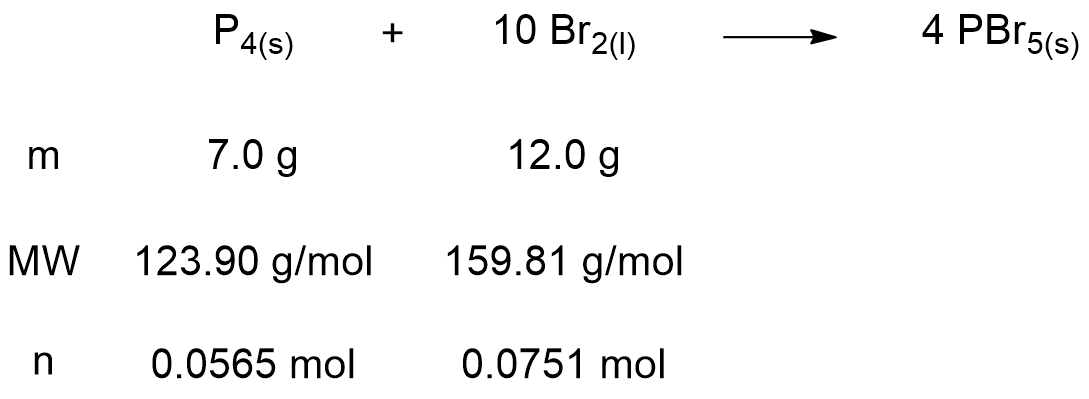
We can see that there is not 10x as much Br2 as P4 so Br2 will be limiting. If you want to prove it to yourself divide the number of moles by the stoichiometric coefficient. The smallest number will be the limiting reagent.
If Br2 is the limiting reagent then it will be completely consumed. Therefore,
We can then find the number of moles of P4 remaining,
We can now convert that number of moles to mass and answer the problem,
Practice: Finding Limiting Reagents
Hydrogen gas reacts with oxygen gas to produce water. When 0.20g H2 are mixed with 0.50g O2, which gas is the limiting reagent?
What is the maximum mass of Ca(CN)2 that can be obtained from 1.56 g of HCN and 2.58 g of Ca(OH)2? The balanced chemical equation is shown below.
Practice: Gases and Limiting Reagents
What volume, in L, of hydrogen gas at STP will be produced when 50g of aluminium is added to 1.00L of 1.5mol/L sulfuric acid? Round your answer to the nearest integer; do not include units in your answer.