Wize High School Grade 11 Chemistry Textbook > Chemical Reactions
Chemical Analysis

0:00 / 0:00
Precipitation Reactions
- Two soluble ionic compounds react to form an insoluble product, that is a precipitate (solid)
- In this reaction, two water soluble salts (magnesium chloride and calcium hydroxide) react to form another soluble salt (calcium chloride) and a precipitate (magnesium hydroxide).
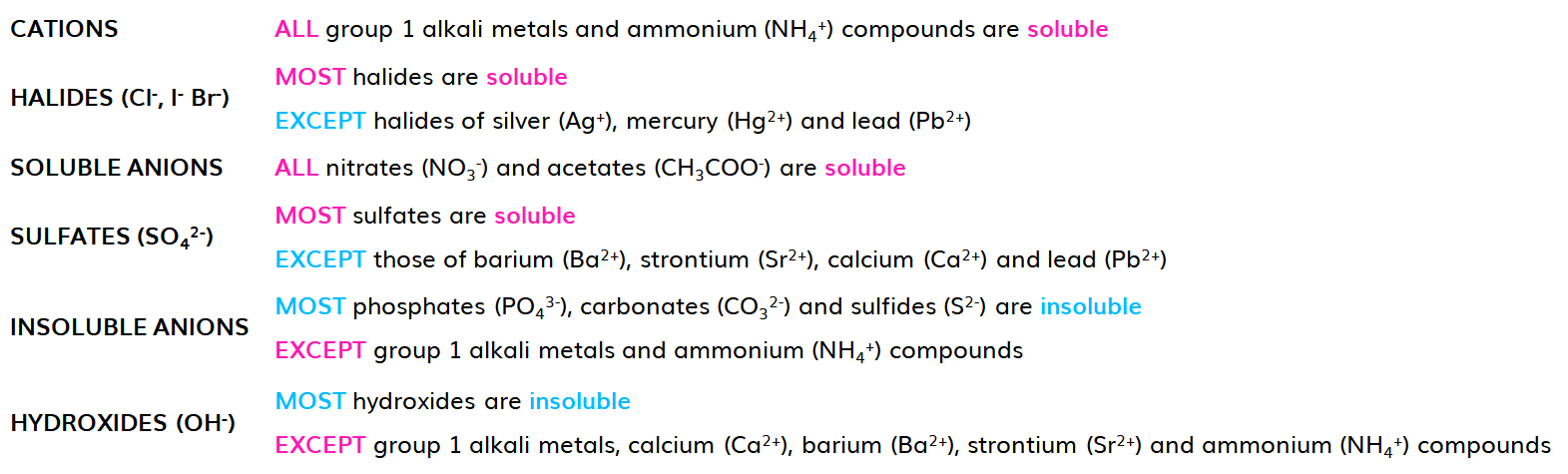
- How do we know magnesium hydroxide is insoluble? Check out the solubility chart below to predict the solubility of ionic compounds.
Solubility Rules

0:00 / 0:00
Hydrocarbon Combustion Reactions
- A combustion reactions is a reaction between a hydrocarbon (CxHy) with oxygen to produce carbon dioxide (CO2) and water (H2O).
- Combustion reactions are commonly used in elemental analysis to determine the empirical formula of a compound.
Complete vs Incomplete Combustion:
- Complete combustion occurs when an excess of oxygen reacts with a hydrocarbon to produce carbon dioxide and water.
- Incomplete combustion occurs when there is insufficient oxygen present and the oxygen reacts with the hydrocarbon to form water and either carbon monoxide or carbon, or both
Steps to Balance a combustion reaction:
- Balance the carbons
- Balance the hydrogens
- Balance the oxygens using ONLY the coefficient of elemental oxygen (O2)
- If the equation has any fractions (often times the coefficient in front of O2 is a fraction), multiply the ENTIRE equation by 2
Example: Balance the following reaction

0:00 / 0:00
Example: Determining the Solubility of Salts
Decide whether these following ionic salts are soluble or not in water.
1) NaCl
Na+ is a group 1 ion. When these are part of a compound, it will always be soluble.
2) AgCl
Cl- is typically soluble when in a compound, BUT when it is paired with Ag+, that is an exception so the combination of these ions will actually be insoluble.
3) BaSO4
SO42- is typically soluble when in a compound, BUT when it is paired with Ba2+, that is an exception so the combination of these ions will actually be insoluble.
4) KNO3
K+ is a group 1 ion. All group 1 ions are always soluble
NO3- is also an ion that is always soluble.
Which of the following compounds is soluble in water at 25 °C?
Practice: Solubility Rules and Precipitation
Which of the following correctly describes what happens when aqueous solutions of ammonium carbonate, (NH4)2CO3, and potassium bromide, KBr, are mixed?
Select the correct balanced equation for the complete combustion reaction expected to occur between C4H10 and O2.