Wize University Chemistry Textbook > Atoms, Ions, & Isotopes
The Periodic Table & Properties
Popular Courses
MCAT
General Course
Grade 12 Chemistry
Ontario High School
Grade 12 Chemistry
Canada High School
CHEM 1301A/B
Western University
CHEM 201
University of Calgary
General Chemistry
University Study Guides
AP Chemistry Exam Prep Course
AP Exam Prep
CHEM 1A03
McMaster University
CHEM 101
University of Alberta
CHEM 112
Queen's University
CHEM 121
University of British Columbia
High School Chemistry
US High School
Chemistry
General Course
DAT
General Course
General Chemistry
University Study Guides
CHEM 103
University of Alberta
CHEM 110
McGill University
CHEM 1E03
McMaster University
CHM135H1
University of Toronto
CHEM 154
University of British Columbia
0:00 / 0:00
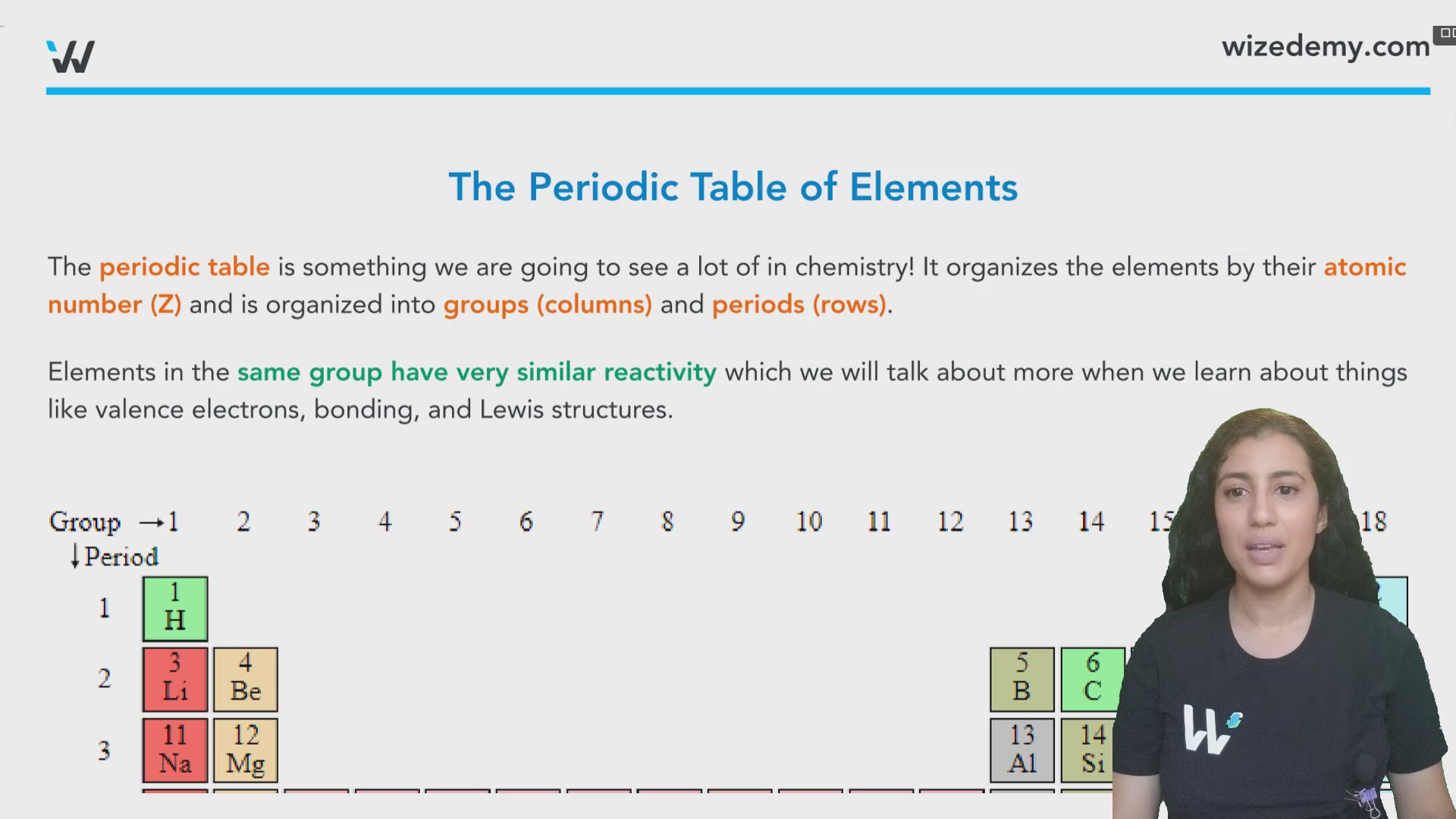
The Periodic Table of Elements
The periodic table is something we are going to see a lot of in chemistry! It organizes the elements by their atomic number (Z) and is organized into groups (columns) and periods (rows).
Elements in the same group have very similar reactivity which we will talk about more when we learn about things like valence electrons, bonding, and Lewis structures.

You should be familiar with each of the following labels:
- Groups
- Periods
- Alkali Metals
- Alkaline Earth Metals
- Transition Metals
- Nitrogen group (aka Pnictogens)
- Oxygen group (aka Chalcogens)
- Halogens
- Noble (Inert) Gases
- Metals
- Non-metals
- Metalloids
- Lanthanides and Actinides (aka Rare Earth Metals)
Practice: Understanding Noble Gases
Which of the following statements is true?