Wize University Chemistry Textbook > Stoichiometry
Introduction to Chemical Equations and Balancing
Popular Courses
MCAT
General Course
CHEM 1301A/B
Western University
CHEM 1302A/B
Western University
General Chemistry
University Study Guides
AP Chemistry Exam Prep Course
AP Exam Prep
CHEM 1A03
McMaster University
CHEM 101
University of Alberta
CHEM 112
Queen's University
DAT
General Course
Chemistry
General Course
General Chemistry
University Study Guides
CHEM 103
University of Alberta
CHEM 120
University of Waterloo
CHEM 205
Concordia University
CHEM 121
Simon Fraser University
CHEM 120
McGill University
CHE 102
University of Waterloo
APSC 131
Queen's University
CHEM-1100
University of Windsor
CHEM 130
University of British Columbia
0:00 / 0:00
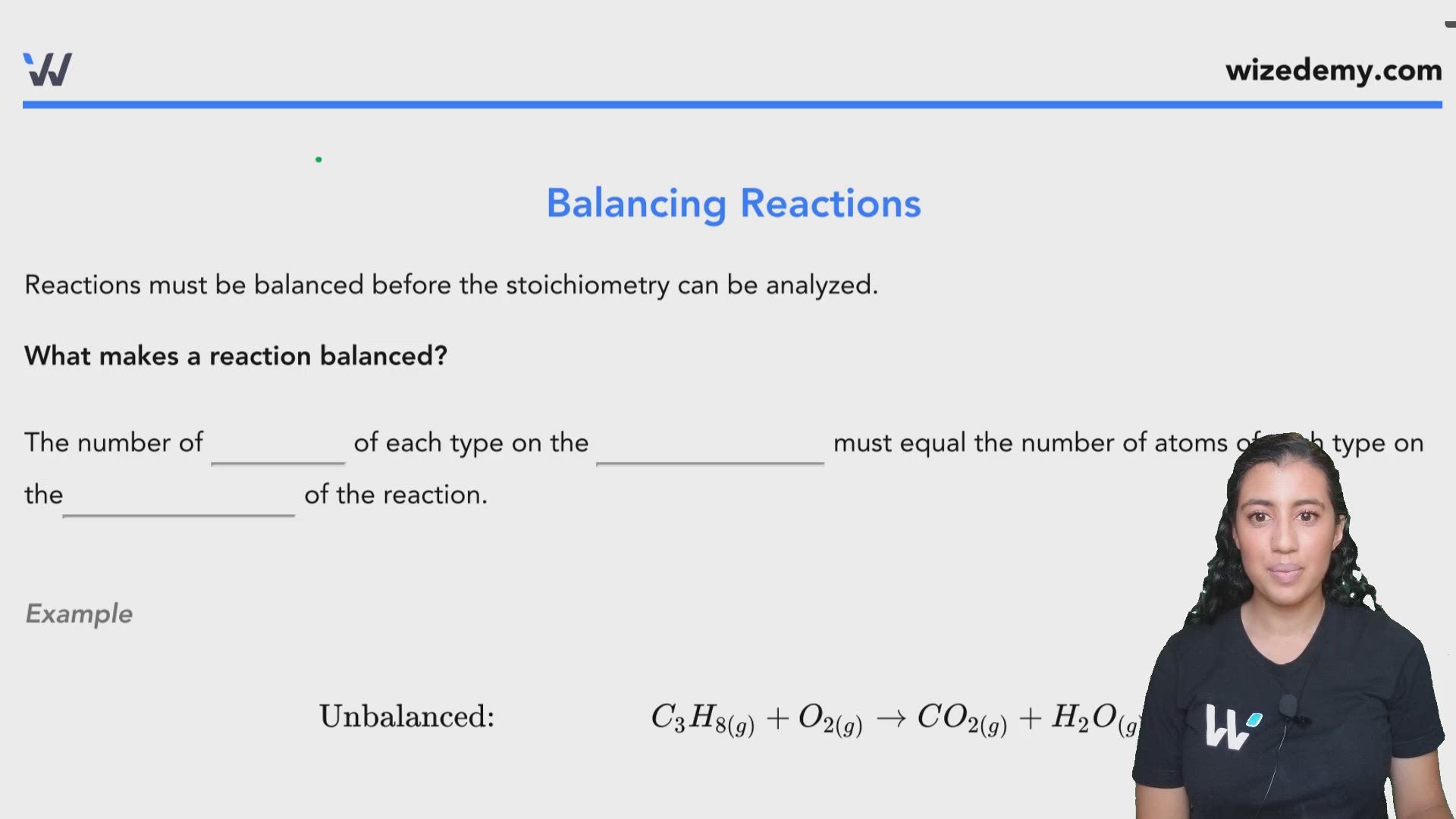
Balancing Reactions
Reactions must be balanced before the stoichiometry can be analyzed.
What makes a reaction balanced?
The number of
atoms
of each type on the reactants side
must equal the number of atoms of each type on the products side
of the reaction.Example:
0:00 / 0:00
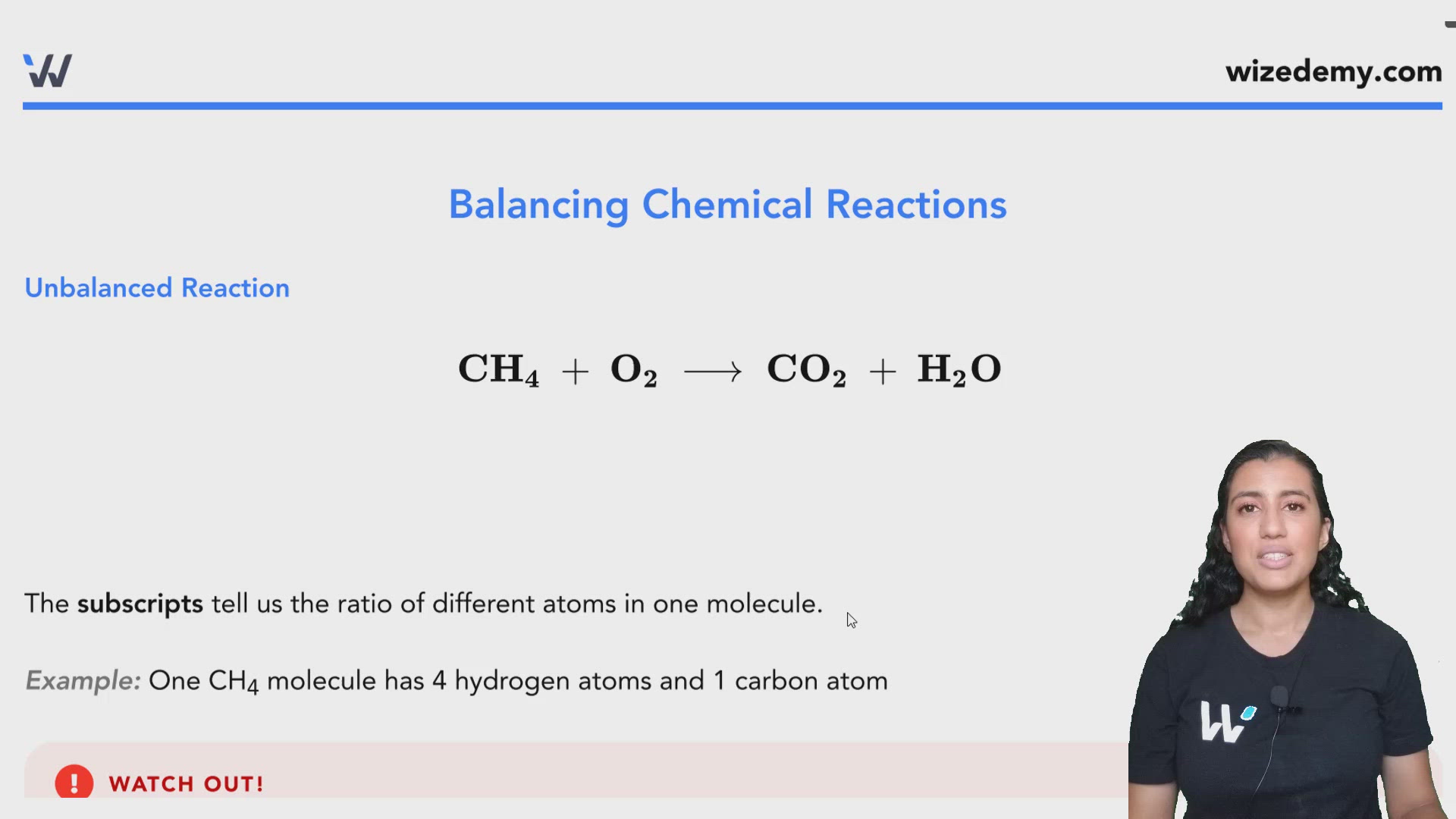
Balancing Chemical Reactions
Unbalanced Reaction
The subscripts tell us the ratio of different atoms in one molecule.
Example: One CH4 molecule has 4 hydrogen atoms and 1 carbon atom
Watch Out!
Sometimes you could be given unbalanced equations and you are expected to balance them!
We need to use the balanced equation for calculations in order to get the correct answer!
Steps to Balance Chemical Equations
- Balance elements that only appear once on the reactant side and once on the product side (typically elements not including C, N, H, O)
- Group polyatomic ions and balance them as a group (not as separate elements, e.g. balance NO3 as 1 NO3 group, not 1 N and 3 O)
- Balance all other elements, starting with the least common elements to the most common elements
- Make sure all coefficients are whole numbers AND are represented in the simplest integer ratio possible
- Check to make sure all elements are balanced on each side of the chemical equation
Balanced Reaction

- The stoichiometric coefficients of the balanced equation tell us that we need2oxygen molecules for each methane (CH4) molecule and we produce2waters for every methane consumed.
- It also tells us that for every 1 mole of methane used we produce1mole of CO2.
Wize Concept
Multipy coefficients by subscripts to see exactly how much of an atom we have on each side.
Watch Out!
We want the lowest possible coefficients.
Example:
If I balanced an equation and got:
The greatest common factor that can go into each coefficient is 2 so we need to divide each coefficient by 2 to get the lowest possible numbers!
0:00 / 0:00
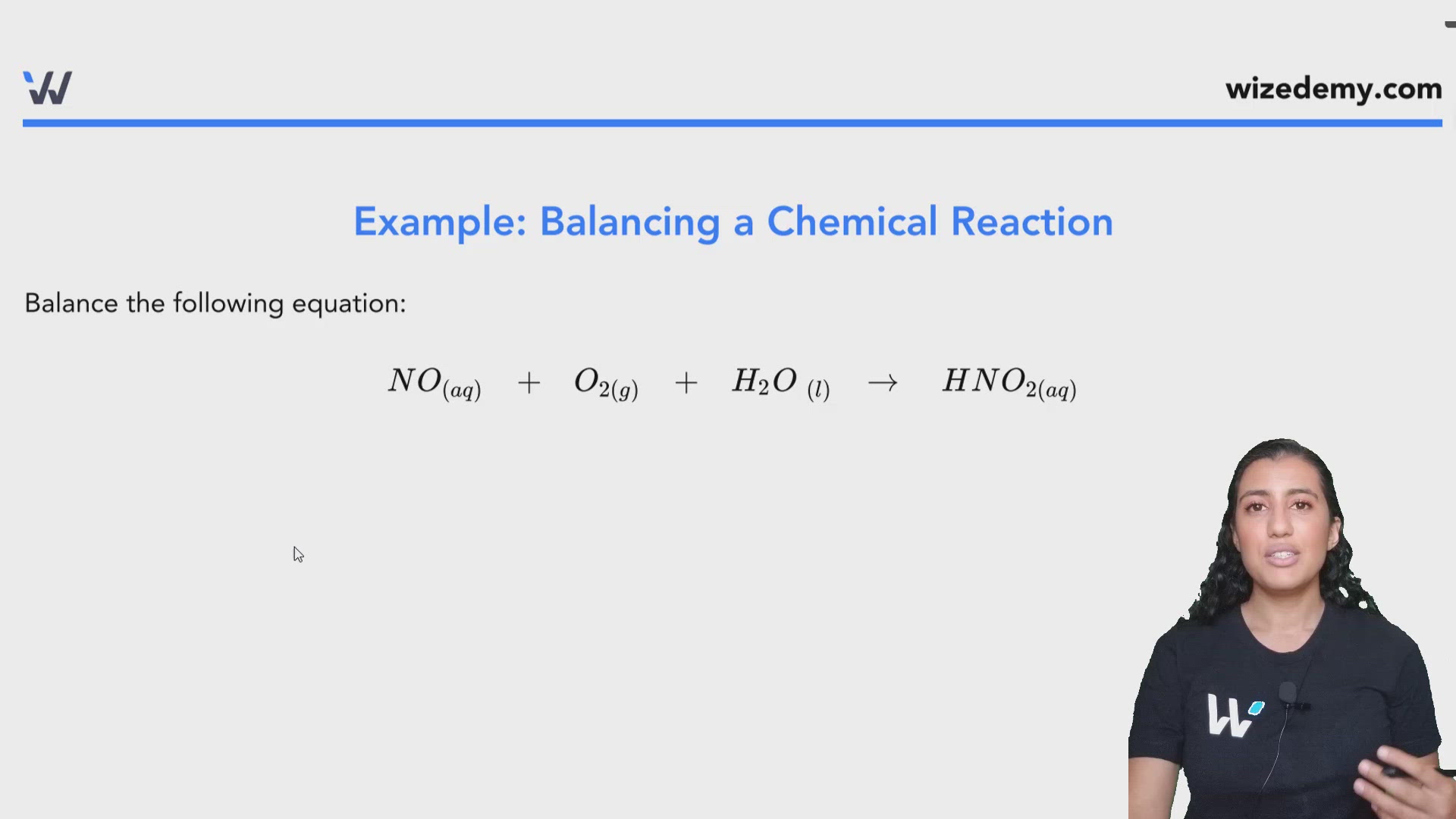
Example: Balancing a Chemical Reaction
Balance the following equation:
Balanced chemical equation:
Wize Concept
The physical state of each chemical compound is often included in chemical equations:
(s) = solid
(l) = liquid
(g) = gas
(aq) = aqueous
0:00 / 0:00
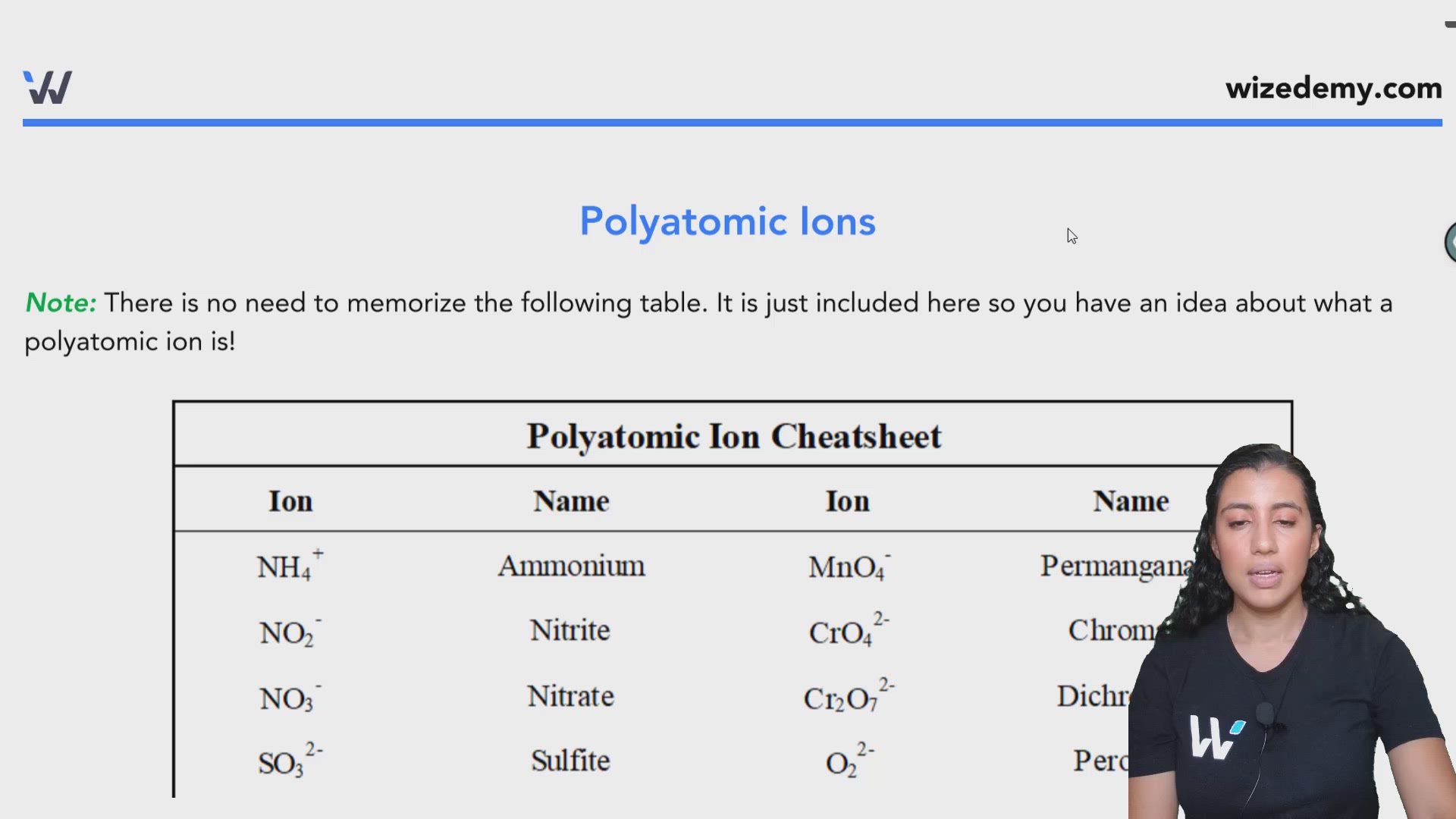
Polyatomic Ions
Note: There is no need to memorize the following table. It is just included here so you have an idea about what a polyatomic ion is!

0:00 / 0:00
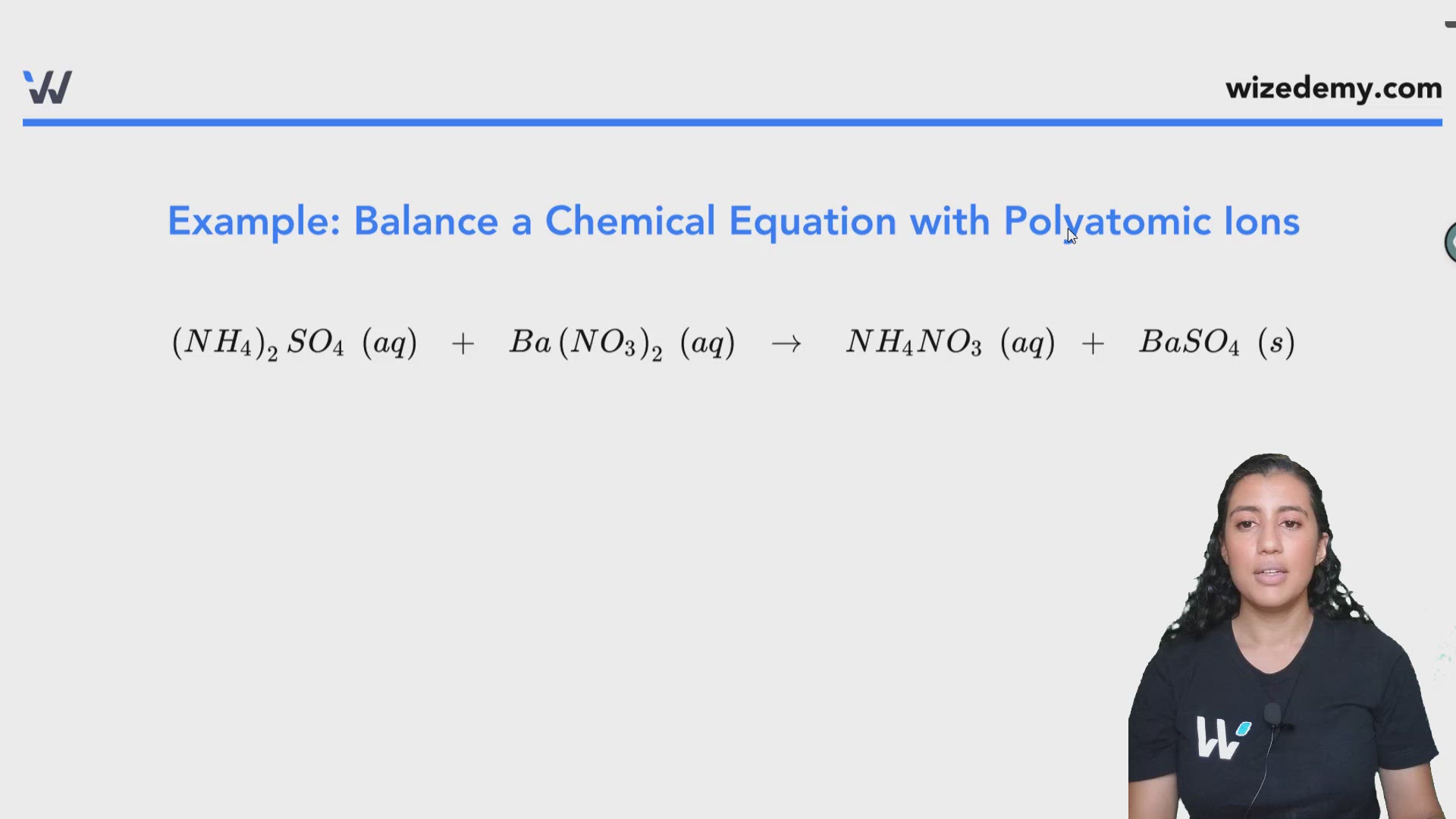
Example: Balance a Chemical Equation with Polyatomic Ions
Practice: Balancing Combustion of Furan
Choose the answer that balances the reaction shown below: