Wize University Chemistry Textbook > Stoichiometry
Atoms, Molecules, and the Mole!
Popular Courses
MCAT
General Course
CHEM 1301A/B
Western University
CHEM 1302A/B
Western University
General Chemistry
University Study Guides
AP Chemistry Exam Prep Course
AP Exam Prep
CHEM 1A03
McMaster University
CHEM 101
University of Alberta
CHEM 112
Queen's University
DAT
General Course
Chemistry
General Course
CHEM 103
University of Alberta
General Chemistry
University Study Guides
CHEM 120
University of Waterloo
CHY 102
Toronto Metropolitan University
CHEM 205
Concordia University
CHEM 121
Simon Fraser University
CHEM 120
McGill University
APSC 131
Queen's University
CHY 103
Toronto Metropolitan University
CHEM 130
University of British Columbia
0:00 / 0:00
Moles
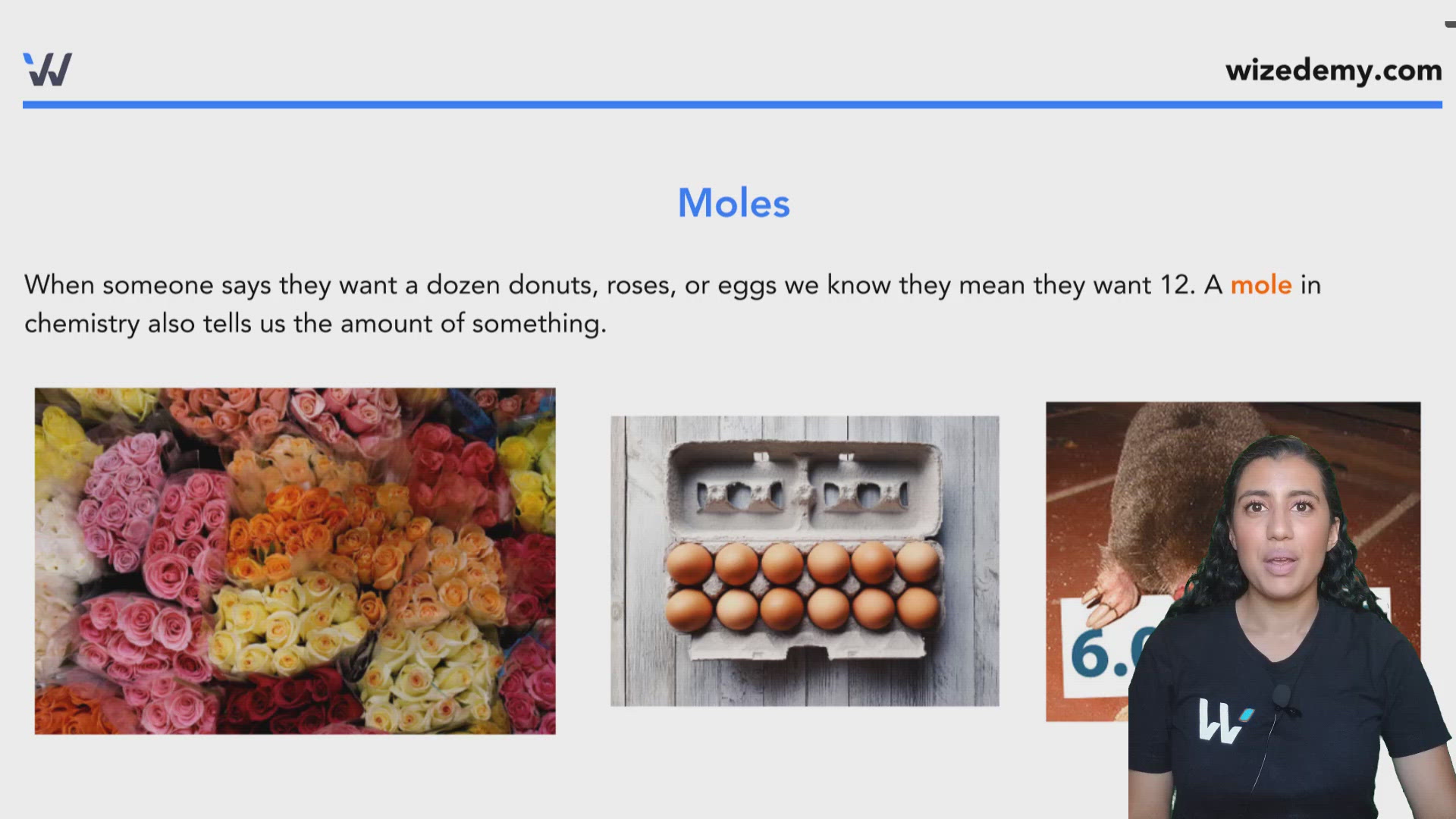
When someone says they want a dozen donuts, roses, or eggs we know they mean they want 12. A mole in chemistry also tells us the amount of something.
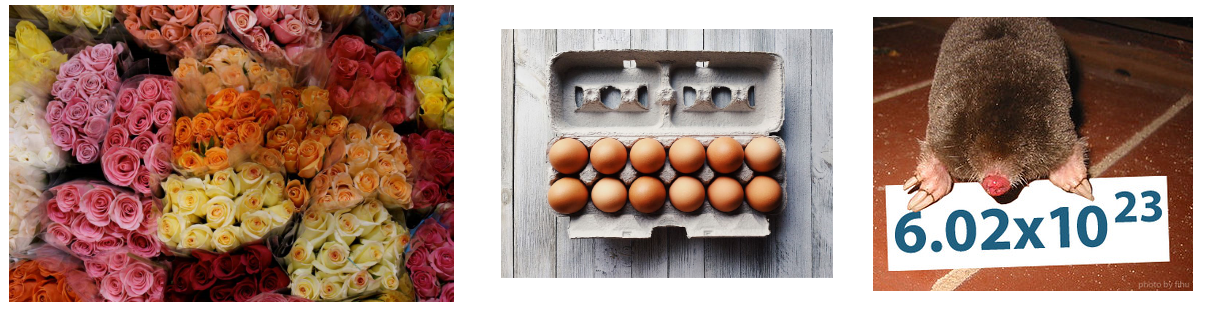
- Just like how a dozen of something = 12, 1 mole of something =6.02x10²³ molecules
- 6.02x10²³ is referred to as Avagadro's number (NA)
Wize Tip
You should memorize Avagadro's number since it is not always provided on exams! We'll soon see that you need to know it to solve problems :)
We use the unit "moles" to help make very small amounts more measurable. A mole is just like any other unit!
There are 2 Equations Related to Moles:
n=# of moles
m=mass (g)
M=molar mass (g/mol)
N=# of molecules or atoms
NA=Avagadro's number=6.02x10²³ molecules
Example #1:
If we are told that a sample of CO2(s) weighs 11g, how many moles are present?
m=11g, n=?
n=m/M
We are given m but need to solve for M:
M=12g/mol + 2(16g/mol)
M=44g/mol
n=m/M
n=11g/44g/mol
n=0.25moles!
Example #2
We have 2 moles of CO2 present in our sample, how many molecules are there?
n=2 moles, N=? NA=6.02x10²³
n=N/NA
N=n(NA)
N=2(6.02x10²³)
N=1.2x1024 molecules
Example #3
How many oxygen atoms there in 1 mole of CO2?
1) Find Number of Molecules In the Sample
n=N/NA N=? (how many molecules are there)
N=n(NA)
N=1(6.02x10²³)
N=6.02x10²³ molecules
2) Find the Number of O atoms in the Sample
In each molecule there are
2
O atoms. Therefore to find the number of O atoms:
# of molecules in sample x
2
O atoms/molecule =# of O atoms# of O atoms=
6.02x1023 x2=1.2x1024 atoms!
0:00 / 0:00
Example: Calculate the Number of Molecules of Ethyl Mercaptan
The volatile liquid ethyl mercaptan,is one of the most odoriferous substances known. It is added to natural gas to make gas leaks detectable. (d = 0.84 g/mL; MW = 62.1 g/mol)
- How manymolecules are contained in a 3.0 sample?
N=? V=3 uL d=0.84 g/mL M=62.1g/mol NA=6.02x10²³
n=N/NA
N=n(NA)
Need to solve for moles first before we can use this equation.
n=m/M need the mass before we can solve for moles
d=m/V
m=dV
density is given in g/mL so the V needs to be in mL so the units cross out and we have a mass in g.
1uL=1x10⁻⁶L
3uL=3x10⁻⁶L
Now we need to convert into mL:
1000mL=1L
V=3x10⁻³mL
m=dV
m=(0.84g/mL)(3x10-3mL)
m=2.52x10⁻³ g
n=m/M now solve for moles
n=2.52x10⁻³g / 62.1 g/mol
n=4.05797x10⁻⁵ moles
Finally since we have the total moles in the sample, we can solve for the total molecules:
N=n(NA)
N=4.05797x10⁻⁵ moles (6.02x10²³ molecules/mole)
N= 2.4x10¹⁹ molecules
- In the same 3.0 µL sample, how many C and H atoms are there?
Practice: Converting Mass to Number of Atoms
Calculate the number of nitrogen atoms in 2.25 g of bismuth(III) nitrate.
Practice: Finding Number of Moles of Iron
Calculate the number of moles of iron atoms in 14.1 g of iron oxide, Fe2O3