Wize University Chemistry Textbook > Stoichiometry
Stoichiometry
Popular Courses
MCAT
General Course
CHEM 1301A/B
Western University
CHEM 1302A/B
Western University
General Chemistry
University Study Guides
AP Chemistry Exam Prep Course
AP Exam Prep
CHEM 1A03
McMaster University
CHEM 101
University of Alberta
CHEM 112
Queen's University
DAT
General Course
CHM 1311
University of Ottawa
Chemistry
General Course
CHEM 103
University of Alberta
General Chemistry
University Study Guides
CHEM 120
University of Waterloo
CHY 102
Toronto Metropolitan University
CHEM 205
Concordia University
CHEM 120
McGill University
CHE 102
University of Waterloo
APSC 131
Queen's University
CHY 103
Toronto Metropolitan University
0:00 / 0:00
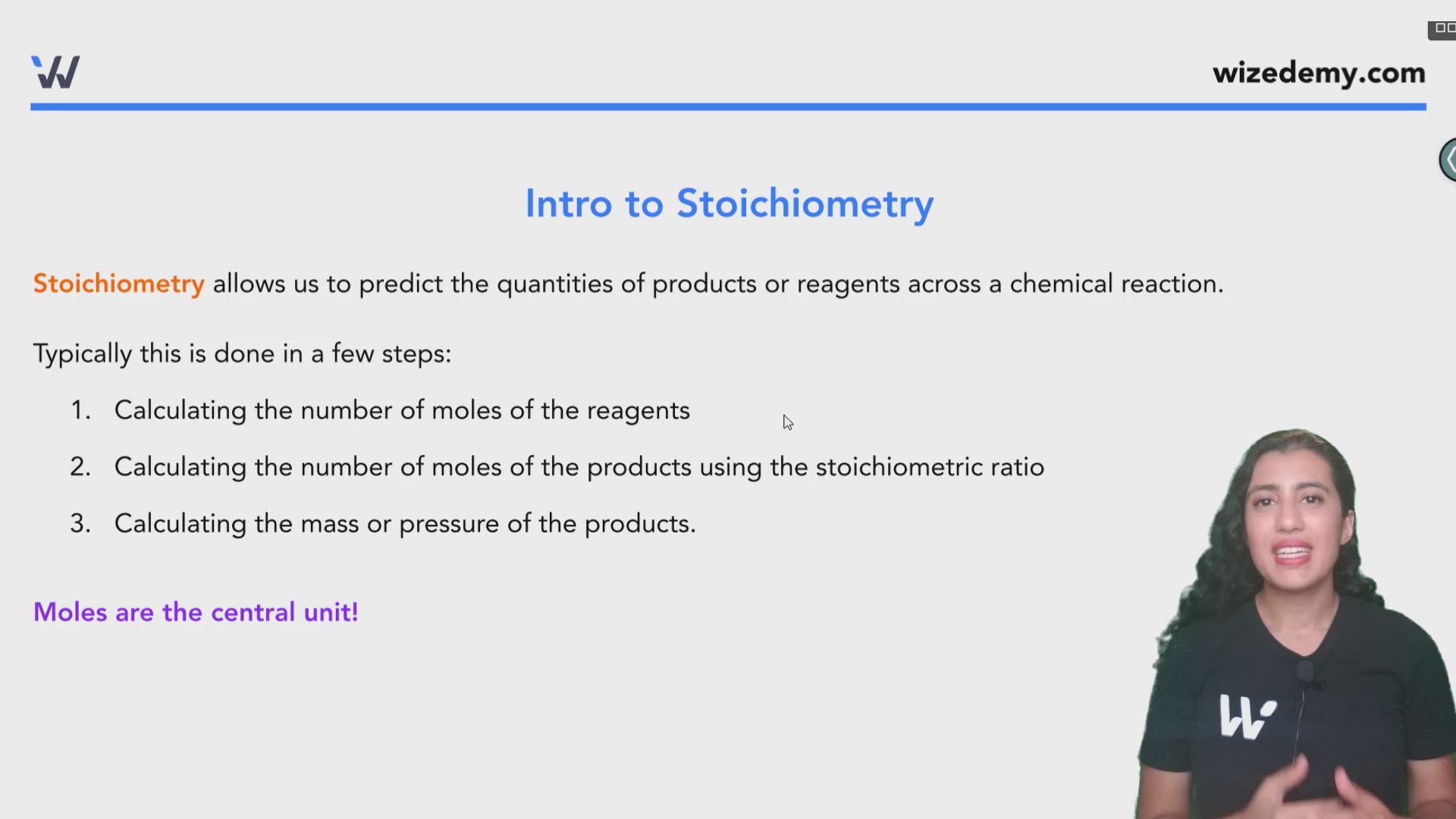
Intro to Stoichiometry
Stoichiometry allows us to predict the quantities of products or reagents across a chemical reaction.
Typically this is done in a few steps:
- Calculating the number of moles of the reagents
- Calculating the number of moles of the products using the stoichiometric ratio
- Calculating the mass or pressure of the products.
Moles are the central unit!

In addition we can convert between mass and volume of a pure substance by looking at it's density,
0:00 / 0:00
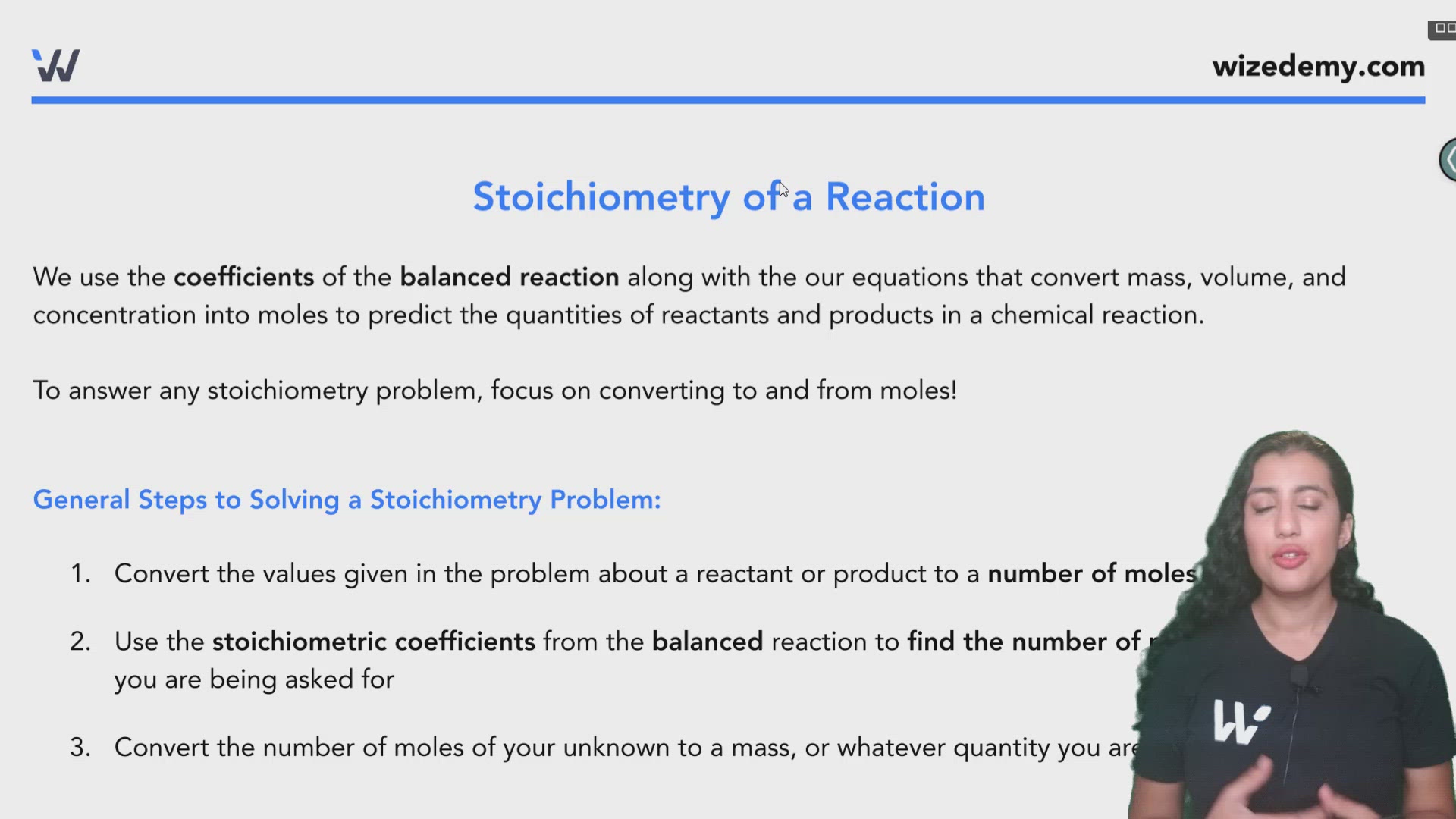
Stoichiometry of a Reaction
We use the coefficients of the balanced reaction along with the our equations that convert mass, volume, and concentration into moles to predict the quantities of reactants and products in a chemical reaction.
To answer any stoichiometry problem, focus on converting to and from moles!
General Steps to Solving a Stoichiometry Problem:
- Convert the values given in the problem about a reactant or product to a number of moles
- Use the stoichiometric coefficients from the balanced reaction to find the number of moles of the unknown you are being asked for
- Convert the number of moles of your unknown to a mass, or whatever quantity you are being asked for
Example
2.6g of sodium metal (Na) reacts with water to form NaOH and H2 according to the unbalanced reaction below. Once the reaction is complete how many grams of NaOH are formed?
Wize Tip
On an exam, your prof will NOT specify if an equation is balanced or unbalanced.
Always double check that the equation is balanced. If it's not, balance the equation before continuing!
The equation must be balanced in order to get the correct answer!
Step 1: Balance the reaction
Step 2: Find the number of moles of sodium
Step 3: Find the number of moles of NaOH
Step 4: Convert the number of moles of NaOH to a mass
0:00 / 0:00
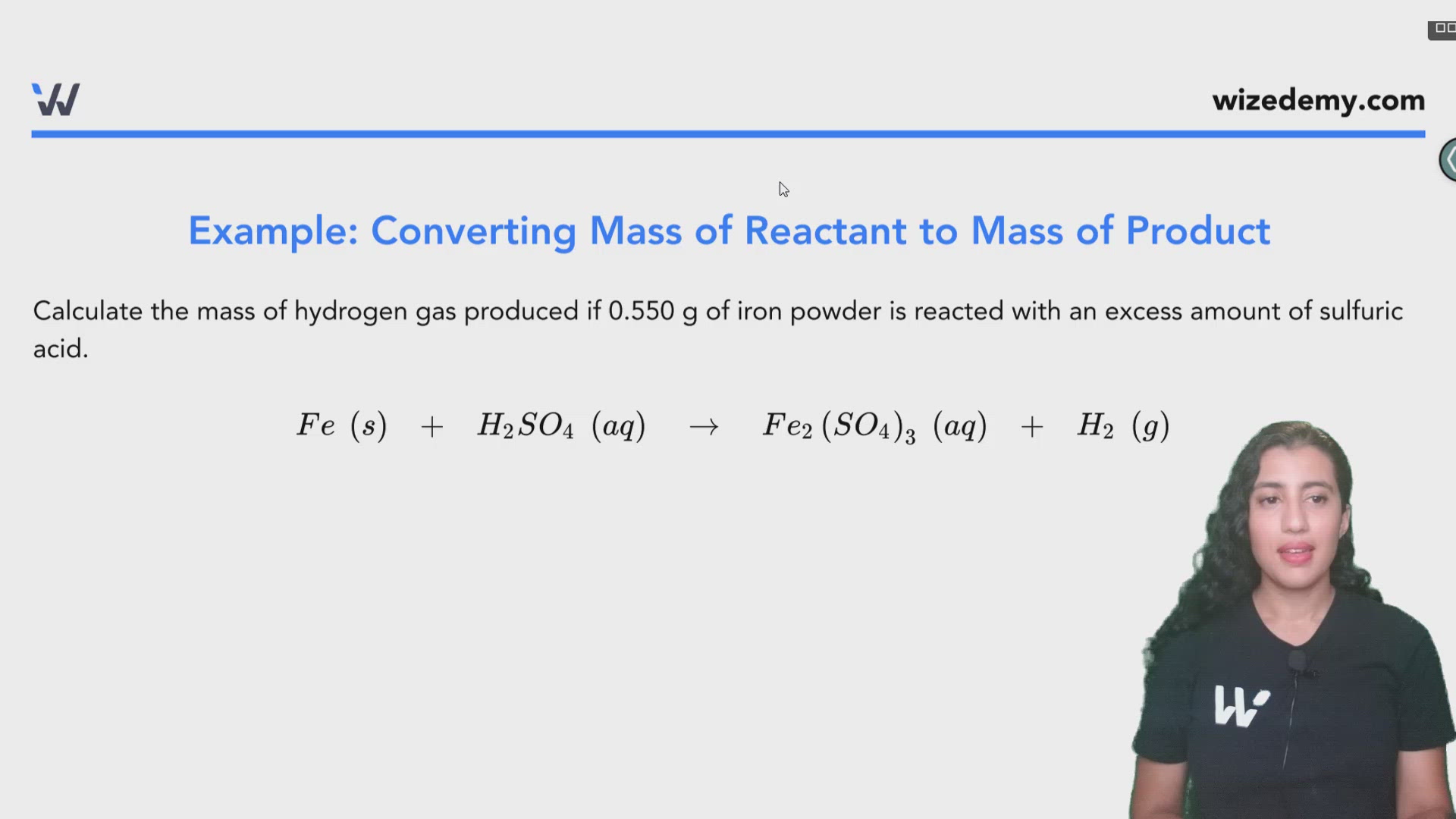
Example: Converting Mass of Reactant to Mass of Product
Calculate the mass of hydrogen gas produced if 0.550 g of iron powder is reacted with an excess amount of sulfuric acid.
Step 1-Balance the equation
Step 2- Calculate the moles of iron (Fe(s))
n=m/M
n=0.550g/55.845g/mol
n=0.00985 mol
Step 3-Using the stoichiometric coefficients from the balanced chemical reaction, determine the number of moles of H2(g)
moles H2(g)=0.01477 moles
Step 4-Calculate the mass of hydrogen gas
n=m/M
m=nM
m=(0.01477moles)(2.02g/mol)
m=0.0298g
0:00 / 0:00
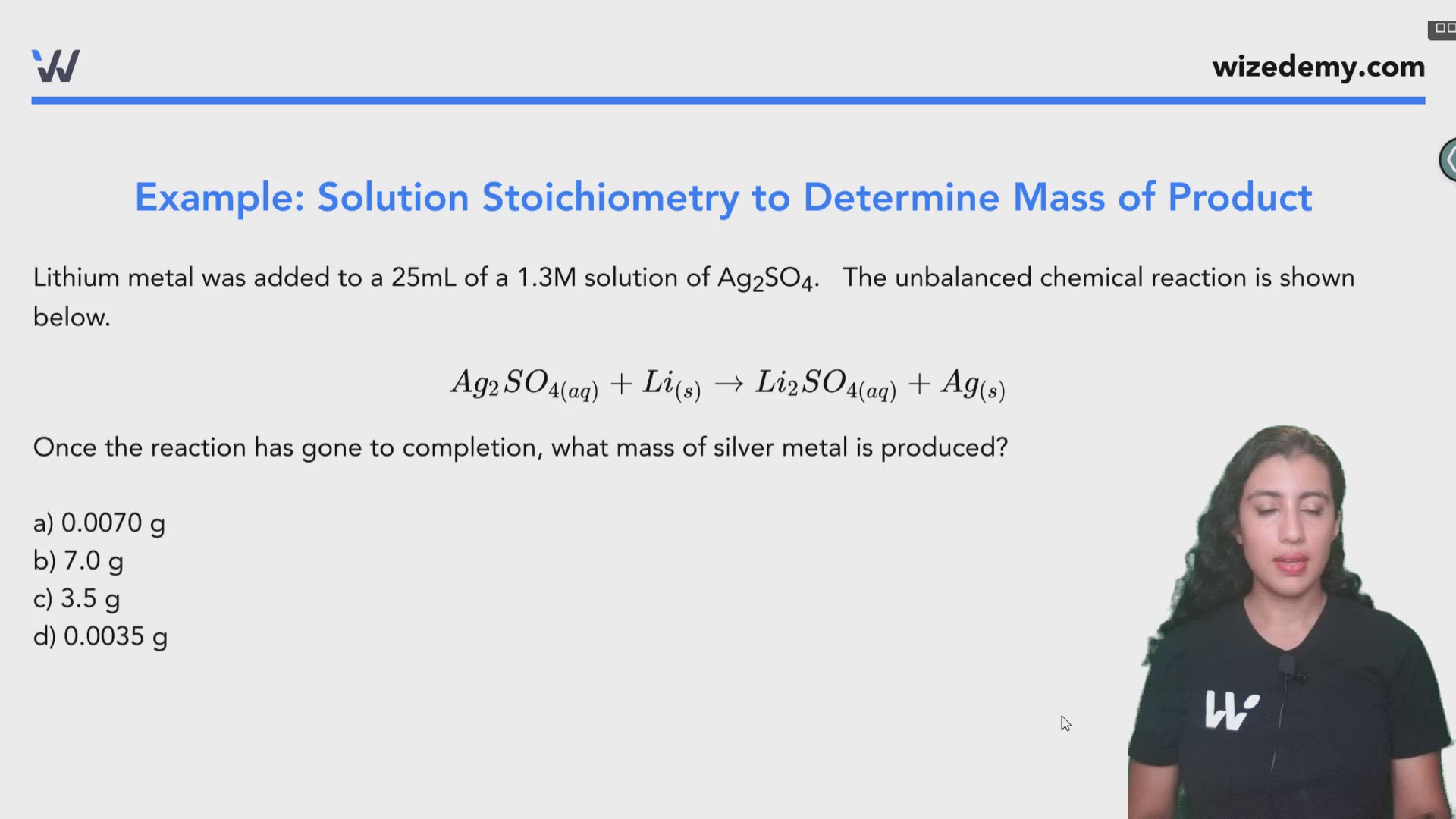
Example: Solution Stoichiometry to Determine Mass of Product
Lithium metal was added to a 25mL of a 1.3M solution of Ag2SO4. The unbalanced chemical reaction is shown below.
Once the reaction has gone to completion, what mass of silver metal is produced?
a) 0.0070 g
b) 7.0 g
c) 3.5 g
d) 0.0035 g
1. Balance the reaction
2. Find the number of moles of Ag2SO4 originally in solution
- Recall n=cv
- c must be in mol/L =M
- V must be in L
- Volume here is 25mL
- 1000mL=1L
- 25mL=0.025L
3. Use the stoichiometric coefficients to find the number of moles of Ag produced
4. Find the mass of silver from the moles
n=m/M
Rearrange to solve for m.
Answer: B
Practice: Calculate Mass of Product
16.0 mL of Hg (mp = –38.8oC, density = 13.56 g/mL) reacts with fluorine gas and the reaction goes to completion as shown below.
Once the reaction has gone to completion, what mass of mercury fluoride, HgF2 is produced?
Practice: Stoichiometry Calculations Application
A solution that is 183 mM (millimolar) NaCl(aq) is isoosmotic with plasma. This means that cells don't swell or shrink when in this solution. How many grams of sodium chloride are required to make 150 mL of isoosmotic NaCl(aq)? The molar mass of NaCl is 58.44 g/mol.