Wize University Chemistry Textbook > Stoichiometry
Limiting Reagents
Popular Courses
MCAT
General Course
CHEM 1301A/B
Western University
CHEM 1302A/B
Western University
General Chemistry
University Study Guides
AP Chemistry Exam Prep Course
AP Exam Prep
CHEM 1A03
McMaster University
CHEM 101
University of Alberta
CHEM 112
Queen's University
DAT
General Course
Chemistry
General Course
CHEM 103
University of Alberta
General Chemistry
University Study Guides
CHEM 120
University of Waterloo
CHY 102
Toronto Metropolitan University
CHEM 205
Concordia University
CHEM 121
Simon Fraser University
CHEM 120
McGill University
CHE 102
University of Waterloo
APSC 131
Queen's University
CHY 103
Toronto Metropolitan University
0:00 / 0:00
Introduction to Limiting Reagents
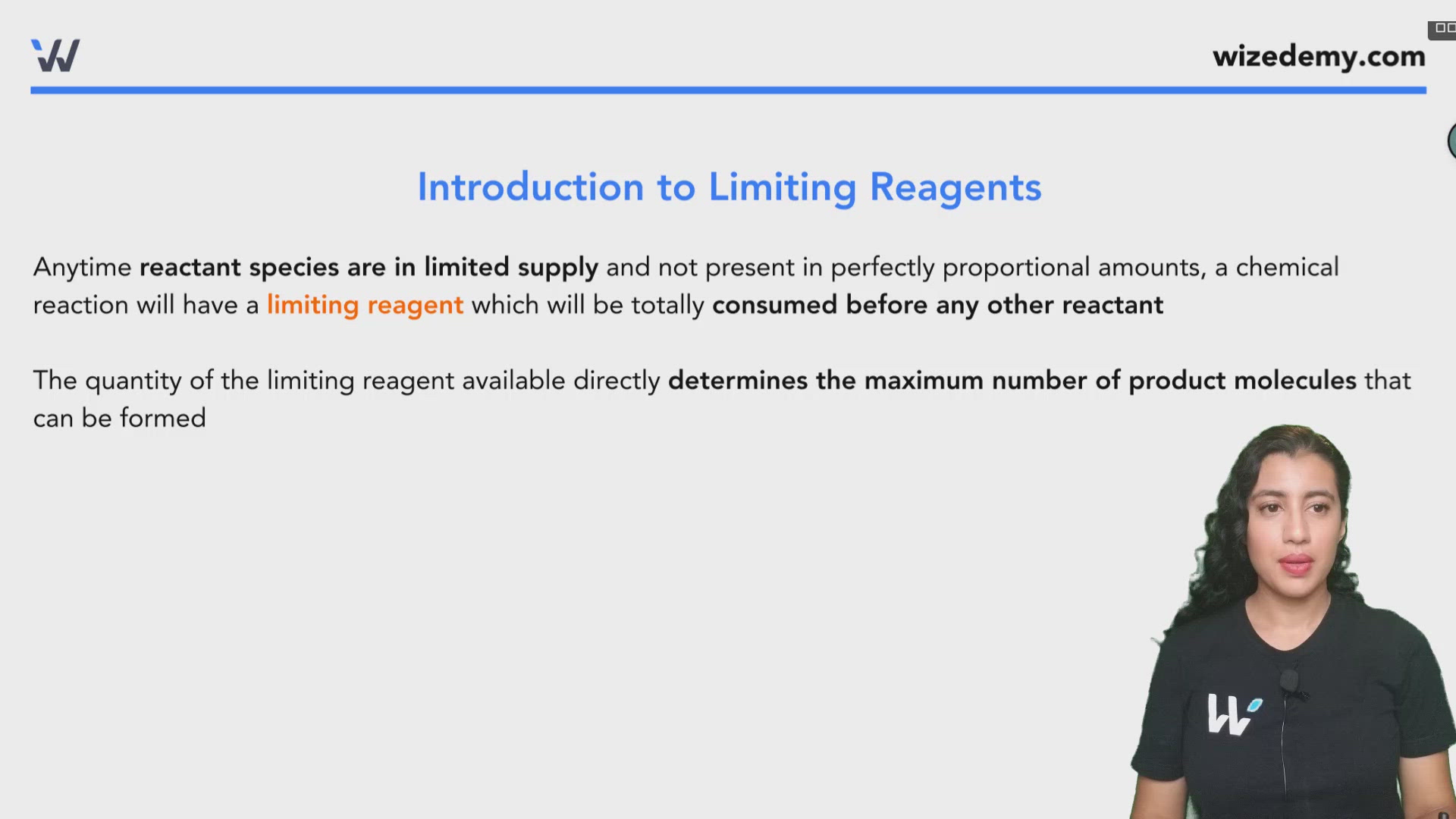
Anytime reactant species are in limited supply and not present in perfectly proportional amounts, a chemical reaction will have a limiting reagent which will be totally consumed before any other reactant
The quantity of the limiting reagent available directly determines the maximum number of product molecules that can be formed!
Let's Consider an Example:
When making smores (yum!!) the "reaction" looks something like:

2 graham crackers + 1 piece of chocolate + 1 marshmellow → 1 smore
If I had 10 graham crackers, 6 pieces of chocolate, and 6 marshmellows, what would be the limiting reagent? In other words, what would I run out of first? And how many smores could I make?
- The "chemistry way" to figure this out would be to take the # of moles of each reactant and divide by its stoichiometric coefficient:
Graham crackers: 10/2=5
Pieces of chocolate: 6/1=6
Marshmellows: 6/1=6
- Now, to figure out the limiting reagent, look at which of the above numbers are the smallest!!
- 5 is smallest, therefore Graham crackers are the limiting reagent!!
Now how many smores could we make?
We know graham crackers will determine how much product we get since we'll run out of the crackers first.
10 x (1/2)= 5 moles of smores created!
Wize Concept
It is necessary to determine the limiting reagent whenever we are given the amounts of two or more reactants in a chemical reaction.
The limiting reagent is totally consumed in the reaction. Any other reactant is in excess.
Limiting reagent stops the reaction by running out first.
The quantity of the limiting reagent available directly determines the maximum number of products molecules that can be formed

0:00 / 0:00
Example: Determine Mass of Product in a Limiting Reagent Problem
Iron and chlorine gas react to form iron (III) trichloride. If 110 g of iron and 105 g of chlorine gas are reacted, which species is the limiting reagent? What is the maximum mass of that can be formed?
2Fe(s) + 3Cl2(g) → 2FeCl3(s)
Wize Tip
Steps for Solving Limiting Reagent Problems:
Step 1 – Write & balance the equation.
Step 2 – Calculate moles of each reactant.
Step 3 – Use the molar ratios of the present reactants (from the balanced equation) to determine the limiting reactant (LR).
- Take the # of moles of each reactant from step 2 and divide by the stoichiometric coefficient for that reactant
- Smallest value from this calculation tells us the LR
Step 4 – From the limiting reactant, use the molar ratio (from the balanced equation) to calculate moles of the desired product.
Step 5 – Convert moles to the desired units (density, molarity, grams, etc…)
2Fe(s) + 3Cl2(g) → 2FeCl3(s)
Step 1 – Write & balance the equation.
Is the equation given balanced?
Yes
Step 2 – Calculate moles of each reactant.
i) Find moles of Fe
n = m/M
n = 110/55.845
n = 1.9697 moles
ii) Find moles of Cl2
n = m/M
n = 105/70.906
n = 1.48083 moles
Step 3 – Use the molar ratios of the present reactants (from the balanced equation) to determine the limiting reactant.
Divide # of moles of Fe by 2: 1.9697/2 =0.98495
Divide # of moles of Cl2 by 3: 1.48083/3=0.49361
Therefore the limiting reagent is
Cl2
! (because it had the smallest number) Step 4 – From the limiting reactant, use the molar ratio (from the balanced equation) to calculated moles of the desired product.
- The maximum mass of FeCl3 that is formed depends on how muchCl2we have (LR).
- Let's use moles of Cl2 to find moles of FeCl3
We found n = 1.48083 for Cl2 --> (1.48083 x 2/3 = 0.98722)
moles of FeCl3 = 0.98722 moles
Step 5 – Convert moles to the desired units (density, molarity, grams, etc…)
m(FeCl3) = ?
M (FeCl3) = 162.2g/mol
n = m/M
m = nM
m = 0.98722 mol x 162.2 g/mol
m = 160.13 g
Therefore, 160g of FeCl3 will be formed from the reaction!
0:00 / 0:00
Example: What is the Limiting Reagent?
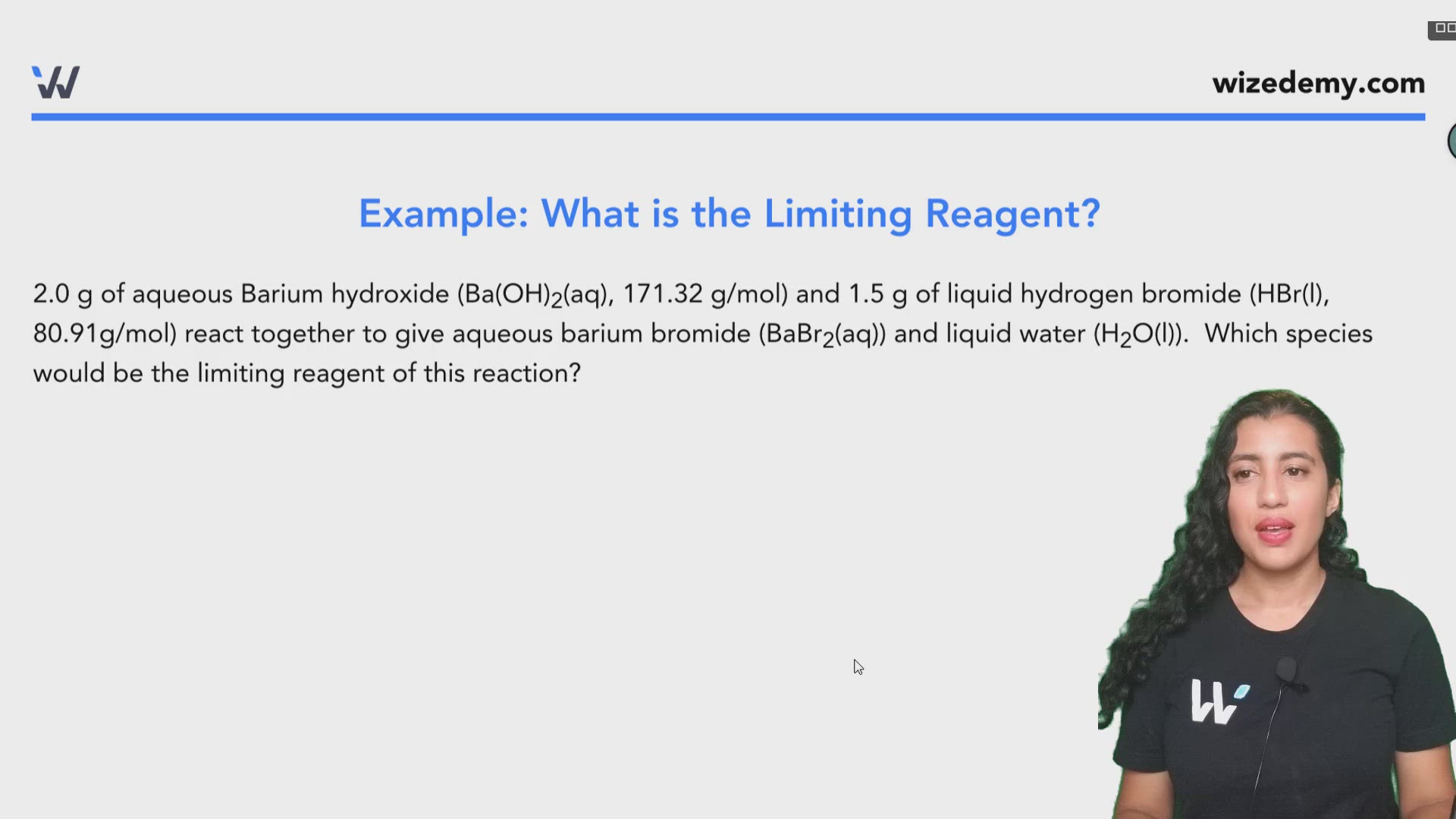
2.0 g of aqueous Barium hydroxide (Ba(OH)2(aq), 171.32 g/mol) and 1.5 g of liquid hydrogen bromide (HBr(l), 80.91g/mol) react together to give aqueous barium bromide (BaBr2(aq)) and liquid water (H2O(l)). Which species would be the limiting reagent of this reaction?
1) Calculate moles of each reactant
i) moles of Ba(OH)2:
n = m/M
n = 2g/171.32g/mol
n = 0.011674 moles
ii) moles of HBr:
n = m/M
n = 1.5g/80.91g/mol
n = 0.01854 moles
2) Now divide the # of moles we just calculated by the stoichiometric coefficients in the balanced equation:
i) Ba(OH)2
0.011674/1 = 0.011674
ii) HBr
0.01854/2 = 0.00927
This shows that HBr is the limiting reagent (we got the smallest number for it)
0:00 / 0:00
Example: How Many Grams of the Excess Reagent Will Remain?
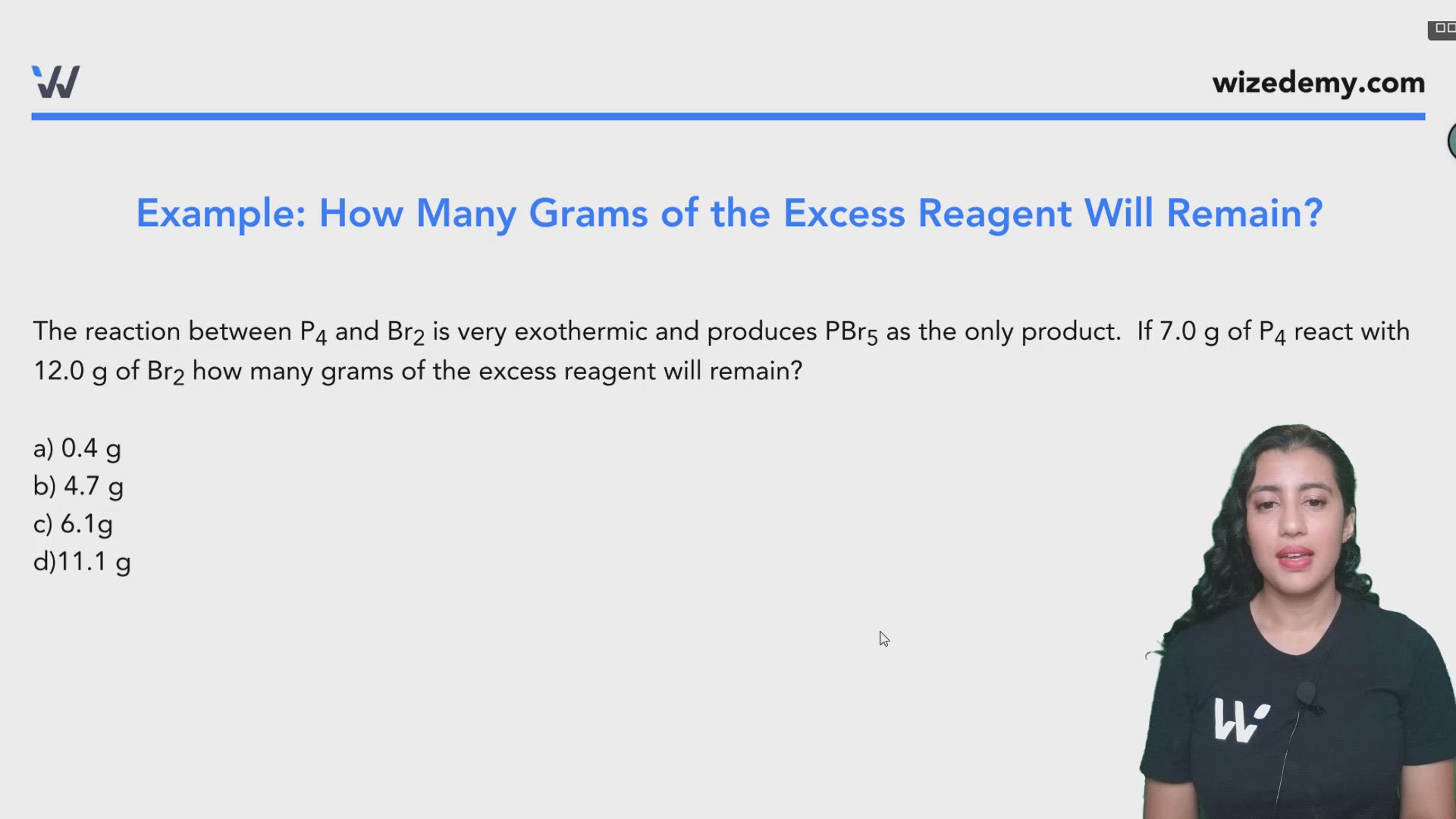
The reaction between P4 and Br2 is very exothermic and produces PBr5 as the only product. If 7.0 g of P4 react with 12.0 g of Br2 how many grams of the excess reagent will remain?
a) 0.4 g
b) 4.7 g
c) 6.1g
d)11.1 g
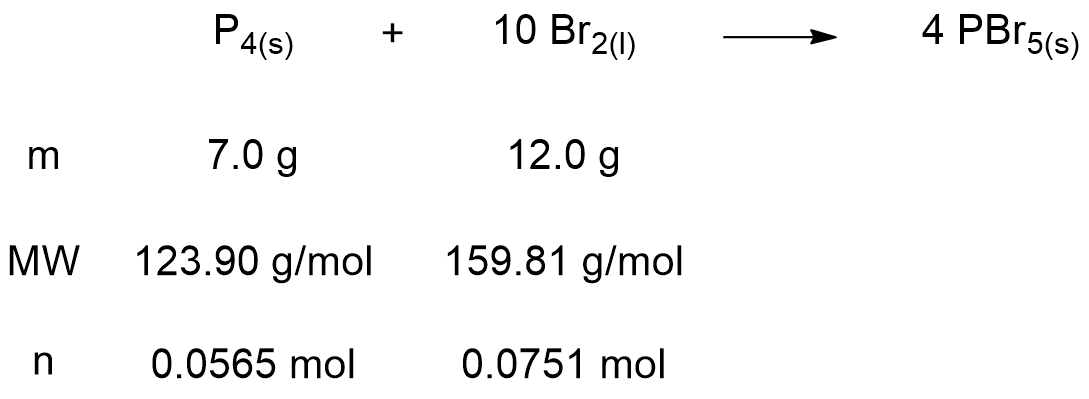
First let's start by writing the reaction out that was described above and balancing it. Don't worry if you didn't include the phases.
Now let's find the moles of each reactant,
To determine the LR, divide the moles by the stoichiometry coefficients:
i) P4:
0.0565/1 = 0.0565
ii) Br2:
0.0751/10 = 0.00751
The smallest number tells us the limiting reagent. The LR is Br2.
The LR (Br2) will be completely consumed.
What amount of P4 will react with Br2?
Now that we calculated the amount of P4 that would completely react with Br2, we can determine the amount of P4 that would be left over.
We can now convert that number of moles to mass and answer the problem,
n=m/M
m=nm
Practice: What is the Limiting Reagent
If 12 g of sodium is mixed with 0.64 g of H2 and 17 g of O2 which reagent will be limiting in the reaction shown below?