Wize University Chemistry Textbook > Stoichiometry
Percent Yield
Popular Courses
MCAT
General Course
CHEM 1301A/B
Western University
CHEM 1302A/B
Western University
General Chemistry
University Study Guides
AP Chemistry Exam Prep Course
AP Exam Prep
CHEM 1A03
McMaster University
CHEM 101
University of Alberta
CHEM 112
Queen's University
DAT
General Course
Chemistry
General Course
CHEM 103
University of Alberta
General Chemistry
University Study Guides
CHEM 120
University of Waterloo
CHEM 205
Concordia University
CHEM 121
Simon Fraser University
CHEM 120
McGill University
APSC 131
Queen's University
CHEM 130
University of British Columbia
CHEM 1100
University of Manitoba
CHEM 1481
Texas A & M University
0:00 / 0:00
Percent Yield
So far we have been assuming that the reaction proceeds 100% to products. In reality, this is rarely the case!
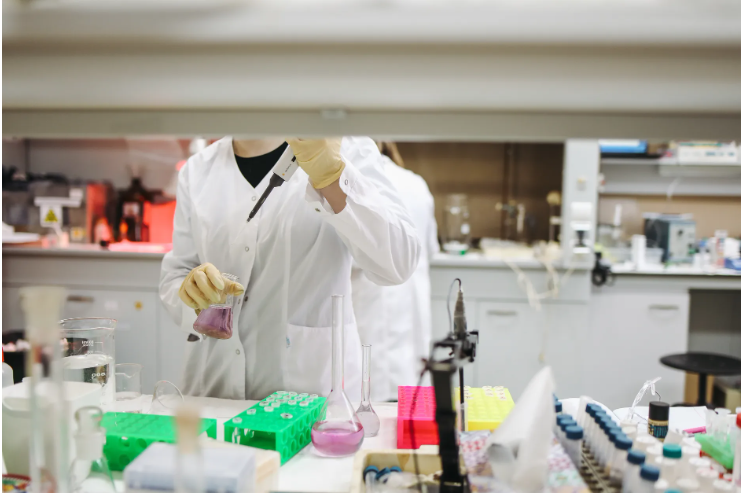
When we are doing experiments in the lab we often lose some of our product by spilling it or residues of it get left on glassware and spatulas.
So far we have been calculating the theoretical yield.
Theoretical Yield - the maximum amount of product produced based on the quantity of the limiting reagent (e.g. the amount of product produced in a calculation).
Actual Yield - the actual amount of product produced in the reaction (e.g. the amount of product obtained in a laboratory experiment).
Test Your Understanding
1) In a lab, you measure your product and record 5.222g. This is the
actual
yield. 2) If everything went 100% perfectly according to the reaction we would get the
theoretical
yield3) If I determined the limiting reagent, and then calculated the number of moles of product and the mass of product based on this, I've just calculated the
theoretical
yield 
0:00 / 0:00
Example: What is the Percent Yield
When 49.00 g of a hydrocarbon fuel with formula is reacted with excess oxygen, a total of 21.56 g of water is collected. What was the percent yield of the reaction?
2
C7H10O2 + 17
O2 → 10
H2O + 14
CO2 actual yield=21.56g water
m = 49 g
MW=126 g/mol
n = m/MW
n = 49 g / 126 g/mol
n = 0.38889 moles
Now we need to convert that into theoretical moles of water:
0.38889 moles divided by 2 multiplied by 10 = 1.945 moles of water
MW(water) = 18 g/mol
Now we need to calculate theoretical mass:
n = m/MW
m = nM
m = 1.945 mol x 18 g/mol
m = 35.01 g of water (theoretical mass)
In the question it states we produced 21.56 g of water (actual mass).
Now we can solve for % yield:
% yield = actual yield/theoretical yield x 100
% yield = 21.56 g / 35.01 g x 100
% yield = 62%
Practice: Calculate Moles Given Percent Yield
If the yield for the following reaction is 45%, how many moles of KClO3 are needed to produce 1 mol of O2?
2KClO3(s) → 2KCl(s) + 3O2(g)
Practice: Limiting Reagent & Percent Yield
Iron oxidizes when exposed to oxygen to form iron oxide according to the following equation:
Fe + O2 → Fe2O3
352g of pure iron is exposed to 12.0 mols of O2, and after a period of time 46.7 g of iron oxide (rust) is collected.
What is the limiting reagent in this reaction?