Wize University Chemistry Textbook > Lewis Structures & Resonance Structures
Resonance Structures
Popular Courses
MCAT
General Course
Grade 12 Chemistry
Ontario High School
Grade 12 Chemistry
Canada High School
CHEM 1301A/B
Western University
CHEM 201
University of Calgary
General Chemistry
University Study Guides
AP Chemistry Exam Prep Course
AP Exam Prep
CHEM 1A03
McMaster University
CHEM 101
University of Alberta
CHEM 112
Queen's University
CHEM 121
University of British Columbia
High School Chemistry
US High School
Chemistry
General Course
DAT
General Course
General Chemistry
University Study Guides
CHEM 103
University of Alberta
CHEM 110
McGill University
CHEM 1E03
McMaster University
CHEM 154
University of British Columbia
CHEM 101
University of Victoria

0:00 / 0:00
Resonance Structures
Resonance structures: are used to describe molecules with delocalized electrons which cannot be described by a single Lewis structure.
Resonance structures follow the same rules as Lewis structures and the same features that make a good Lewis structure also make good resonance structures.
Wize Concept
The atoms will be connected in the exact same way for each resonance structure (no single bonds can change).
The only thing that moves are the multiple bonds and lone pairs!
Wize Tip
How to Draw Resonance Structures:
1. If it is not provided, draw a Lewis structure.
2. Move lone pairs and double bond around to spread out charge.
3. If you move a lone pair into a multiple bond, make sure your new structure doesn’t break the octet rule.
Example: Resonance structures for CO32-
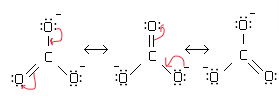
Resonance structures are not discrete molecules which exist individually, but rather the molecule exists as an average of all of its resonance structures.
Resonance hybrid: The "average" of all of a molecule's resonance structures (see below)

Average C-O bond order: 1 1/3
Average Charge on oxygen: -2/3

0:00 / 0:00
Equivalent Vs Non-Equivalent Resonance Structures
If there is more than one relatively good Lewis structure for a molecule, the molecule exhibits resonance.
Equivalent Resonance Structures
All resonance structures are equally stable.
Example:

In reality, the molecular structure will be the average (hybrid) of each resonance form:

Non-Equivalent Resonance Structures
One resonance structure is better than the other.
Wize Tip
The major contributor (aka the more stable resonance structure) is the one where the negative charge resides on the most electronegative atom!
The major contributor will also have the smallest charges (charges more spread out).
You could be asked to identify the most stable resonance structure on an exam.
Example:

Out of these two non-equivalent resonance structures, which is the more stable one? The one on the left or right?
Right
The resonance structure on the right has the negative charge on the N atom, while the resonance structure on the left has the negative charge on the C atom.
Nitrogen is a lot more electronegative than C and so it is a lot more favourable and stable for N to have the negative charge on it!
0:00 / 0:00
Example: Draw the Resonance Structures
Draw all the reasonable resonance structures for SO3F- . Are these equivalent or non-equivalent resonance structures?

These are 3 equivalent resonance structures. You can think of it as each oxygen atom wanted to take a turn to have a single bond :)
0:00 / 0:00
Example: Resonance Structures and Stability
Draw all reasonable resonance structures for the following compounds.
Are they equivalent or non-equivalent resonance structures?
If one resonance structure is more stable than the other(s), indicate which one is most stable.
a) N3–

These are non-equivalent resonance structures (2 have 1 triple bond, 1 single bond, 1 has 2 double bonds)
The resonance structure in the middle is most stable. It has the same net charges as the other two resonance structures (net charge =-1), but it is more stable to spread charge over two centers than localizing it on on one center.
b) PO43–

These are equivalent resonance structures.
All resonance forms are equivalent and equally stable

Mark Yourself Question
- Grab a piece of paper and try this problem yourself.
- When you're done, check the "I have answered this question" box below.
- View the solution and report whether you got it right or wrong.
Practice: Drawing Arrows for Resonance Structures and Stability
There are three resonance structures one can draw where the octet rule is satisfied for all the atoms of the polyatomic ions SCN–. These three resonance structures are shown below.
a) On the Resonance Structures draw curved arrows that show how one could go from Resonance Structure 1 to 2 and Resonance Structure 2 to 3.

b) Which of the structure(s) would you identify to be the best Lewis structure(s)? Explain your reasoning.
Practice: Invoking Resonance Structures
For which of the following molecules do we need to invoke resonance to effectively describing the bonding?