Wize High School Grade 12 Chemistry Textbook > Energy Changes
Ways to Represent Enthalpy Changes

0:00 / 0:00
Different Ways to Represent Enthalpy Changes
1) Equations Can Have Enthalpy Values In Them!
- Ex. H2O(l) + 285.8 kJ --> H2(g) + 1/2O2(g)
- This reaction is (endothermic/exothermic):endothermic
- Ex. Mg(s) + 1/2O2(g) --> MgO(s) + 601.6 kJ
- This reaction is (endothermic/exothermic):exothermic
2) Equations Can Have Enthalpy Values Written Besides Them!
- Ex. CO(g) + 2H2(g) --> CH3OH(l) ΔH=-128.6 kJ
- This reaction is (exothermic/endothermic):exothermic
- Ex. Ba(OH)2·8H2O (s) + 2NH4Cl (s) → BaCl2·2H2O (s) + 2NH3 (aq) + 8H2O (l) ΔH=+222.4 kJ/mol
- This reaction is (exothermic/endothermic):endothermic
3) Molar Enthalpies of Reaction
- Ex. ΔHfusion (this is the energy change associated with melting for one mole of a substance)
- Recall we can use the equation q=nΔHfusion where q will equal the total amount of energy associated with the reaction!
- You can also have the standard molar enthalpy of reaction:
- Ex. ΔHofusion, the o represents that this is a standard value at SATP (P=100kPa, T=25oC).
- It is representing the emergy change associated with 1 mol of a substance at SATP
4) Potential Energy Diagrams
- Is the following potential energy diagram showing a reaction that is endothermic or exothermic?Exothermic

0:00 / 0:00
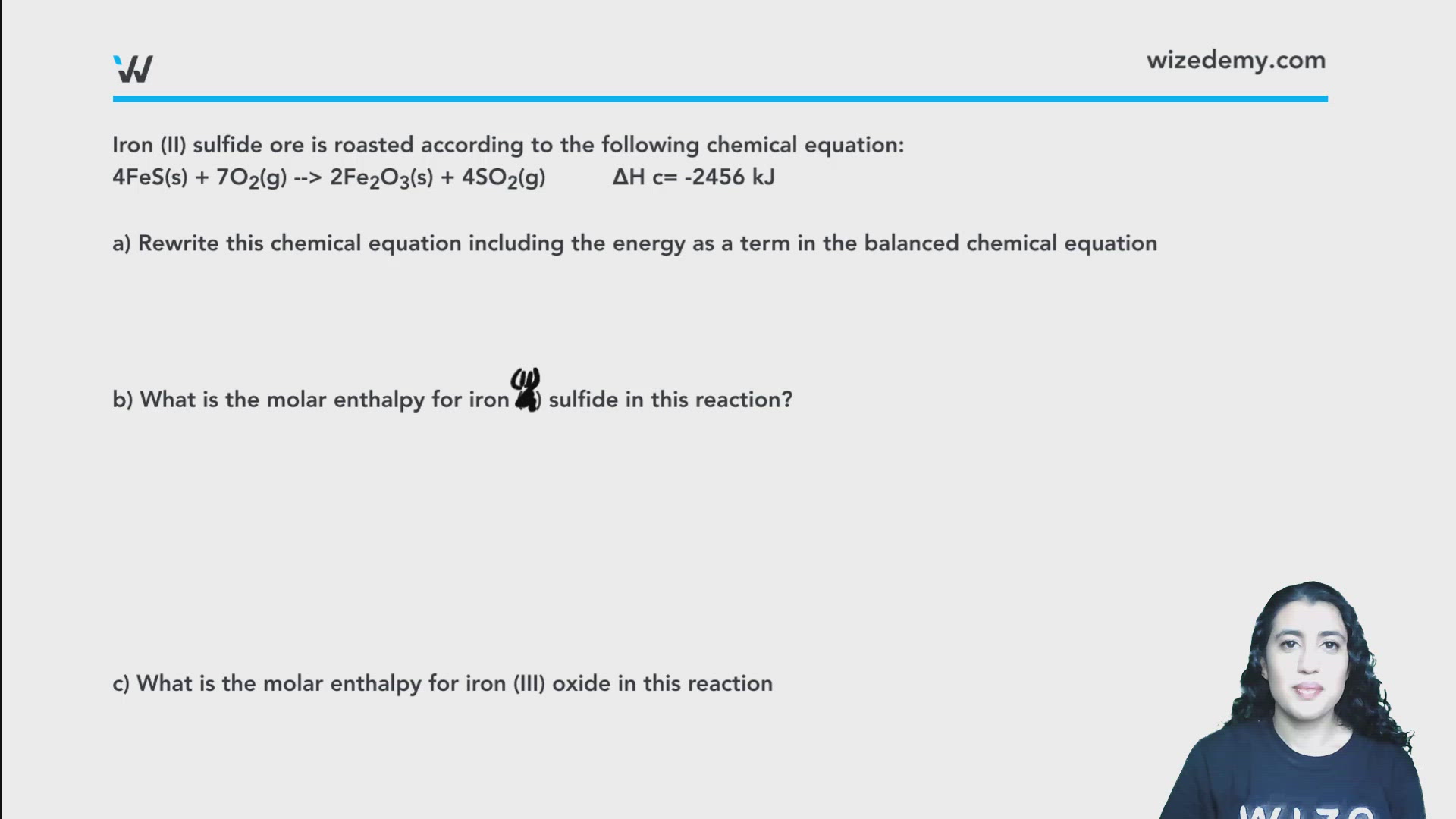
Iron (II) sulfide ore is roasted according to the following chemical equation:
4FeS(s) + 7O2(g) --> 2Fe2O3(s) + 4SO2(g) ΔH c= -2456 kJ
a) Rewrite this chemical equation including the energy as a term in the balanced chemical equation
4FeS(s) + 7O2(g) --> 2Fe2O3(s) + 4SO2 (g) + 2456 kJ
b) What is the molar enthalpy for iron (iI) sulfide in this reaction?
There are 4 moles of FeS in the equation.
- For 4 moles of FeS, 2456kJ of energy is released.
- For 1 mole of FeS, ______ energy is released.
2456kJ/4moles=614 kJ of energy is released (-614 kJ/mol of FeS(s)).
c) What is the molar enthalpy for iron (III) oxide in this reaction
There are 2 moles of Fe2O3(s) in the equation.
- For 2 moles of Fe2O3, 2456 kJ of energy is released.
- For 1 mole of Fe2O3, _______ energy is released.
2456 kJ/2 mole of Fe2O3=1228 kJ of energy is released (-1228 kJ/mol of Fe2O3)