Wize High School Grade 12 Chemistry Textbook > Energy Changes
Ways to Calculate Enthalpy of Reactions

0:00 / 0:00
Hess' Law
We will be looking at 2 ways to calculate ΔHorxn:
1) Hess' Law of Formation Method
2) The Heats of Formation Method (ΔHof)
- If a reaction is carried out in a series of steps, ΔH for the overall reaction can be found from the sum of the enthalpy changes of the individual steps.
- This is because enthalpy (H) is a state function and when it changes, it does not depend on the pathway taken
ΔHrxn = ΔH1 + ΔH2 + ΔH3 + …
Consider the following thermochemical equations:
C (s) + O2 (g) → CO2 (g) ΔH = -393.5 kJ
2 C (s) + O2 (g) → 2 CO (g) ΔH = -221.1 kJ
The ΔH for the reaction: CO (g) + ½ O2 (g) → CO2 (g) is what?
Solution:
Equation 1 can stay the same (we see that it has CO2 on the right side of the equation and in the overall equation we want CO2 to be on the right side. The coefficient of CO2(g) does not need to be changed either).
For equation 2, we see that it has 2CO on the right. The overall equation has 1 CO on the left. This means that we would need to flip equation 2 (multiple deltaH by -1 and multiply equation 2 by 1/2. In total for equation 2 we will multiply it by -1/2.
1) C(s) + O2(g) --> CO2(g) deltaH= -393.5kJ
2) CO(g) --> C(s) +1/2O2(g) deltaH= +110.6kJ
Now for the overall reaction, add 1) and 2):
CO(g) + 1/2O2(g) --> CO2(g) deltaH= -282.9kJ

0:00 / 0:00
Hess' Law
Wize Concept
The 2 things you need to remember for this method are:
1) Whenever we want to look at a reaction in reverse, we must multiply ΔH by -1
2) Whenever we want to multiply a reaction step by a coefficient, we must multiply ΔH of that step by that same coefficient!
What is the ΔHrxn for the following reaction?
2C2H6(g) + 7O2(g) --> 4CO2(g) + 6H2O(g)
1) 2C + 3H2 --> C2H6 ΔH=-84.68kJ
2) C + O2 --> CO2 ΔH=-394kJ
3) H2 + 1/2O2 --> H2O ΔH=-286kJ
The following reaction enthalpies are provided:
Use this data to find the ΔHrxn for the following reaction:
0:00 / 0:00
Heats of Formation
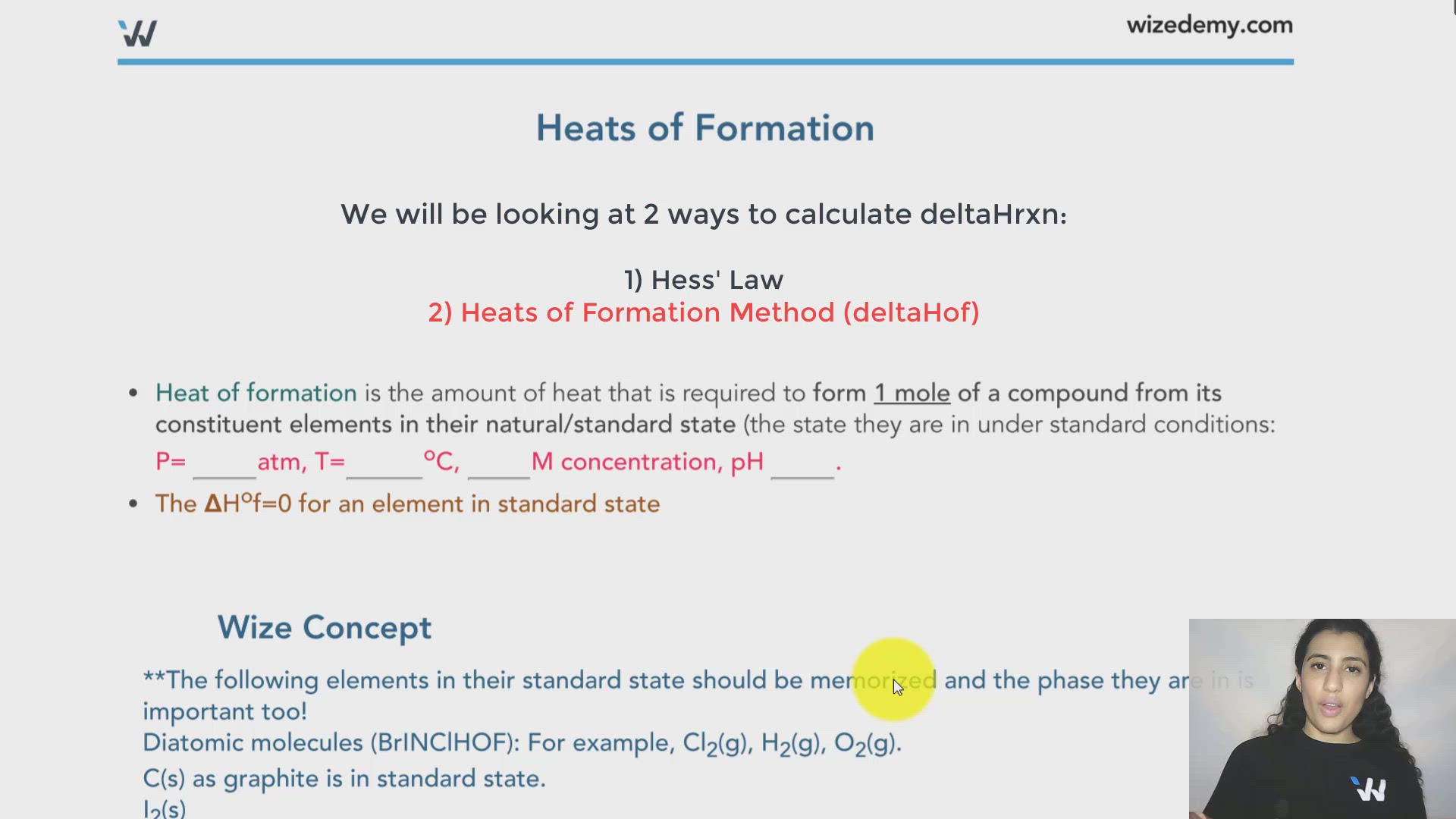
We will be looking at 2 ways to calculate ΔHorxn:
1) Hess' Law of Formation Method
2) The Heats of Formation Method (ΔHof)
- Heat of formation is the amount of heat that is required to form 1 mole of a compound from its constituent elements in their natural/standard state (the state they are in under standard conditions: P=1atm, T=25oC,1M concentration, pH7.
- The ΔHof=0 for an element in standard state
Wize Concept
**The following elements in their standard state should be memorized and the phase they are in is important too!
Diatomic molecules (BrINClHOF)
- For example, Cl2(g), H2(g), O2(g).
C(s) as graphite is in standard state.
I2(s)
Br2(l)
Hg(l)
Watch Out!
If you are shown O(g) on your exam, this is NOT oxygen in its standard state. Remember oxygen in its standard state has to be gaseous AND diatomic! So: O2(g) would be in standard state.
Example: The formation reaction for C4H10O(l) would be:
- In fact, if you know the enthalpy of formation for each reactant and product in any chemical equation, you can find the enthalpy change for that reaction with the following formula:
- This equation says to add up the enthalpies of formation for each product, multiplied by the stoichiometric coefficient of that product, and subtract it from the sum of the enthalpies of formations of the reactants multiplied by their coefficients.
- In other words, Δ= Final - Initial
Example:
2NO(g) + O2(g) eqm 2NO2(g) Calculate ΔHorxn.
ΔHof(NO(g))=90.75kJ/mol
ΔHof(NO2(g))=33.18kJ/mol
ΔHof(O2(g))=
0
ΔHorxn=[(2x33)-(2x90 + 0)]
ΔHorxn=[(66-180)]
ΔHorxn= -114 kJ

0:00 / 0:00
Write a reaction for the heat of formation for dimethylaminopyridine, (CH3)2NC5H4N.
Recall: C in its standard state is in the form of C(s) or C(graphite)
Note: In a formation reaction only want to form one mole of the substance!
0:00 / 0:00
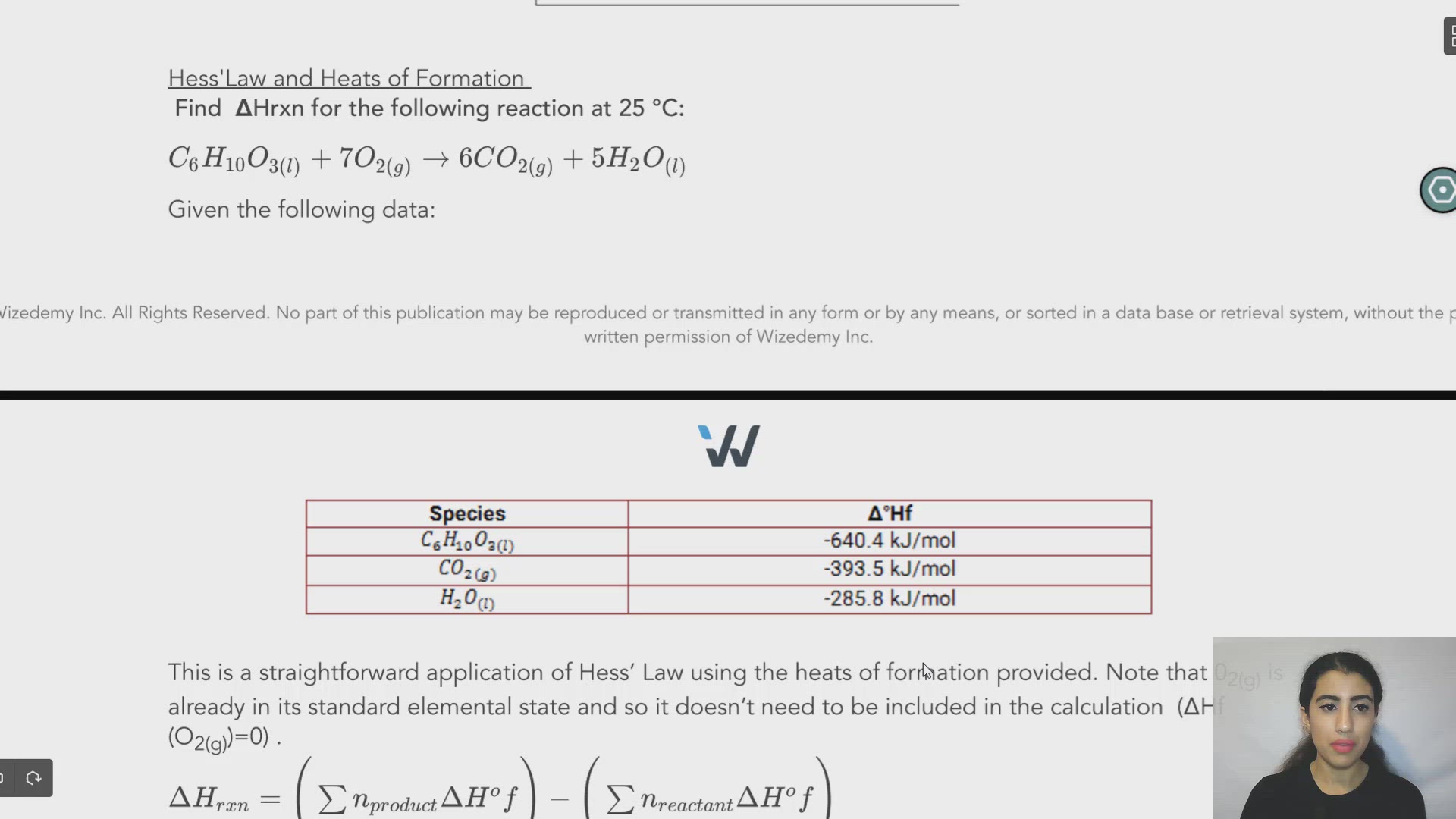
Find ΔHrxn for the following reaction at 25 °C:
Given the following data:

Note that O2(g) is already in its standard elemental state and so it doesn’t need to be included in the calculation (ΔHof (O2(g))=0) .
Therefore, ΔHrxn is -3150 kJ/mol. Since this is a combustion reaction, we expect a negative ΔH value, in agreement with calculations.
Calculate the ΔH°f value of benzene (C6H6) from the following information:
2 C6H6(l) + 15 O2(g) → 12 CO2(g) + 6 H2O(l) ΔH° = −6535 kJ/mol
CO2(g) ΔH°f = −393.5 kJ/mol
H2O(g) ΔH°f = −241.8 kJ/mol
H2O(l) ΔH°f = −285.8 kJ/mol
0:00 / 0:00
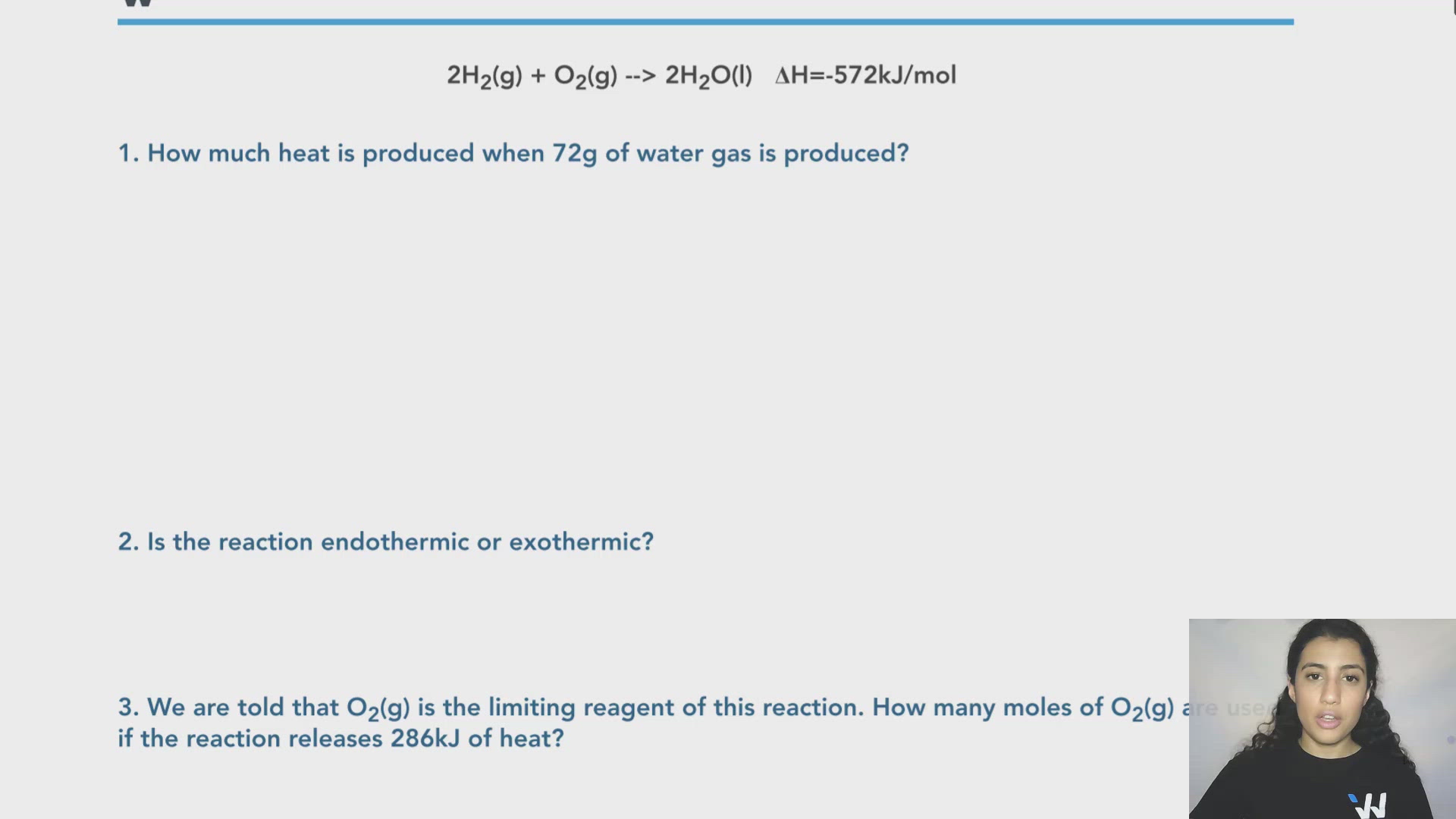
2H2(g) + O2(g) --> 2H2O(l) ΔH=-572kJ/mol
1. How much heat is produced when 72g of water gas is produced?
Currently we see that when 2 mol of H2O(l) are produced we have 572kJ/mol of heat produced.
We need to find out how many moles of water we have when we have 72g of water:
n=? m=72g, M=18g/mol
n=4 moles
Now that we have 4 moles of H2O(l) produced (double the amount shown in the equation), that means that the heat produced would also be doubled.)
Therefore, 1040kJ of heat would be released (q=-1040kJ) when 4 moles of water is produced.
2. Is the reaction endothermic or exothermic?
Since ΔH is negative, it means heat is being released and the reaction is therefore exothermic (heat is EXiting!)
3. We are told that O2(g) is the limiting reagent of this reaction. How many moles of O2(g) are used if the reaction releases 286kJ of heat?
- 286/572=1/2
- Since we now have half the amount of heat released, it means that we would start with half the amount of moles of O2 that we have in the reaction
- The reaction has 1 mol of O2 leading to 572kJ of heat being released
- So 1/2 a mole of O2 would lead to 286kJ of heat being released
Given this reaction, answer the following questions:
C3H8(g) + 5O2(g) --> 3CO2(g) + 4H2O(l)

What is the ΔHo for the reaction? (Ans in kJ and round to the nearest whole number)