Popular Courses
MCAT
General Course
Grade 12 Chemistry
Ontario High School
Grade 12 Chemistry
Canada High School
CHEM 1302A/B
Western University
General Chemistry
University Study Guides
AP Chemistry Exam Prep Course
AP Exam Prep
CHEM 1A03
McMaster University
CHEM 1A03
McMaster University
CHEM 101
University of Alberta
CHEM 112
Queen's University
High School Chemistry
US High School
DAT
General Course
Chemistry
General Course
CHEM 103
University of Alberta
General Chemistry
University Study Guides
CHM135H1
University of Toronto
CHEM*1050
University of Guelph
CHY 102
Toronto Metropolitan University
CHEM 121
Simon Fraser University
CHEM 120
McGill University
0:00 / 0:00
Introduction to the Heat Curve
Before we take a look at what a heat curve is, we must first understand what can happen when heat is added to a system.
Wize Concept
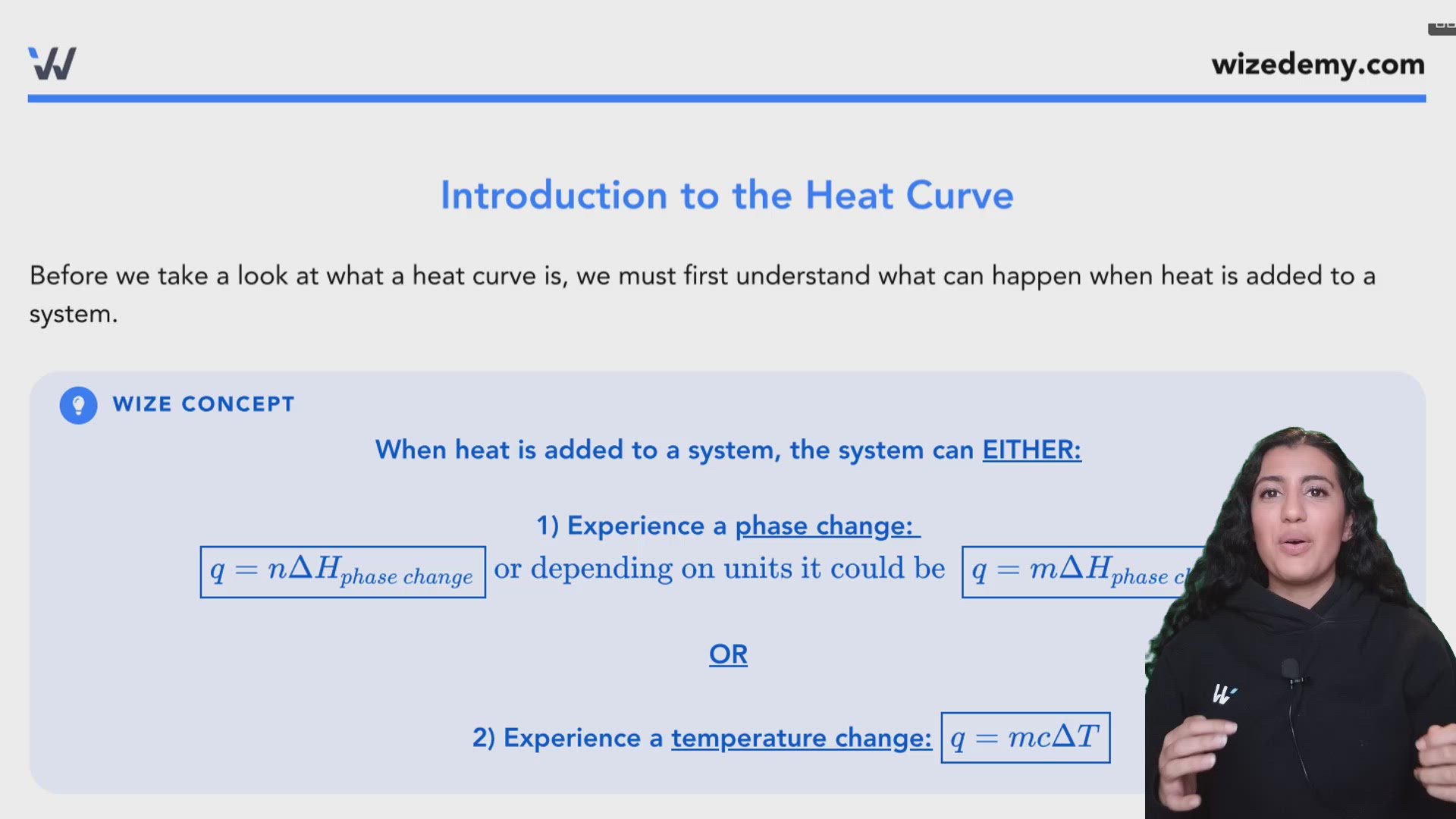
When heat is added to a system, the system can EITHER:
1) Experience a phase change:
OR
2) Experience a temperature change:
More Information on Each of These Important Equations
q is heat
n is moles
ΔHphase change is the enthalpy value that describes the heat of transition (energy required to complete a transition)
Example: the heat of vapourization (ΔHvap) is describing the amount of energy that is required to convert a liquid → gas (vapourization).
q is heat
m is mass (g)
c is the specific heat capacity (J/goC or J/goK)
ΔT is the change in temperature ΔT=Tf-Ti (oC or oK)
Wize Tip
For H2O(l), c=4.18J/goC. This means that it takes 4.2 J of heat energy to heat up 1 g of liquid water by 1oC!
Note: Each phase will have a different "c" value!
Example: We will see that water in liquid form and solid ice form have different c values!
- H2O(l), c=4.18 J/goC
- H2O(s), c=2.06 J/goC
Heat curve for H2O
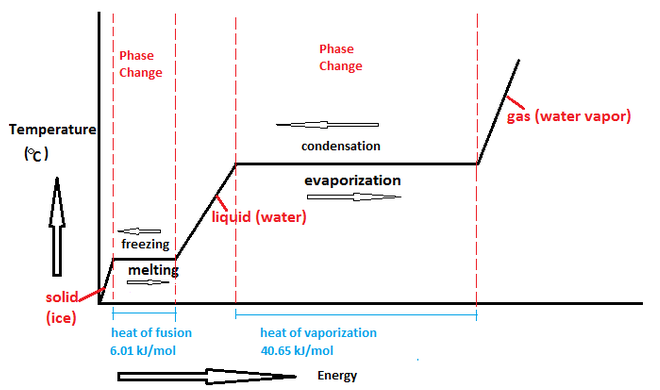
- Label the melting and boiling points of water on the y axis.
- Label what is happening on the horizontal lines as we move to the right.
- Label the appropriate equation for each column in the diagram (q=mcΔT or q=nΔH).
- What c values and ΔH values would you use in each column?
- What is the slope of horizontal sections?0
- Are the phase changes occuring at the parts of the graph that have a slope of 0 or a positive slope?0
Summary
Wize Concept
The horizontal regions on the graph show when a phase change is occurring. We know this because there is no ΔT at these horizontal lines.
We said we can either have a phase change OR a temperature change.
During a phase change, all the heat is being used to overcome the intermolecular forces to make the phase change possible!
Once a phase change has occurred, then the heat increases the temperature (this is where we see the positive slopes)!

0:00 / 0:00

- ΔHvap because there are more intermolecular forces that need to be broken to go from liquid to gas than there are from solid to liquid.
- This is because gases have no intermolecular forces (or almost none) so to go from a liquid to a gas, it requires more energy since all the intermolecular forces need to be broken.
- This will always be the case!
- The longer the horizontal line in the heat curve, the more/less:morethe value of the ΔH for that phase change!
- qvap will also be greater than qfusion
Based on the given values of ΔHfusion and ΔHvapourization in the diagram above, what do you think the ΔHcrystallization and ΔHcondensation would be?
Same magnitude but opposite sign so for crystallization it would be -6 kJ and for condensation it would be -40 kJ
Melting/Boiling Points
The melting point is the temperature where (
s
) ⇌ (l
) phase The boiling point is the temperature where (
l
) ⇌ (g
) phase Both these points (melting and boiling) occur at a pressure of 1atm. We'll see how this will come in handy for us to know soon!
0:00 / 0:00
Example: Heat Curve
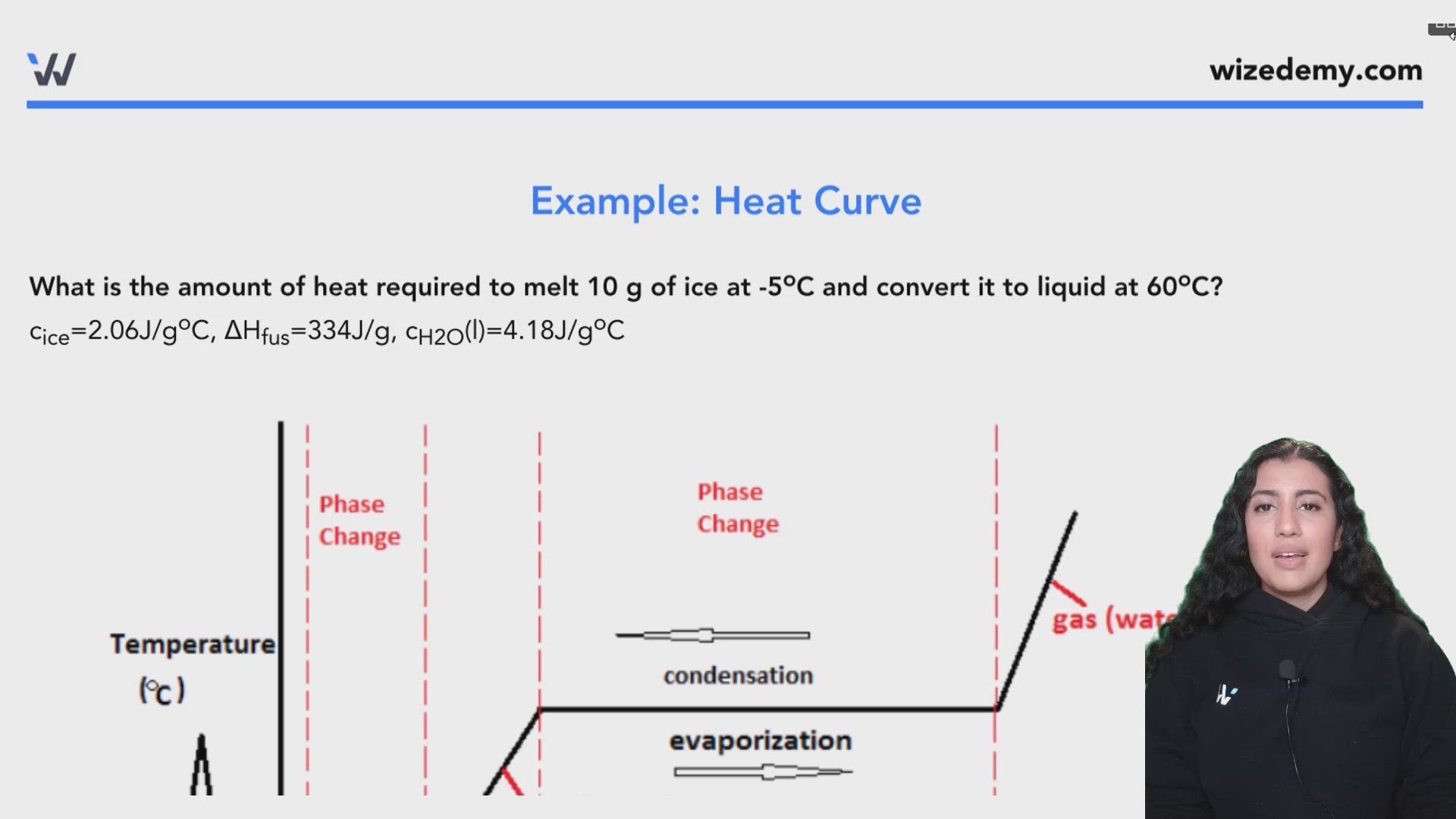
What is the amount of heat required to melt 10 g of ice at –5°C and convert it to liquid at 60°C?
cice = 2.06 J/g°C, ΔHfus = 334 J/g, cH2O(l) = 4.18 J/g°C

Hint: For a problem like this we need to think of what we are doing (increasing temperature or changing phase) and when
- We start with ice at –5°C. The ice will need to be heated until it reaches 0°C
- At 0°C we then change ice's phase into liquid by melting it
- Once we melt the ice into a liquid, we then heat the liquid from 0°C to 60°C
Now that we have thought of the different steps, let's write out an equation that describes each step:
qT = mciceΔT + nΔHfusion + mcwaterΔT
= (10 g)(2.06 J/goC)(5oC) + (10 g)(334 J/g) + (10 g)(4.18 J/goC)(60oC)
= 5951 J
If we wanted to answer in kJ, what would be our answer (if our answer only has 2 significant digits):
= 5.951 kJ
= 6.0 kJ
Watch Out!
Pay attention to the units for these problems and convert units if necessary.
Practice: Solve for Heat
If water's heat of fusion (ΔHfus) is 6 kJ/mol, how much heat would be required to melt 5 moles of water?
Practice: Heat Curve
Consider the heat curve below and the following statements:

1 The segment A-B corresponds to the heating of a solid.
2. The segment D-E corresponds to the vaporization of a liquid.
3. The segment E-F corresponds to the heating of a liquid
4. The segment B-C corresponds to a phase change.