Wize High School Grade 12 Chemistry Textbook > Energy Changes
Introduction to Enthalpy (Heat Content of a System)

0:00 / 0:00
Enthalpy of Reaction (ΔHorxn)
Enthalpy (H): is a measure of the energy associated with breaking or forming bonds
- Breaking bonds (requires/releases)requiresenergy
- Therefore, this is (endothermic/exothermic)endothermic
- *Think: you need to be strong to break bonds!
- Forming bonds (requires/releases)releasesenergy
- Therefore, this is (endothermic/exothermic)exothermic
- *Think: bonds want to form if they are stable and lower in energy!
Wize Concept
In summary: breaking bonds requires energy & forming bonds releases energy!
We will soon look at the different ways to calculate ΔHorxn:
The Heats of Formation Method (ΔHof)
Average Bond Enthalpy Method (BDE)
Hess' Law of Formation Method
0:00 / 0:00
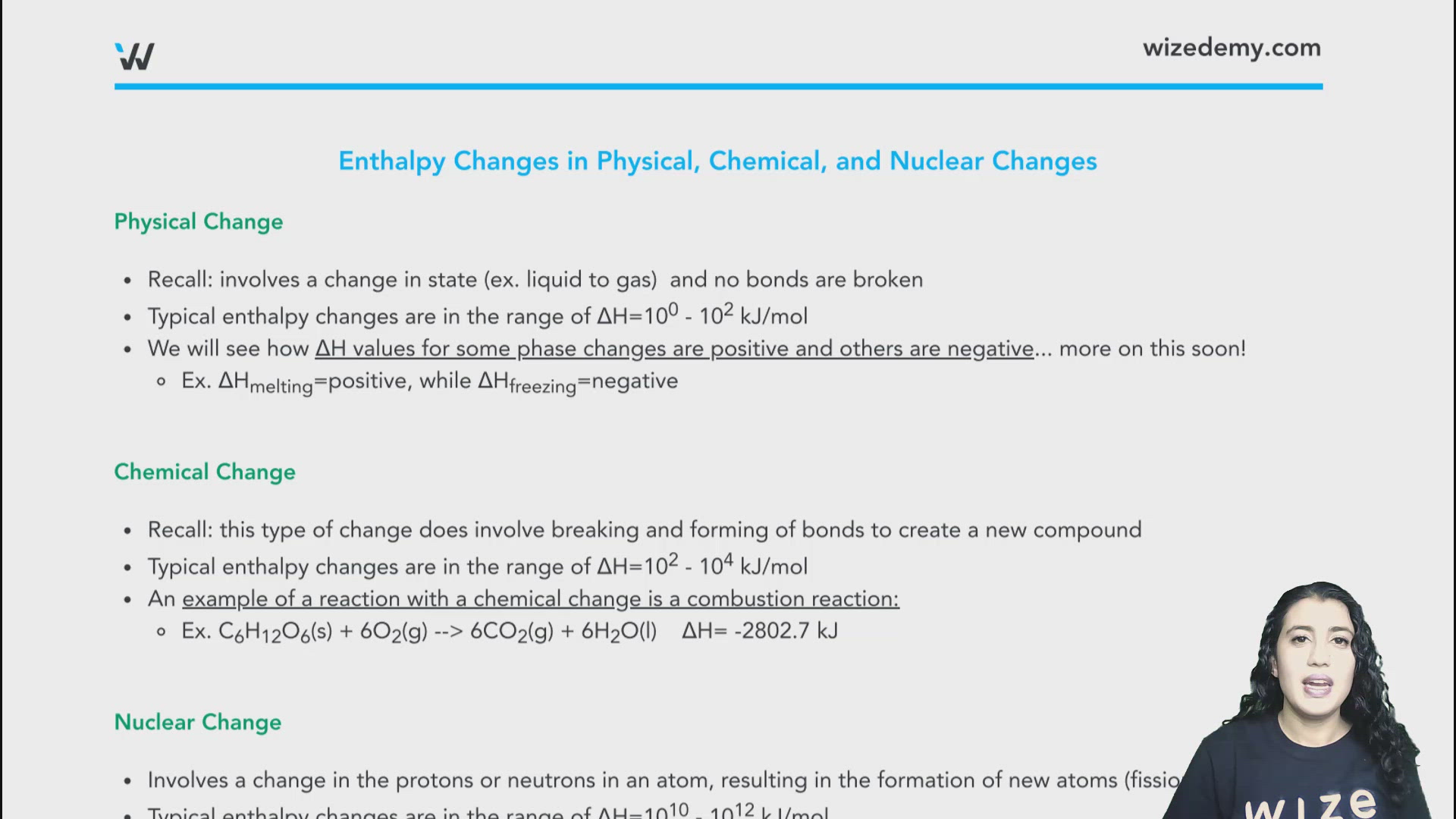
Enthalpy Changes in Physical, Chemical, and Nuclear Changes
Physical Change
- Recall: involves a change in state (ex. liquid to gas) and no bonds are broken
- Typical enthalpy changes are in the range of ΔH=100 - 102 kJ/mol
- We will see how ΔH values for some phase changes are positive and others are negative... more on this soon!
- Ex. ΔHmelting=positive, while ΔHfreezing=negative
Chemical Change
- Recall: this type of change does involve breaking and forming of bonds to create a new compound
- Typical enthalpy changes are in the range of ΔH=102 - 104 kJ/mol
- An example of a reaction with a chemical change is a combustion reaction:
- Ex. C6H12O6(s) + 6O2(g) --> 6CO2(g) + 6H2O(l) ΔH= -2802.7 kJ
Nuclear Change
- Involves a change in the protons or neutrons in an atom, resulting in the formation of new atoms (fission)
- Typical enthalpy changes are in the range of ΔH=1010 - 1012 kJ/mol
Wize Tip
Don't memorize the typical enthalpy change ranges above. Instead, know the relative differences between the different types of changes (i.e. know that physical changes typically involve the smallest amount of energy, chemical changes are in the middle, and nuclear changes involve the highest amount of energy!)
0:00 / 0:00
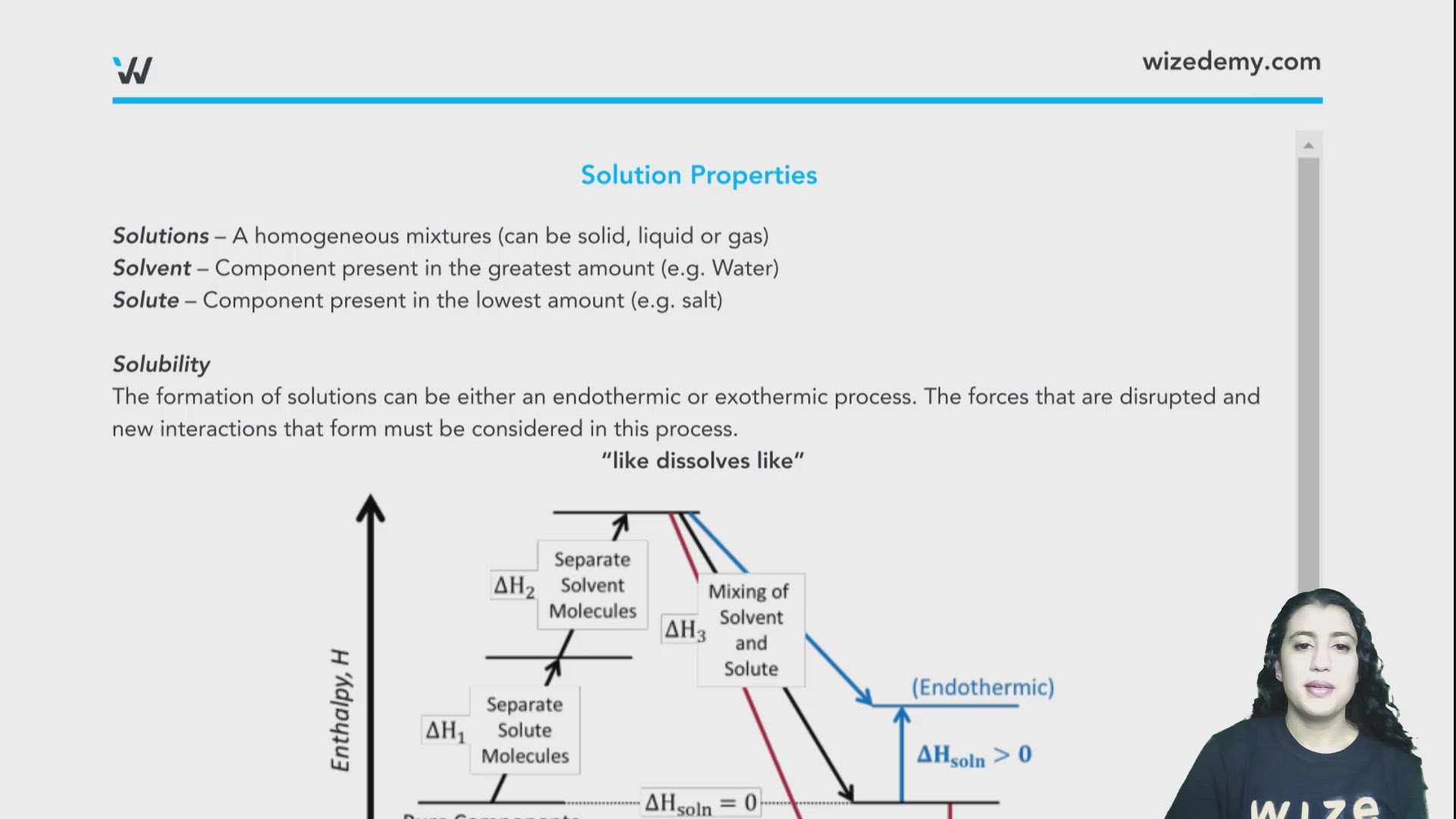
Solution Properties
Solutions – A homogeneous mixtures (can be solid, liquid or gas)
Solvent – Component present in the greatest amount (e.g. Water)
Solute – Component present in the lowest amount (e.g. salt)
Solubility
The formation of solutions can be either an endothermic or exothermic process. The forces that are disrupted and new interactions that form must be considered in this process.
“like dissolves like”
