
0:00 / 0:00
Heat Capacity and Calorimetry
- The relationship between heat entering or leaving a system and the resulting change in temperature is the heat capacity, C
- This can be presented as C (heat capacity, units of J/K, describes the amout of heat needed to heat the substance/object by one degree) or c (specific heat capacity, units of J/gK or J/goC , amount of heat required to heat up 1 g of a substance by one degree).
- Note that C=mc
Wize Tip
You should memorize water's specific heat value: c=4.18J/goC.
This means that you would need to add 4.18J of energy in order to heat 1 g of water up by 1oC.
- Calorimeters come in two general varieties: simple "coffee cup" calorimeters and bomb calorimeters
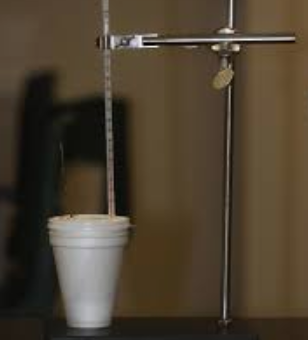

- What is a calorimeter?
- A calorimeter is just a container that is insulated. It holds a liquid that is usually water inside of it and you can have reactions happening inside of it as well.
- A thermometer will be able to read the temperature changes of the water.
- If the thermometer measures an increase in temperature, that means the water went up in temperature.
- For a calorimeter, the water is the surroundings and the reaction is the system.
- Therefore, if the water went up in temperature then that means it gained all of the heat from the system (or the reaction taking place inside the calorimeter). It didn't gain the heat from anywhere else because the calorimeter is insulated!
- This means the system/reaction lost heat and is endothermic/exothermic:exothermic.
- qwater=-qrxn where q=mcΔT
Wize Concept
For exothermic reactions, q < 0 (heat is being released by the system)
For endothermic reactions, q > 0 (heat is being gained by the system)
Coffee cup calorimeters
- Essentially an open styrofoam cup with a thermometer, and are most frequently used to measure the temperature change of an aqueous reaction under constantpressureconditions
In general:
qsystem(sample) = -qsurroundings(H2O)
using q=mcΔT
(mass of sample)(c of sample)(ΔT of sample) = -(mass of H2O)(c of H2O)(ΔT of water)
Bomb calorimeters
- Typically consist of a sealed reaction vessel loaded with a combustible material and filled with oxygen placed in a surrounding water bath. A combustion reaction is performed under constantvolumeconditions and the resulting change in temperature of the water bath is measured
In general:
qrxn = -qcalorimater
(mass of sample)(c of sample)(ΔT of sample) = -(C of calorimeter)(ΔT of calorimeter)
(using q=CΔT!)
Which kind of a substance needs more energy to undergo an increase in temperature of 5oC, something with a high or low specific heat?
0:00 / 0:00
How many joules are needed to increase the temperature of 15.0g of Fe from 20.0oC to 40.0oC?
(cFe=0.4998 J/goC)
First, it is always helpful to write out the variables that we have:
m=15g
T1=20oC
T2=40oC
cFe=0.4998 J/goC
q=? (Ans in joules!)
Now plug in the variables into the equation and solve!
Can solve for ΔT first: ΔT=T2-T1=40 - 20= 20oC
q=(15g)(0.4998 J/goC)(20oC)
q=149.94 J
q=150J
If 500 mL of olive oil, initially at 25oC, received 1.25 kJ of energy, what is its final temperature?
(colive oil= 2.0J/goC, density=0.91 g/mL)
A 5.00 g mass of metal was heated to 100.0 oC and then placed into 100.0 g of water at 24oC. The temperature of the resulting mixture became 28oC.
How many joules did the water absorb?

0:00 / 0:00
Example: Calorimetry
A block of lead cube () is heated to . The cube is then submerged into a Styrofoam cup containing of water at room temperature (). After the water and the lead cube come to thermal equilibrium, what is the final temperature of the water?
Wow! Water is a pretty good insulator