Wize University Chemistry Textbook > Buffers and Titrations
Titration Curves
Popular Courses
MCAT
General Course
Grade 12 Chemistry
Ontario High School
Grade 12 Chemistry
Canada High School
CHEM 1302A/B
Western University
General Chemistry
University Study Guides
AP Chemistry Exam Prep Course
AP Exam Prep
CHEM*1040
University of Guelph
CHEM 203
University of Calgary
High School Chemistry
US High School
CHEM 1AA3
McMaster University
Chemistry
General Course
DAT
General Course
General Chemistry
University Study Guides
Chemistry 12
British Columbia High School
CHM135H1
University of Toronto
CHEM 102
University of Alberta
APSC 132
Queen's University
CHEM 112B
Queen's University
CHEM 123
University of Waterloo
CHEM 130
University of British Columbia
0:00 / 0:00
Introduction to Titrations
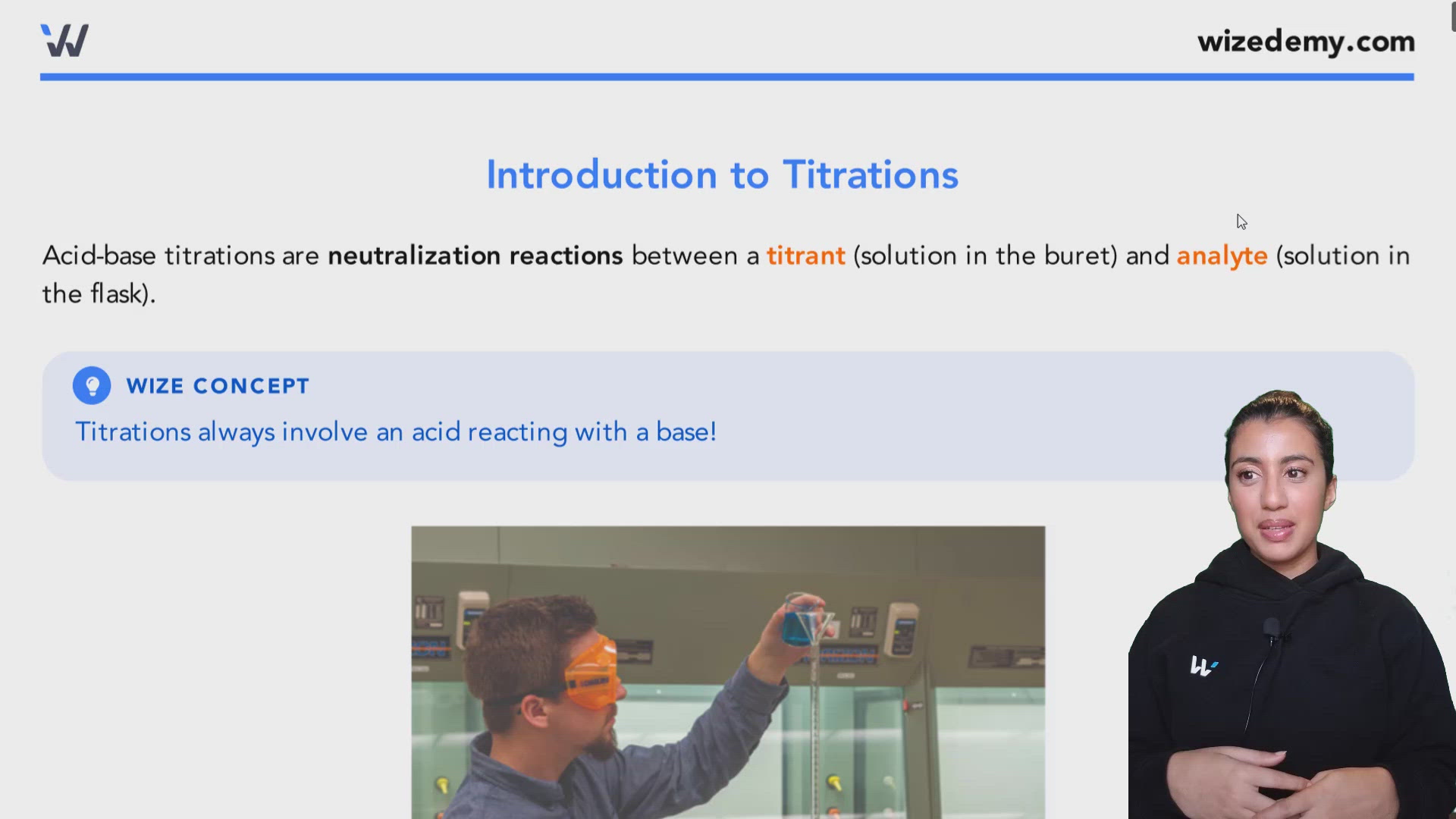
Acid-base titrations are neutralization reactions between a titrant (solution in the buret) and analyte (solution in the flask).
Wize Concept
Titrations always involve an acid reacting with a base!
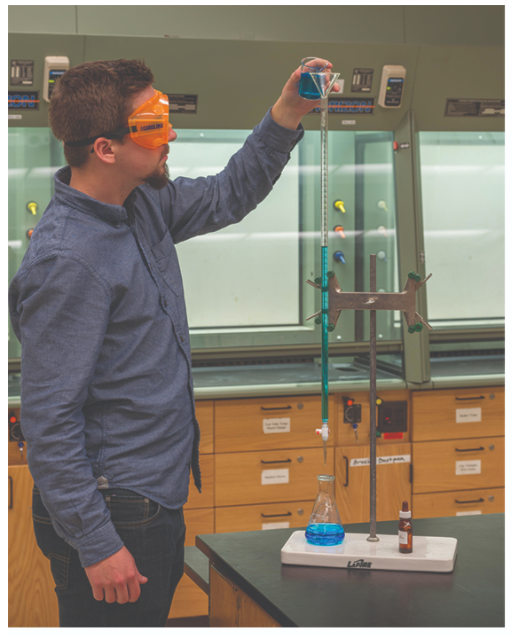
Titrant
- Solution in the buret
- We control the amount we add of the titrant to the flask
- We know its volume, concentration, and identity Example: 1M 100mL NaOH
- It is usually a strong acid or base
Analyte
- Solution in the flask
- It is the unknown (we don't know its concentration, identity, or if it is weak or strong)
- We do know it's volume (can easily measure its volume in the flask) and its pH (we can simply use a pH meter to measure this in the flask)
- The other way to know if there's a pH change in the flask is if we see a visual change in color
- Indicators help to indicate this pH change by changing the color inside the flask
- When the color changes, we call this an end-point.
Wize Concept
We do titrations (where we add small amounts of titrant to the analyte) to determine the unknown concentration of an acid or a base!
0:00 / 0:00
Labeling a Titration Curve
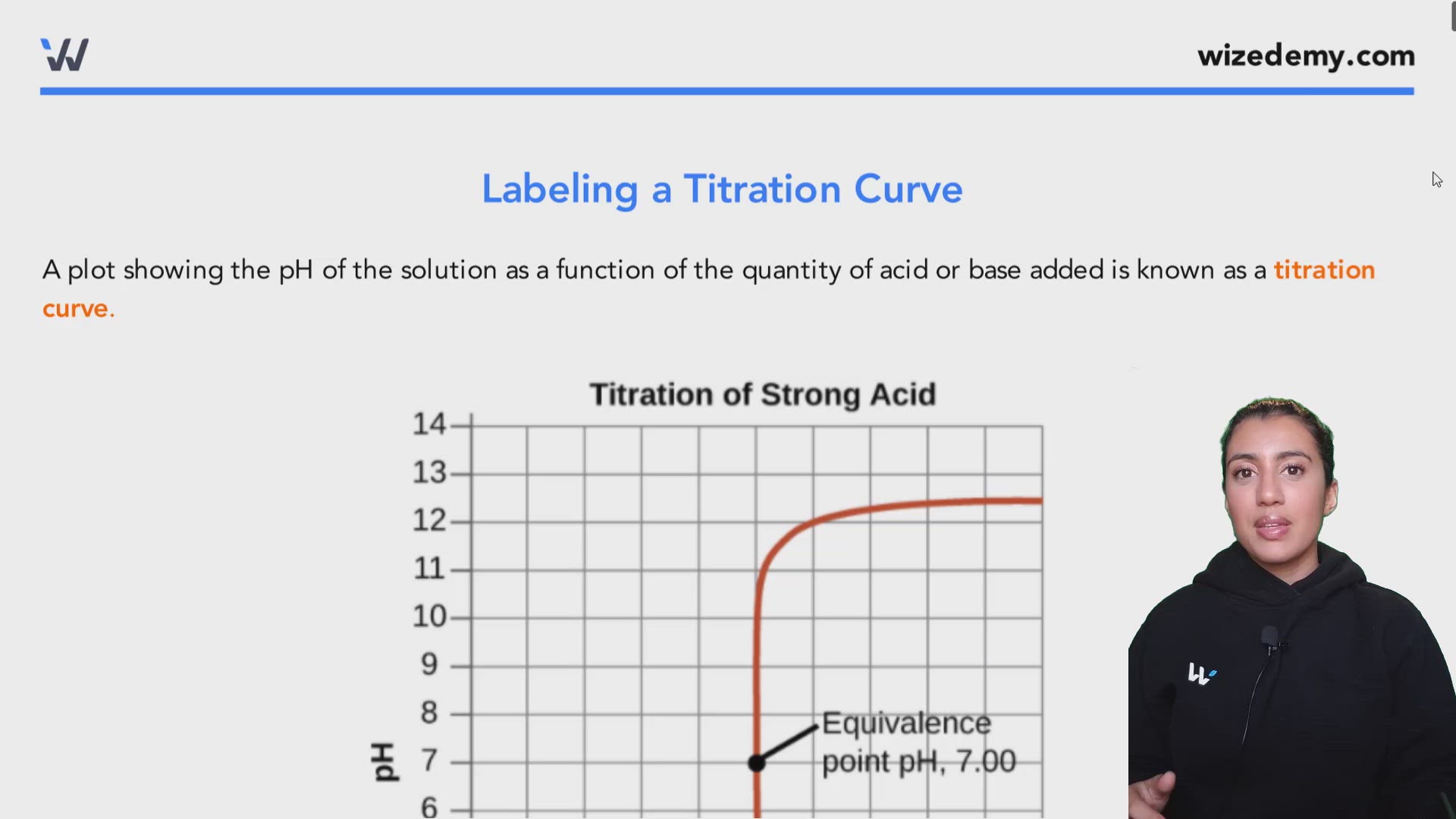
A plot showing the pH of the solution as a function of the quantity of acid or base added is known as a titration curve.

The titrant (substance in the buret that is being added to the analyte in the flask slowly overtime) is:
NaOH
What is the volume for the equivalence point?
25mL
What is the volume for the half equivalence point?
12.5mL
Wize Concept
@ Half-Equivalence Point: [HA] = [A-] and moles of acid=moles of conjugate base
- Exactly half of the initial amount of weak species has been reacted by the addition of a strong base or acid
- Remember according to the Henderson Hassalbalch equation:
- When the [HA]=[A-] how are pH and pKa related?
- log1=0 so pH=pKa of analyte
@ Equivalence Point: [HA] = [OH-] added and moles of acid=moles of base
- Enough titrant has been added to completely neutralize ALL of the unknown
- In other words, the acid and base have completely reacted together so there is no more acid or base left.
Finally, the pH @ Equivalence Point (pH=7, pH <7, or pH>7) is determined by the acidity/basicity of the salt produced
- Strong acid and strong base → pH @ equivalence point will be neutral (=7)
- Strong acid and weak base → pH @ equivalence point will be acidic (<7)
- Weak acid and strong base → pH @ equivalence point will be basic (>7)
0:00 / 0:00
Titration Curves
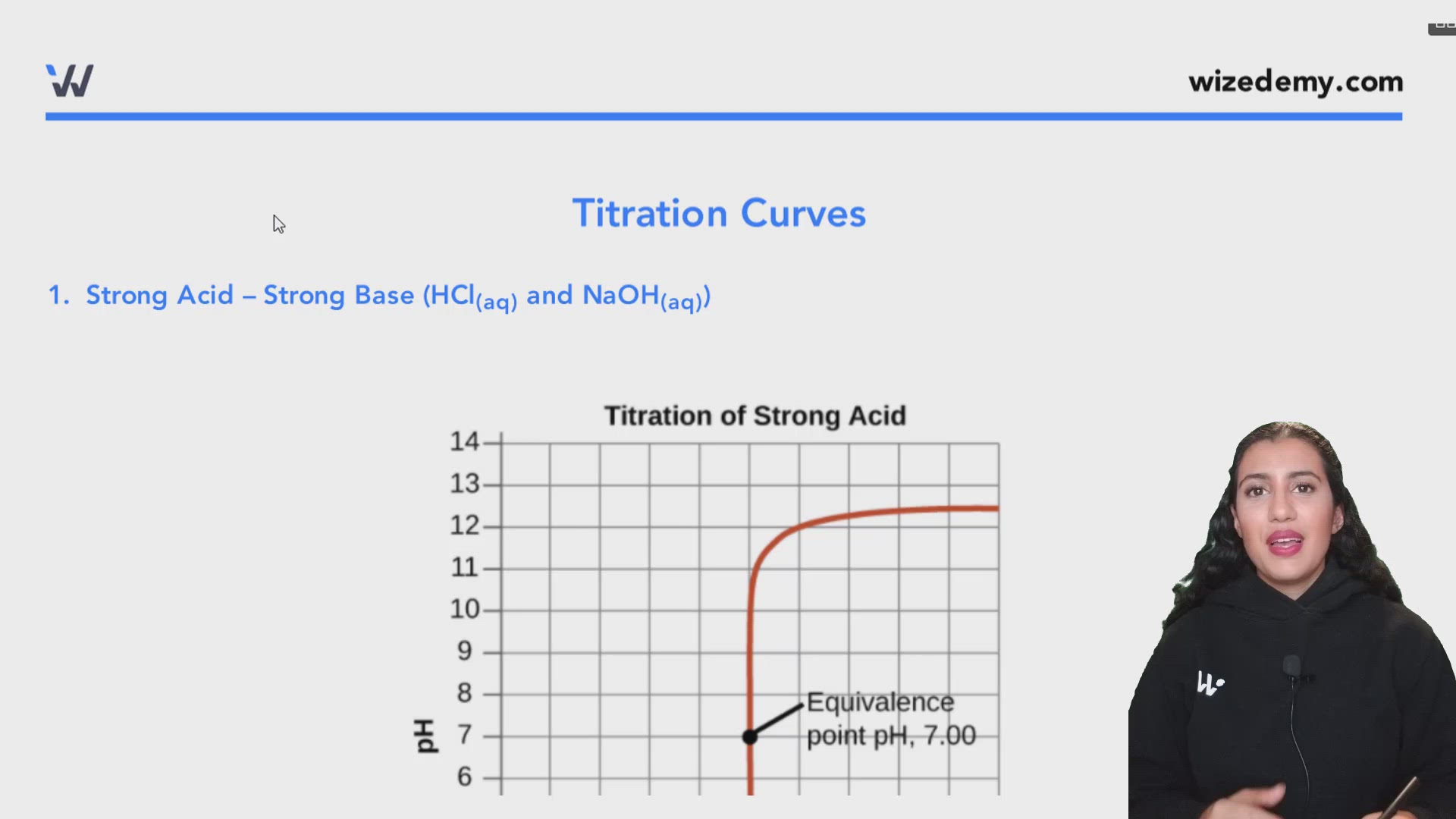
1. Strong Acid – Strong Base (HCl(aq) and NaOH(aq))
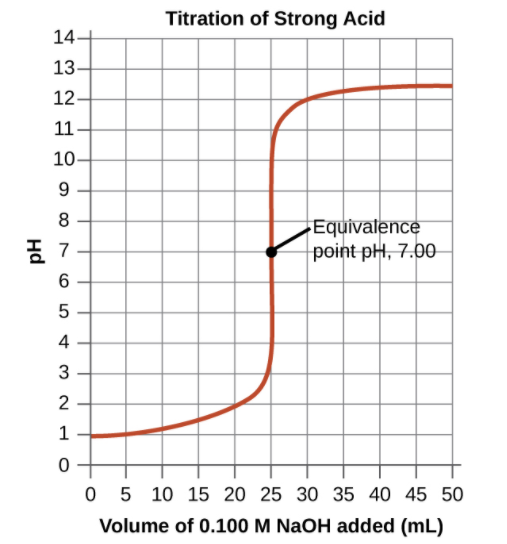
- pH is low initially
- As base is added, the pH increases slowly.
- The pH rises steeply when the moles of OH- nearly equals the moles of H3O+
- pH=7 at equivalence point
- The additional drop of base neutralizes the tiny excess acid and introduces a tiny excess of base
- Then, pH increases smoothly as more base is added.
2. Weak acid – Strong base Titration (CH3COOH(aq) with NaOH(aq))
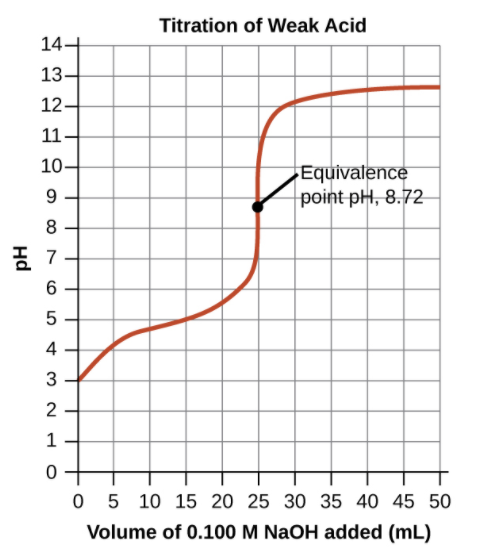
- In a weak acid – strong base titration: pH>7 at the equivalence point
- Past the equivalence point: pH determined by the [OH-] from the excess strong base. You need the total volume of the solution to determine [OH-]
Calculating pH at different points in the titration
At the start: solution of the weak acid, CH3COOH; use ICE table and Ka to determine pH
Between the start and equivalence point: buffer region due to presence of both CH3COOH and CH3COO-; determine moles of acid left unreacted and moles of base produced. Use Henderson – Hasselbach equation to solve for pH.
At half equivalence point: pH = pKa
At equivalence point: all CH3COOH has been converted to CH3COO-; the pH is controlled by the acetate ion, and is thus basic.
Past the equivalence point: pH determined by the [OH-] from the excess strong base. You need the total volume of the solution to determine [OH-]
3. Weak base –Srong acid Titration: (NH3 and HCl)
Draw the titration curve where HCl(aq) is the titrant and being added in gradually.
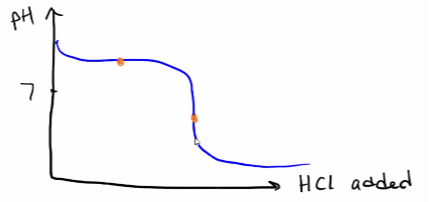
- In a weak base – strong acid titration: pH<7 at the equivalence point
- Past the equivalence point: pH determined by the [H3O+] from the excess strong acid
Calculating pH at different points in the titration
At the start: solution of the weak base, NH3; use ICE table and Kb to determine pH
Between the start and equivalence point: buffer region due to presence of both NH3 and NH4+ determine [NH3] left unreacted and [NH4+] produced; use Henderson-Hasselbach equation to determine pH
At half equivalence point: pH = pKa of NH4+
At equivalence point: all NH3 has been converted to NH4+; use Ka of NH4+ to determine [H3O+]
Past the equivalence point: pH determined by the [H3O+] from the excess strong acid
Practice: Equivalence Point
For which type of titration will the pH be basic at the equivalence point?