Popular Courses
MCAT
General Course
Grade 12 Chemistry
Ontario High School
Grade 12 Chemistry
Canada High School
CHEM 1302A/B
Western University
General Chemistry
University Study Guides
AP Chemistry Exam Prep Course
AP Exam Prep
CHEM 203
University of Calgary
High School Chemistry
US High School
Chemistry
General Course
CHEM 1AA3
McMaster University
DAT
General Course
General Chemistry
University Study Guides
CHEM 1E03
McMaster University
Chemistry 12
British Columbia High School
CHM135H1
University of Toronto
CHEM 102
University of Alberta
APSC 132
Queen's University
CHEM 112B
Queen's University
CHEM 123
University of Waterloo
CHEM 130
University of British Columbia
0:00 / 0:00
Indicators
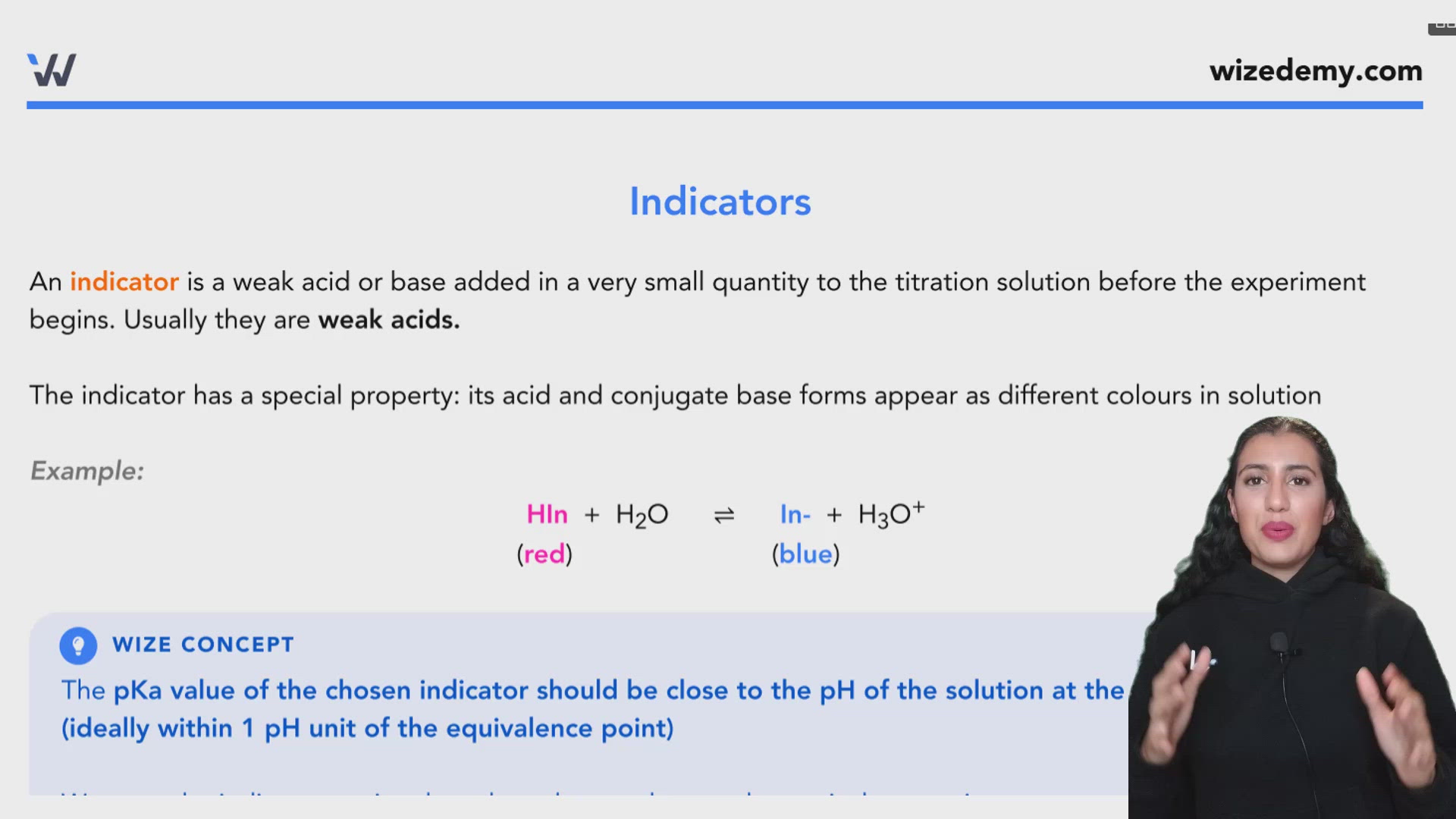
An indicator is a weak acid or base added in a very small quantity to the titration solution before the experiment begins. Usually they are weak acids.
The indicator has a special property: its acid and conjugate base forms appear as different colours in solution
Example:
HIn + H2O ⇌ In- + H3O+
(red) (blue)
Wize Concept
The pKa value of the chosen indicator should be close to the pH of the solution at the equivalence point (ideally within 1 pH unit of the equivalence point)
We want the indicator to signal a colour change close to the equivalence point.
When the pH of the solution=pKa of the indicator, the indicator's acid and conjugate base components will have an equal concentration [HIn]=[In-] and we will see a mixture of the two colors!
Example:
In our example above, we'd see a
purple
colour Equivalence Point vs Endpoint
Equivalence point: moles of H+=moles of OH-
End point: when we see a colour change because of the indicator
Example:
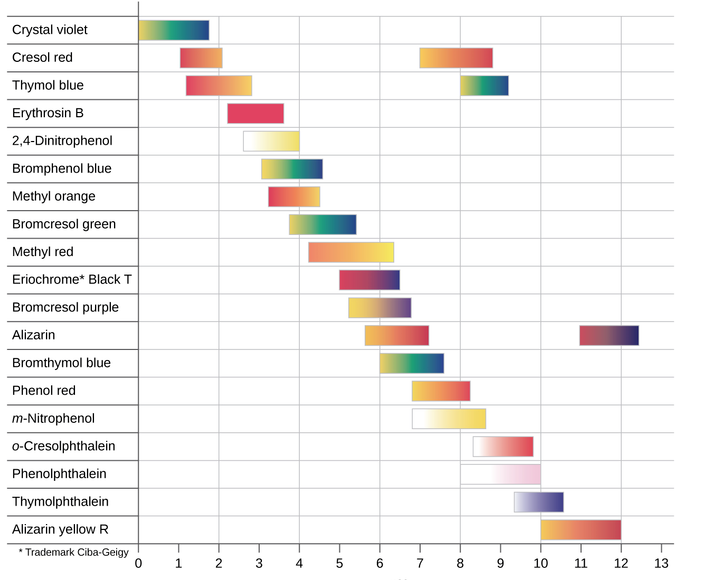
Look at methyl orange in the table below. Indicate an endpoint and a possible equivalence point.
HIn + H2O ⇌ In- + H3O+
(red) (blue)
1) When pH=pKa of indicator:
- [HIn]=[In-]
- red + blue → we'd seepurple!
2) When pH < pKa
- [HIn] > [In-]
- we'd seered!
3) When pH > pKa
- [HIn] < [In-]
- we'd seeblue!
Practice: Indicators
The indicator cresol red has Ka = 5.0 × 10⁻⁹. Over what approximate pH range does it change color?