Wize High School Grade 12 Chemistry Textbook > Rates of Reactions
Introduction to Rates of Chemical Reactions
0:00 / 0:00
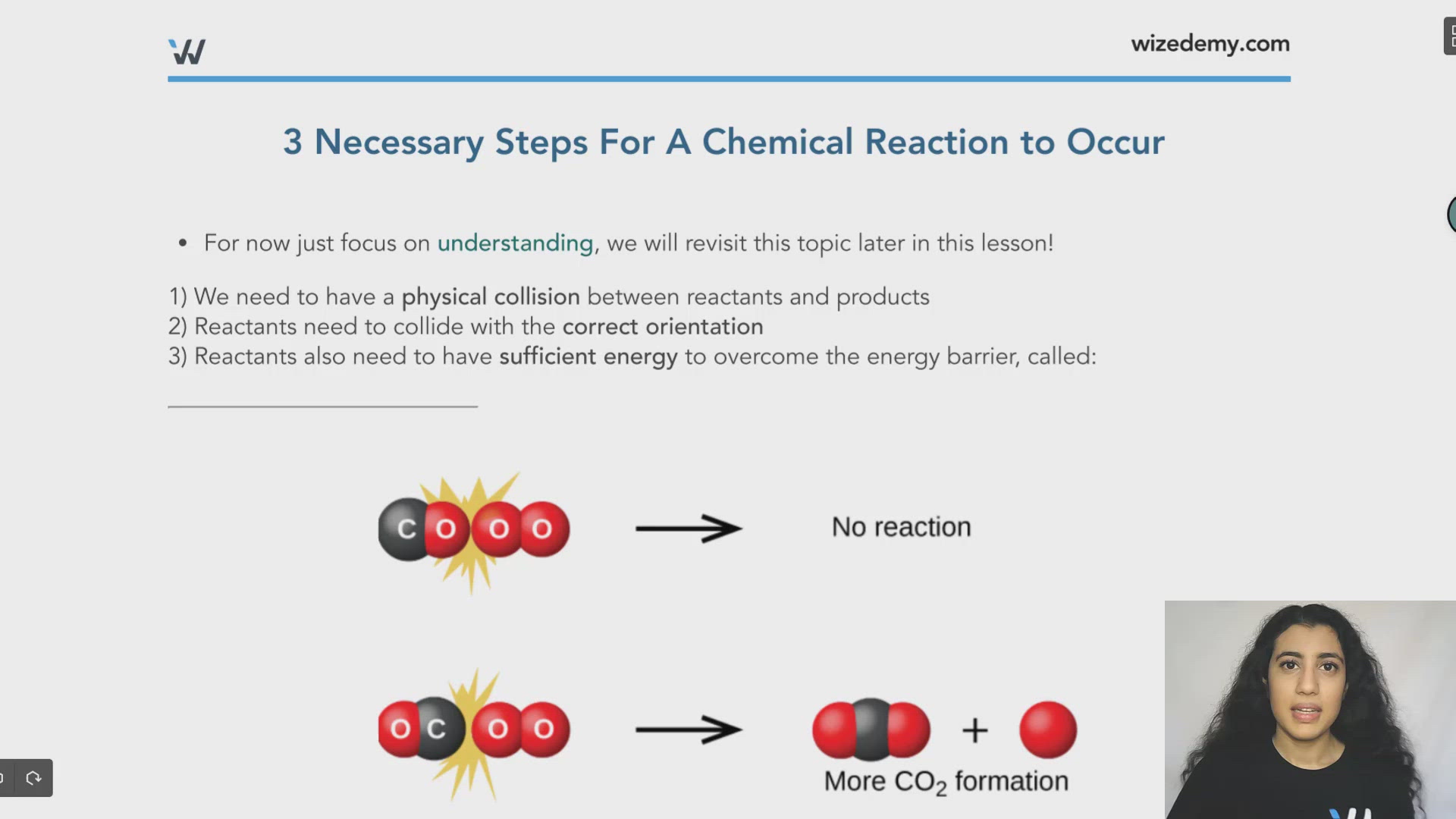
3 Necessary Steps For A Chemical Reaction to Occur
- For now just focus on understanding, we will revisit this topic later in this lesson!
1) We need to have a physical collision between reactants and products
2) Reactants need to collide with the correct orientation
3) Reactants also need to have sufficient energy to overcome the energy barrier, called:
the activation energy, Ea

0:00 / 0:00
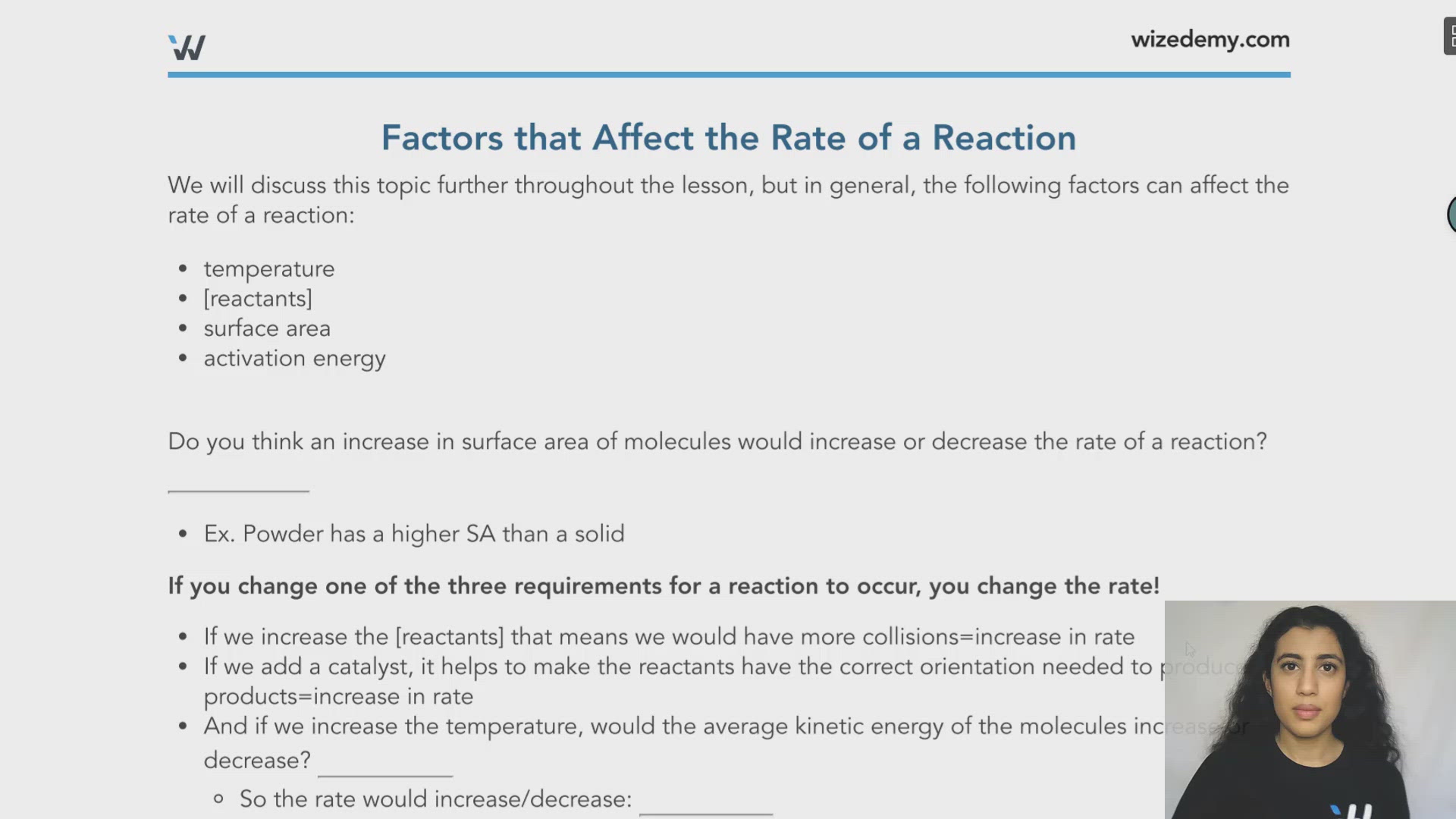
Factors that Affect the Rate of a Reaction
We will discuss this topic further throughout the lesson, but in general, the following factors can affect the rate of a reaction:
- temperature
- [reactants]
- surface area
- activation energy
Do you think an increase in surface area of molecules would increase or decrease the rate of a reaction?
Increase!
- Ex. Powder has a higher SA than a solid
If you change one of the three requirements for a reaction to occur, you change the rate!
- If we increase the [reactants] that means we would have more collisions=increase in rate
- If we add a catalyst, it helps to make the reactants have the correct orientation needed to produce products=increase in rate
- And if we increase the temperature, would the average kinetic energy of the molecules increase or decrease?Increase
- So the rate would increase/decrease:increase
Match each scenario with the correct factor that can affect the rate of a chemical reaction!
A.
Vinegar is safe to add to food and consume, but pure acetic acid will burn skin to contact
B.
Gold and copper are both used in jewellery, but copper bracelets will turn green over time
C.
Milk kept in a refrigerator will stay fresh for at least a week, but milk left out on the counter will quickly turn sour.
D.
Papain is a food additive that is sometimes added to meat to make it more tender
E.
The dust in grain silos have been known to explode, whereas kernels of grain are almost nonflammable
Temperature
Catalyst
Surface Area
Concentration of Reactants
Chemical Nature of Reactants