Wize High School Grade 12 Chemistry Textbook > Equilibrium
Le Chatelier's Principle
0:00 / 0:00
Le Chatelier's Principle
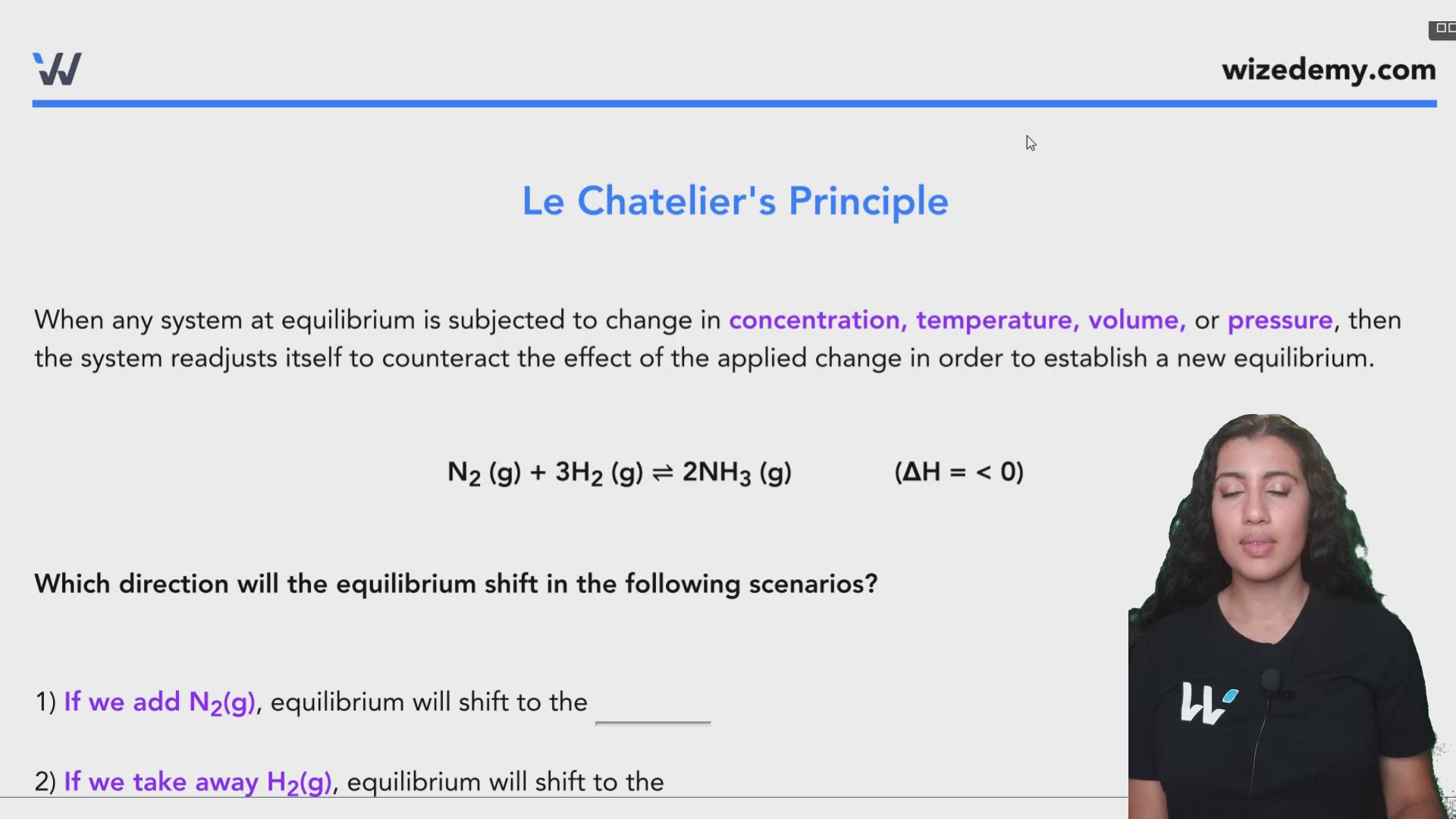
When any system at equilibrium is subjected to change in concentration, temperature, volume, or pressure, then the system readjusts itself to counteract the effect of the applied change in order to establish a new equilibrium.
N2 (g) + 3H2 (g) ⇌ 2NH3 (g) (ΔH = < 0)
Which direction will the equilibrium shift in the following scenarios?
1) If we add N2(g), equilibrium will shift to the
right
2) If we take away H2(g), equilibrium will shift to the
left
3) If we increase the volume of the container:
- Does the pressure inside the container increase or decrease?decrease
- If pressure is decreased, the equilibrium will want to shift to the side withmoremoles of gas
- If pressure is increased, the equilibrium will want to shift to the side withlessmoles of gasd
- In our example, the equilibrium will shift to theleftside since it hasmoremoles
N2 (g) + 3H2 (g) ⇌ 2NH3 (g) (ΔH = < 0)
4) If we add heat:
- We want to treat temperature as a reagent
- To do this, we need to figure out what side of the reaction temperature is on for this particular reaction
- We are given an enthalpy value that is negative, does this mean that our reaction is endothermic or exothermic?exothermic
- Based on this, does our reaction require energy or is it releasing energy?
- Itreleasesenergy
- So would we expect to see temperature on the left or right side of the equation? (write it above)rightside
- Now this question is asking what direction the equilibrium will shift, so treat temperature as any other reagent on therightside
- Equilibrium will shift to theleft!
5) For the following reaction what direction would the equilibrium shift if we added more AgCl(s):
AgCl(s) ⇌ Ag+(aq) + Cl-(aq)
Remember that K or Q does not include solids or liquids.
This means that if we change the concentration of a solid or liquid it would not cause any change to the equilibrium! Q would still be equal to K.
No shift in equilibrium.
N2 (g) + 3H2 (g) ⇌ 2NH3 (g) (ΔH = < 0)
6) If we added a catalyst what direction would the equilibrium shift in?
- Catalysts → Kinetics
- Equilibrium → Thermodynamics
- A catalyst would not affect equilibrium. A catalyst speeds up the rate of the forward and backward reactions equally. As a result, equilibrium amounts aren't changed!
- No shift in equilibrium
N2 (g) + 3H2 (g) ⇌ 2NH3 (g) (ΔH = < 0)
7) If we add an inert gas to the mixture, what direction would the reaction shift:
a) If the container keeps a constant volume
- This is a rigid container. Remember for Kp we are concerned with the partial pressures of each gas. Inert gases are non-reactive so wouldnt react with anything. Would the partial pressures ratios of the gases change?
- Remember that partial pressure is the pressure that the gas would have if it was alone in the container, the partial pressure ratios would not change (if there was 2x NH3 than H2 that would still be the case after the inert gas was added)
- Therefore the equilibrium would not shift
b) Low yield: If the container was a constant pressure container
- If we add an inert gas this time, it increases the total pressure in the container
- However, this container wants to have a constant pressure, so to avoid that increase in pressure it would change its volume....it would increase its volume so that the pressure remains constant
- Now you can treat this scenario as an "increase in volume" scenario -> think of it as before, increase in volume means decrease in pressure, shift to the side with more moles! (shift left in our case)
Given the following exothermic reaction, decide which direction the equilibrium will shift (if any) in each scenario.
CH4(g) + 2H2S(g) ⇌ CS2(g) + 4H2(g)
The concentration of dihydrogen sulfide is decreased.
0:00 / 0:00
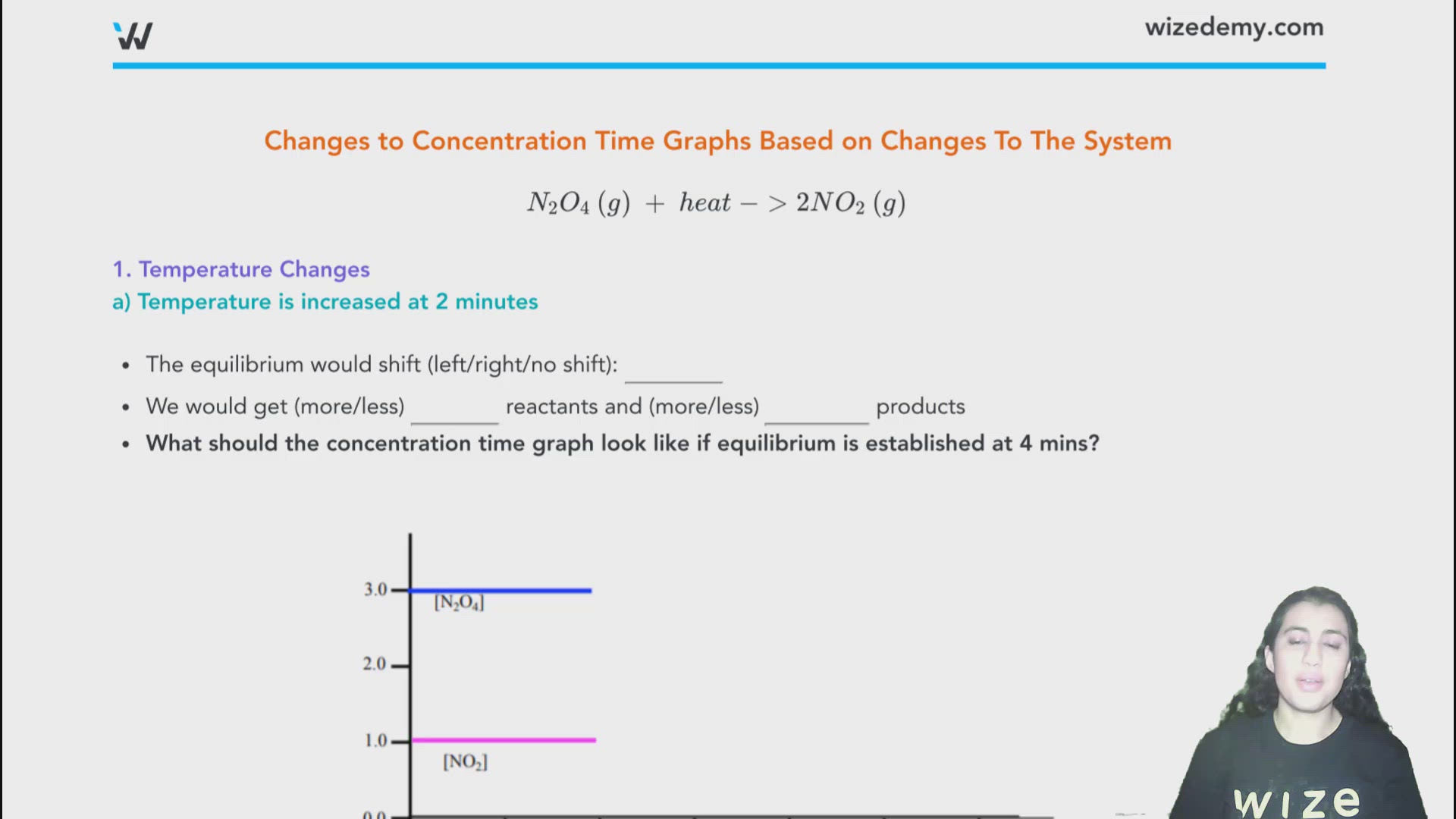
Changes to Concentration Time Graphs Based on Changes To The System
1. Temperature Changes
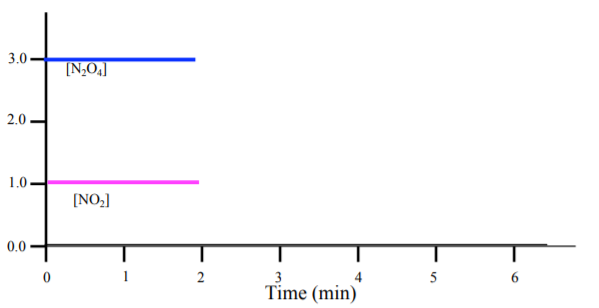
a) Temperature is increased at 2 minutes
- The equilibrium would shift (left/right/no shift):right
- We would get (more/less)lessreactants and (more/less)moreproducts
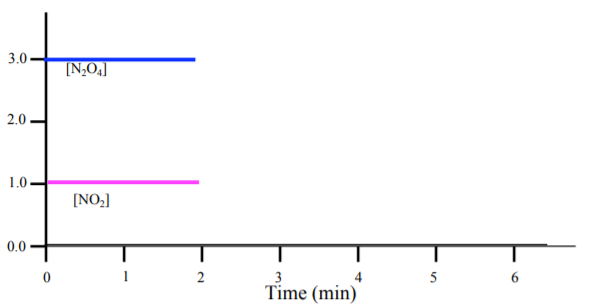
- What should the concentration time graph look like if equilibrium is established at 4 mins?

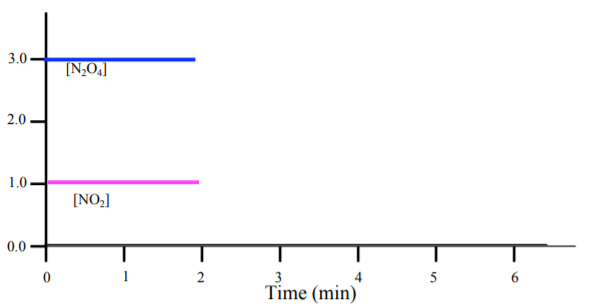
b) Temperature is decreased at 2 minutes
- The equilibrium would shift (left/right/no shift):left
- We would get (more/less)morereactants and (more/less)lessproducts
- What should the concentration time graph look like if equilibrium is established at 4 mins?

2. Concentration Changes
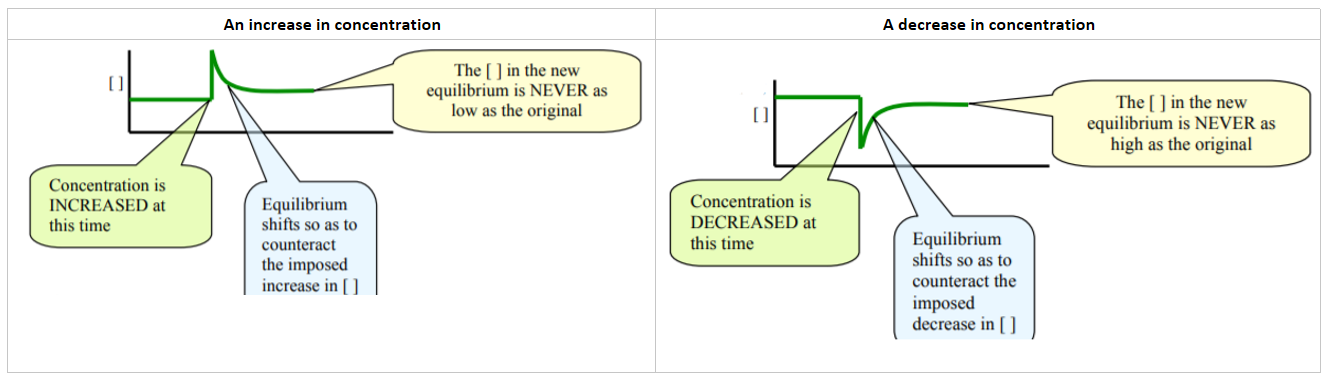
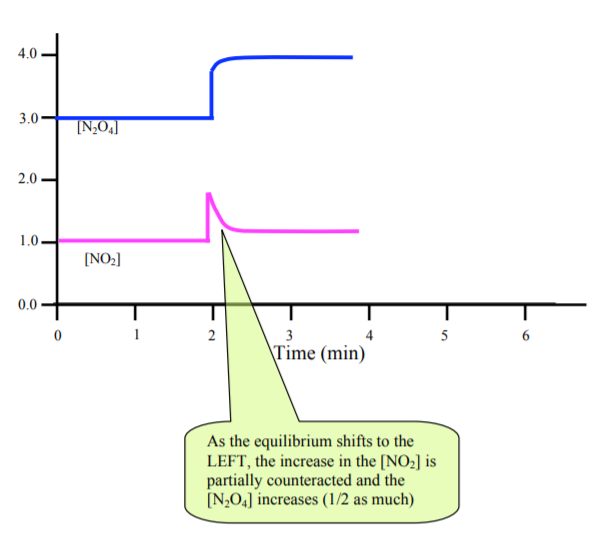
- What will an increase or decrease look like on the concentration time graph?
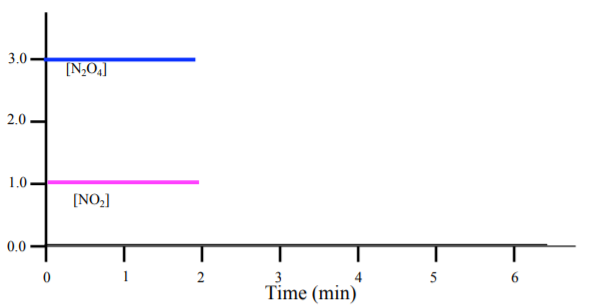
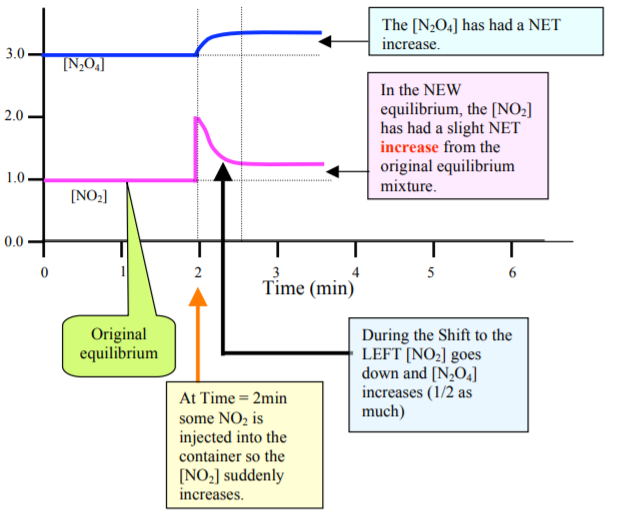
- What should the concentration time graph look like if [NO2] was increased and the new equilibrium is established at 4 mins?
- The equilibrium would shift (left/right/no shift):left
3. Changes in Total Pressure
- What will an increase in pressure or decrease in volume look like on the concentration time graph?
- When total pressure increases, the concentration of every gas in the container initially increases at that moment (since the # of moles/unit volume increases), then the equilibrium will shift whichever way it needs to to counteract the stress
- **Pressure or volume changes will result in vertical lines on the concentration time graphs
- If we increase the pressure at time 2 minutes, it would look like this:
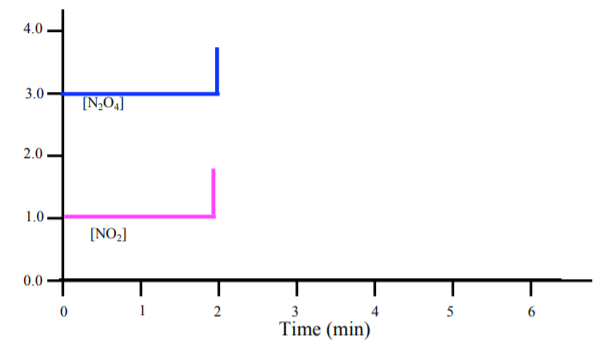
- Fill in the rest of the concentration time graph after the pressure was increased:
- When pressure is increased, eqm shift to side with (more/less)lessmoles, which is left.
4. Adding a catalyst
- results in no changes to equilibrium concentrations so you wouldnt see any changes to the concentration graph!

Mark Yourself Question
- Grab a piece of paper and try this problem yourself.
- When you're done, check the "I have answered this question" box below.
- View the solution and report whether you got it right or wrong.
Depending on the season, the skyline in busy cities can look different.
One thing that contributes to this is the following reaction:
Heat + N2O4(g) ⇌ 2NO2(g)
N2O4(g) is a colourless gas while NO2(g) is a brown gas. Can you explain why the city skyline may look one colour in the summer (with high temperatures) and a different colour in the winter? What season would the air be the most brown looking?
Practice: Le Chatelier's Principle
The reaction below is at equilibrium. You want to apply Le Chatelier’s principle to produce a higher quantity of product gases. Which change will accomplish this effect?
CO2 (g) + 2 H2O (l) ⇌ CH4 (g) + 2 O2 (g)