Wize High School Grade 12 Chemistry Textbook > Equilibrium
The Equilibrium Constant (K)

0:00 / 0:00
Equilibrium Constant (K)
To define the extent to which equilibrium favors one side of the reaction over the other, we can use the Equilibrium Constant.
Given the model reaction:
A & B are reactants and C & D are products.
a,b,c,d are their stoichiometric coefficients
The Equilibrium Expression (in terms of concentration) can be written as:
The equilibrium constant (K) is a ratio used to describe the relative concentrations of products and reactants at equilibrium!
You may also see it called the Law of Mass Action.
Examples:
Keq (at equilibrium), Ka (for acids), Kb (for bases), Kw (for water), Ksp (solubility product constant)
Wize Concept
K can have different subscripts, but all K's follow the same rules!
Example: What is the K expression for the reaction below?
N2(g) + 3H2(g) ⇌ 2NH3(g)
Wize Tip
Since coefficients become exponents in the K expression, we need to make sure that our equation is balanced!
K=
Additional Notes About K:
1) Above we wrote Kc. The c stands for concentration because we are considering the concentrations of the species in mol/L.
2) If instead we were considering gases and their pressures in atm, then we would write Kp!
Example: What is the Kp expression for the following reaction?
2SO2(g) + O2(g) ⇌ 2SO3(g)
3) If any species in the reaction are solids (s) or liquids (l), their concentrations do not affect equilibrium and therefore they do not appear in the equilibrium expression!
Example: What is the equilibrium expression for the following reaction?
PbCl2(s) ⇌ Pb2+ (aq) + 2Cl- (aq)
K= [Pb2+][Cl-]2
4) We will see that changes in volume, pressure, temperature, and concentration can shift the equilibrium (according to Le Chatelier's Principle)
But the only factor that will change K is temperature!

0:00 / 0:00
The Magnitude of the Equilibrium Constant, K
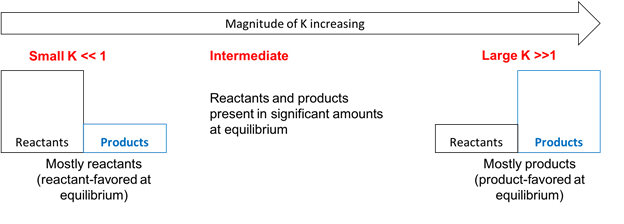
K tells us which side of the reaction (products or reactants) are favored and to what extent.
Example:
If we had the K value 1.8x10¹⁰ would products or reactants be favored at equilibrium?
Products!
Since there is an exponent of 10, then (products/reactants)
products
are favored to a (small/great) great
extent! Example:
If K was 1.2x10⁻⁸ then are products or reactants favored at equilibrium? And to a great or small extent?
Reactants
are favored to a great
extent!Example: Are products or reactants favored at equilibrium according to the following reaction and concentration time graph?
2SO2(g) + O2(g) ⇌ 2SO3(g)
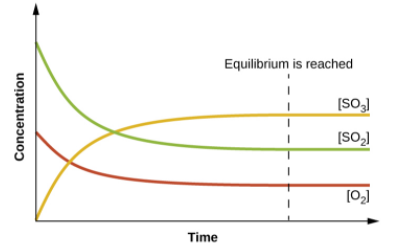
Products are favored at equilibrium since at equilibrium (when the concentrations start to get flat in the graph), there is a higher concentration of SO3 (a product) than the reactants.
Summary of What K Tells Us
Keq > 1
- At equilibrium, products/reactants are favored:products
- This is because products/reactants are more stable:products
- As a result, at equilibrium there will be more reactants, more products, or equal amounts of products and reactants:more products
Keq = 1
- At equilibrium, products/reactants are favored:neither
- This is because products/reactants are more stable:equally stable
- As a result, at equilibrium there will be more reactants, more products, or equal amounts of products and reactants:equal amounts
Keq < 1
- At equilibrium, products/reactants are favoured:reactants
- This is because products/reactants are more stable:reactants
- As a result, at equilibrium there will be more reactants, more products, or equal amounts of products and reactants:more reactants
Which of the following expression is the correct equilibrium-constant expression for the reaction below?
HF(aq) + H2O(l) ⇌ H3O+(aq) + F-(aq)
1.
2.
3.
4.
5.
For the process: N2 (g) + 3 H2 (g) ⇌ 2 NH3 (g)
Determine the value of Kc when an equilibrium mixture contains 0.0420 mol N2, 0.516 mol H2, and 0.0357 mol NH3 in a 1.00 liter container at 400oC.

Mark Yourself Question
- Grab a piece of paper and try this problem yourself.
- When you're done, check the "I have answered this question" box below.
- View the solution and report whether you got it right or wrong.
Earlier we learned about how only one factor changes K (the equilibrium constant) and that factor is temperature.
Given the reaction:
H2(g) + I2(g) ⇌ 2HI(g) + heat
At 448oC K=50.5. Would you predict the K value to be higher or lower at 348oC?