
0:00 / 0:00
Buffers
- A buffer is a solution that can resist large changes to pH/pOH
- The best ones have ~ equal [weak acid] and [conjugate base] OR [weak base] = [conjugate acid]
- A buffer can even resist large changes in pH when small amounts of either strong acid (H+) or strong base (OH-) are added to it

(openstax)
Buffer Capacity – the amount of H+ or OH− a buffer can absorb without a significant change in pH.
- A solution with more weak base, [A-], has a higher buffer capacity for addition of strong acid.
- A solution with more weak acid, [HA], has a higher buffer capacity for addition of strong base.
To calculate pH of buffer...
- Think of how we calculated pH of weak acids/bases. Let's say our buffer is a weak acid buffer.
- Write out the chemical equation (like we've done before), and then solve for H+ using the Ka expression (like we've also done before!) Once we have the H+ we can easily find pH :)
Buffers involve an eqm: HA + H2O ⇌ A- + H3O+
Effective buffer range:
- For an acidic buffer: range= pKa +/- 1
- For a basic buffer: range=pKb +/- 1
0:00 / 0:00
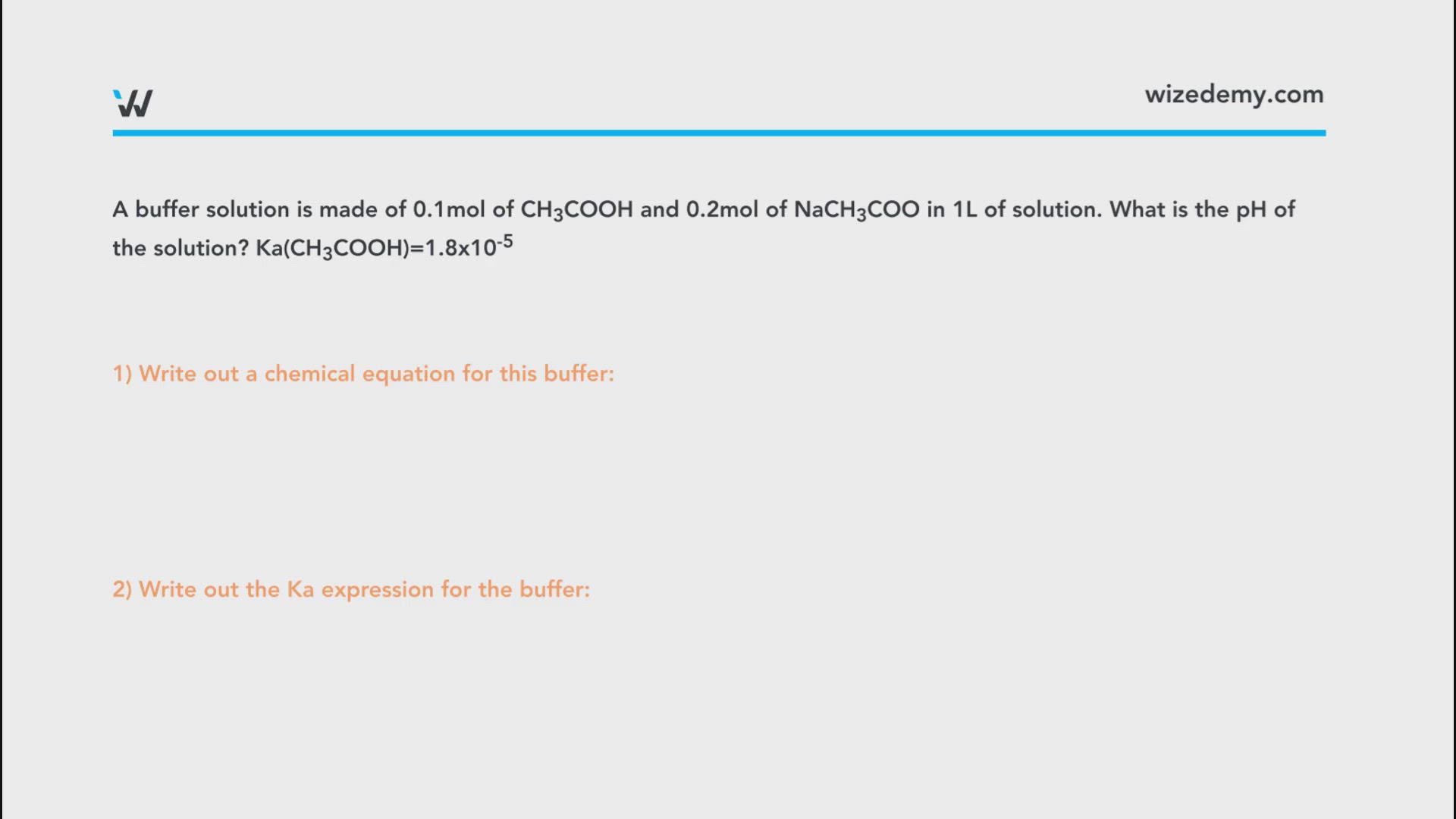
A buffer solution is made of 0.1mol of CH3COOH and 0.2mol of NaCH3COO in 1L of solution. What is the pH of the solution? Ka(CH3COOH)=1.8x10⁻⁵
1) Write out a chemical equation for this buffer:
CH3COOH + H2O eqm CH3COO- + H3O+
2) Write out the Ka expression for the buffer:
3) Plug the concentrations of the acid and base portion of the buffer into the Ka expression, solve for [H+]
[H+]=9x10⁻⁶
4) Solve for pH
pH=-log[H+]
pH=-log[9x10⁻⁶]
pH=5.05