
0:00 / 0:00
Naming Alkanes
- For alkanes the suffix (ending) is -ane
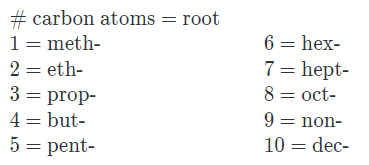
- The root of the name indicates the number of carbon atoms in the longest straight chain in the molecule
- IUPAC naming will always follow the general form: prefix + root + suffix
- prefix=identifies side chains
- root=identifies the number of carbon atoms in the main/parent chain
- suffix=indicates the family of compounds to which it belongs
Wize Tip
You can remember the roots with the following sentence:
Mary Eats Peanut Butter Pancakes Happily Hugging Our New Dog
Ex. 

butane hexane
We can also see branches in the chain:
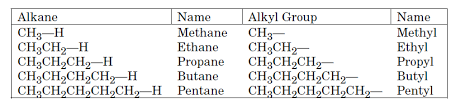
- An alkyl group is a hydrocarbon group derived from an alkane but has a hydrogen atom removed
- These are often branches on organic molecules
- ex. Methane is CH4, but when it is attached to the main chain of a molecule, we call this branch a methyl group -CH3
- ex. Ethane is CH3CH3 , but when it is attached to the main chain of a molecule, we call this branch an ethyl group -CH2-CH3
Alkanes and Related Alkyl Groups
Rules for Naming Branched Alkanes
Wize Concept
1. Identify the longest carbon chain
2. Number the carbon atoms in the longest carbon chain starting from the end that is closest to the branches (we do this because we want the branches to have the lowest numbers possible)
3. Name each branch and identify its location on the parent chain.
4. Write the IUPAC name in the form (# of location)-(branch name)(parent chain)
5 . If there is more than 1 branch present, list the branches in alphabetical order. If there is more than one substituent of the same type, then we we combine them with a prefix such as di, tri, tetra (these prefixes don't affect alphabetical order). Each number is separated by a comma (,).
Note: When naming cyclic hydrocarbons, if the carbon atoms that form the ring structure are the parent chain, the prefix cyclo is added to the parent hydrocarbon name, name the substituted groups/branches as you would normally. If the ring is not the parent chain, it will be labelled as a branch (ex. 3-cyclopentylheptane indicates a cyclopentyl ring attached to the 3rd carbon in a chain of 7 carbons).
Ex. Name the following molecule:
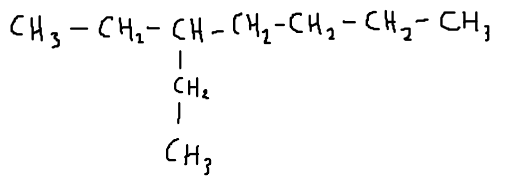
3-ethylheptane
Ex. Name the following molecule:
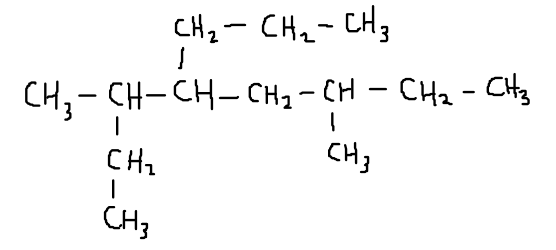
3,6-dimethyl-4-propyloctane
Ex. Name the following molecule:
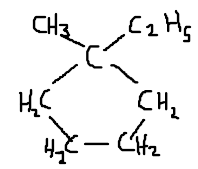
1-ethyl-1-methylcyclopentane
Name the following molecule:
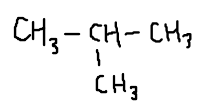
Name the following molecule:


Mark Yourself Question
- Grab a piece of paper and try this problem yourself.
- When you're done, check the "I have answered this question" box below.
- View the solution and report whether you got it right or wrong.
Draw the following molecules:
1. 3, 3, 5-trimethyloctane
2. 1, 1-diethylcyclohexane