0:00 / 0:00
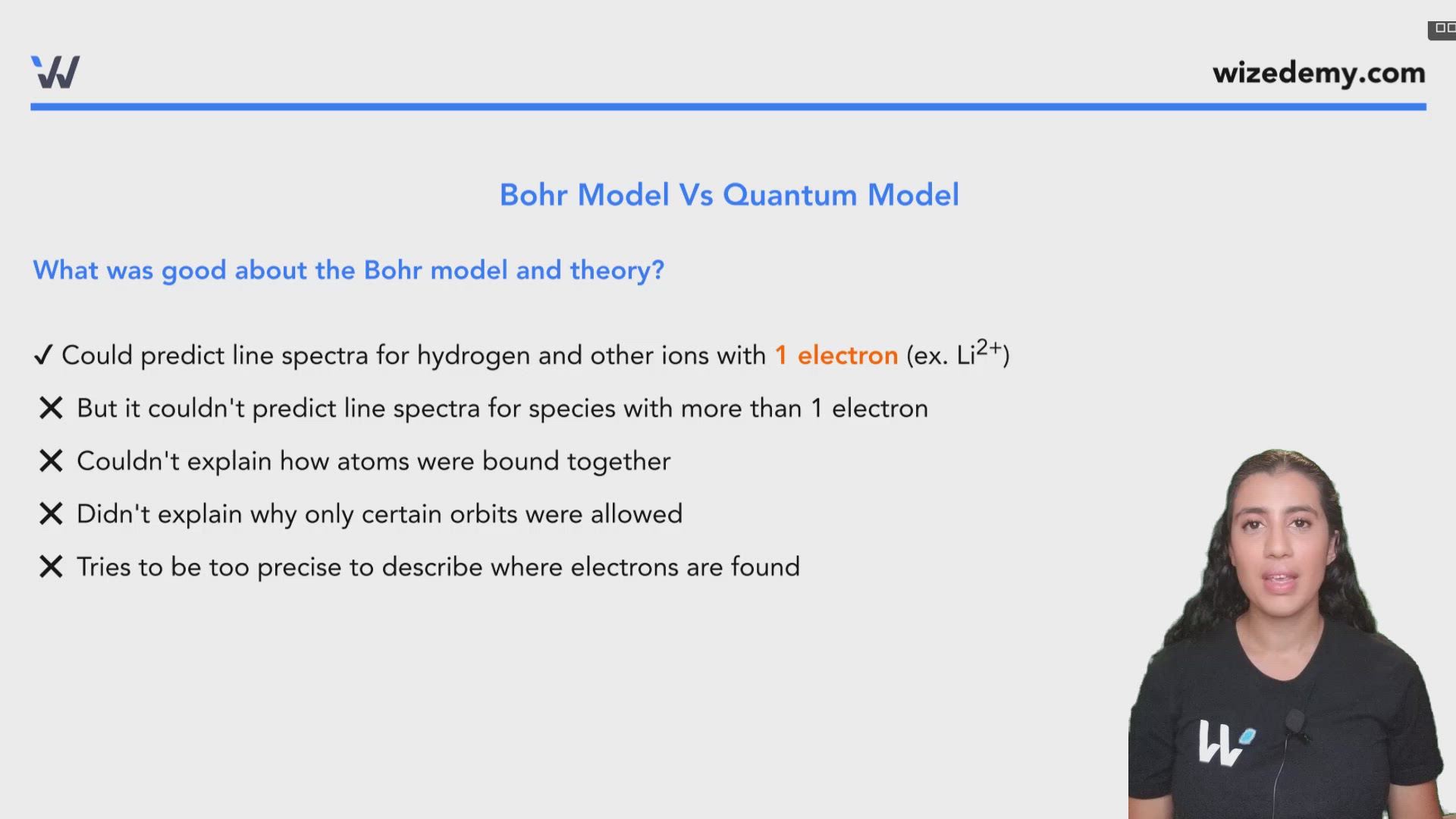
Bohr Model Vs Quantum Model
What was good about the Bohr model and theory?
✔ Could predict line spectra for hydrogen and other ions with 1 electron (ex. Li2+)
❌ But it couldn't predict line spectra for species with more than 1 electron
❌ Couldn't explain how atoms were bound together
❌ Didn't explain why only certain orbits were allowed
❌ Tries to be too precise to describe where electrons are found
Bohr Theory was replaced by Quantum Mechanics!
✔ Quantum model can predict atomic spectra for many-electron atoms
✔ Quantum mechanics provides us with probabilities where electrons are most likely to be found
- Provides a 3D region where electrons are most likely to be found (instead of circular paths in Bohr model)
✔ Adds on to the Bohr model:
- Electrons are still only found at discrete energy levels with specific amounts of energy (quantized)
- In this model, each electron has 4 quantum #s that are unique to that electron and describe it.

Electron Density Diagram

0:00 / 0:00
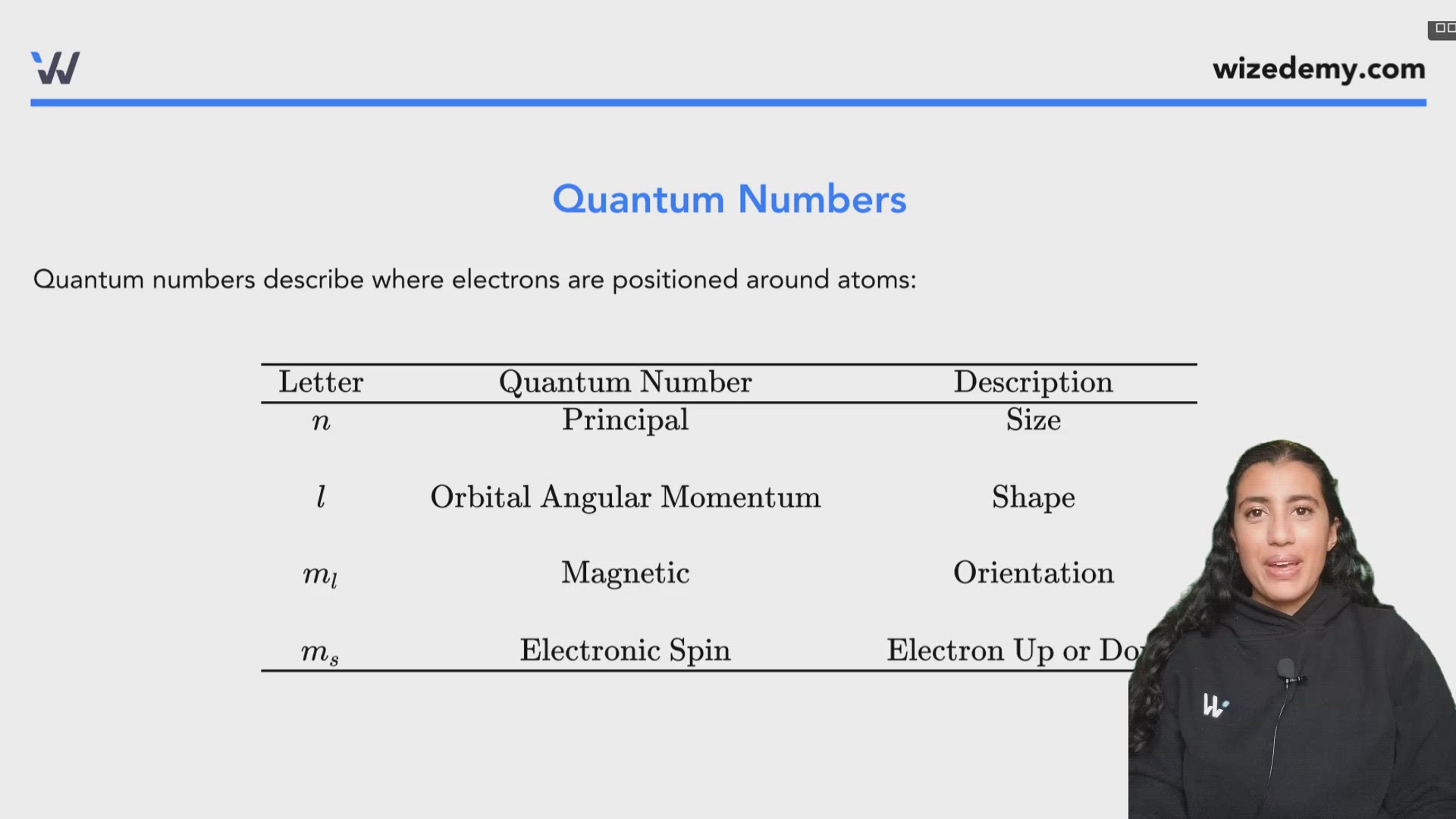
Quantum Numbers
Quantum numbers describe where electrons are positioned around atoms:
Rules:
- Can be any positive integer Example: n = (1, 2, 3, 4…)
- As n increases, energy and size of shellincreases
Wize Tip
n is also called the "principle quantum number"
- Can be any non-negative integer up to n-1 Example: l = (0, 1, 2, 3, …, n-1)
- l (orbital shapes) are described as:

Increasing energy →

- These shapes show us where an electron is most likely to be found
- There is a 90% chance in finding an electron somewhere inside the given shape
Wize Concept
S orbitals are spheres and with increasing "n" the sphere will get larger.
There is one s orbital in a subshell.
P subshells are dumbbell shaped.
There are three p orbitals in a subshell, each orientated along an axis (px, py and pz)
- Can be any integer from –l to +l Example: m1 = (-l, …, 0, …, l)
- This quantum # designates a specific orbital within a given shell Example: if n=2 and l=1, we are looking at 2p.
- ml can be -1, 0, or +1 this designates each of the 2p orbitals: 2px, 2py, and 2pz
- Spin of an electron
- Can only be +1/2 or -1/2
Match the correct quantum number with the correct description.
Match the quantum number with the correct description of what this quantum number tells us.
A.
principle quantum number; tells us about the size and energy of an orbital
B.
tells us about the spin of an electron
C.
tells us about the shape of an orbital (ex. spherical)
D.
tells us about the orientation of an orbital (ex. 2px)
n
l
ml
ms
Shape of Atomic Orbitals
This cheatsheet is here just so you can get a general idea of the orbital shapes :)
Note: Each orbital holds 2 electrons (more on this soon!)
- s orbitals have 1 possible orientation
- p orbitals have 3 possible orientations
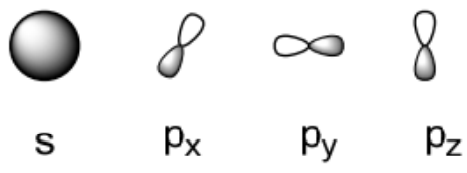
- d orbitals have 5 possible orientations


- f orbitals are not shown but they have 7 possible orientations
The sketches below show possible orbitals for the electron in a hydrogen atom. Which orbital would have the lowest energy?

0:00 / 0:00
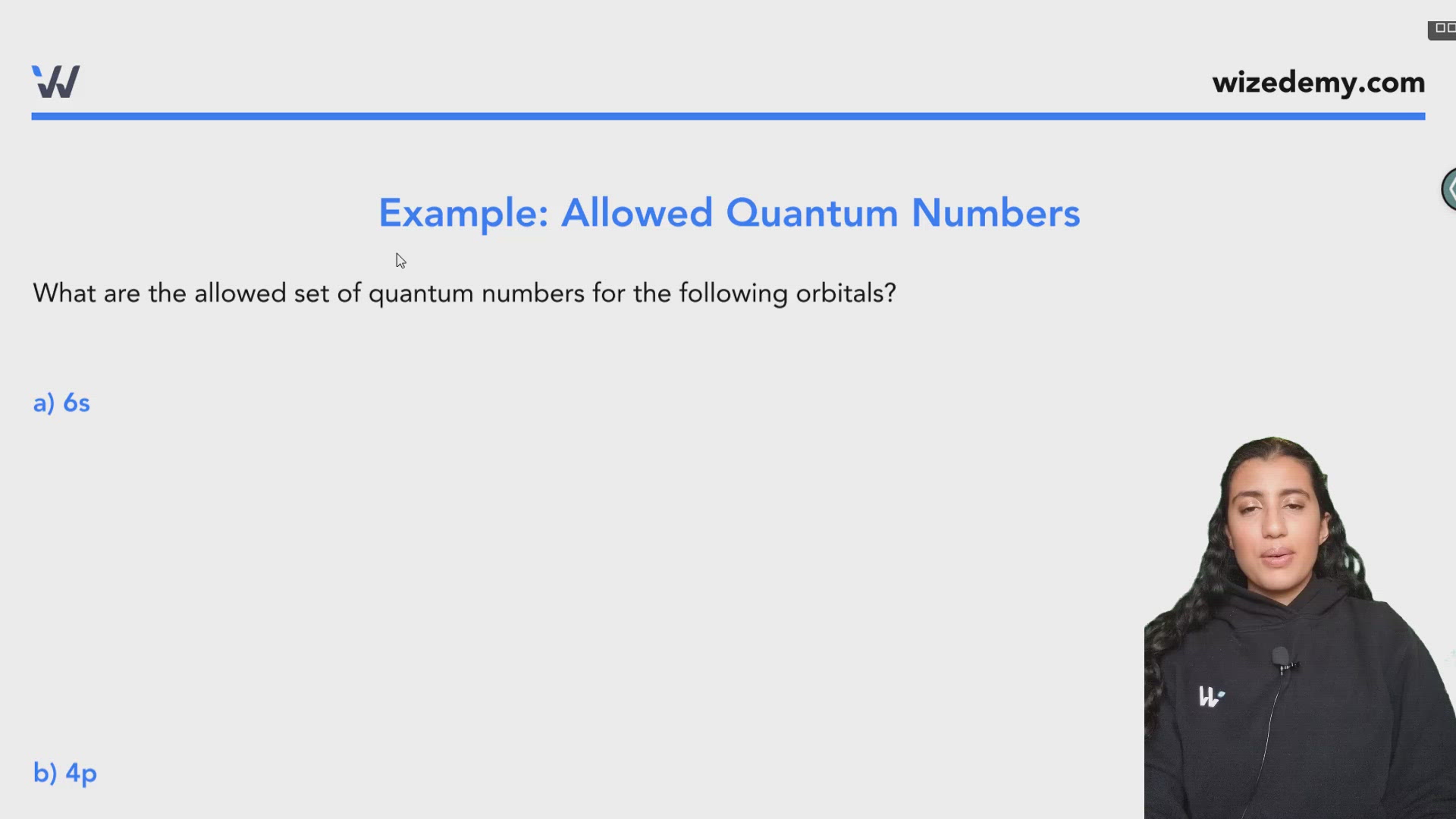
Example: Allowed Quantum Numbers
What are the allowed set of quantum numbers for the following orbitals?
a) 6s
n = 6
l = 0
ml = 0
ms= +1/2 or -1/2
b) 4p
n = 4
l = 1
ml = -1, 0, or 1
ms= +1/2 or -1/2
c) 3d
n = 3
l = 2
ml = -2, -1, 0, 1, or 2
ms= +1/2 or -1/2
0:00 / 0:00
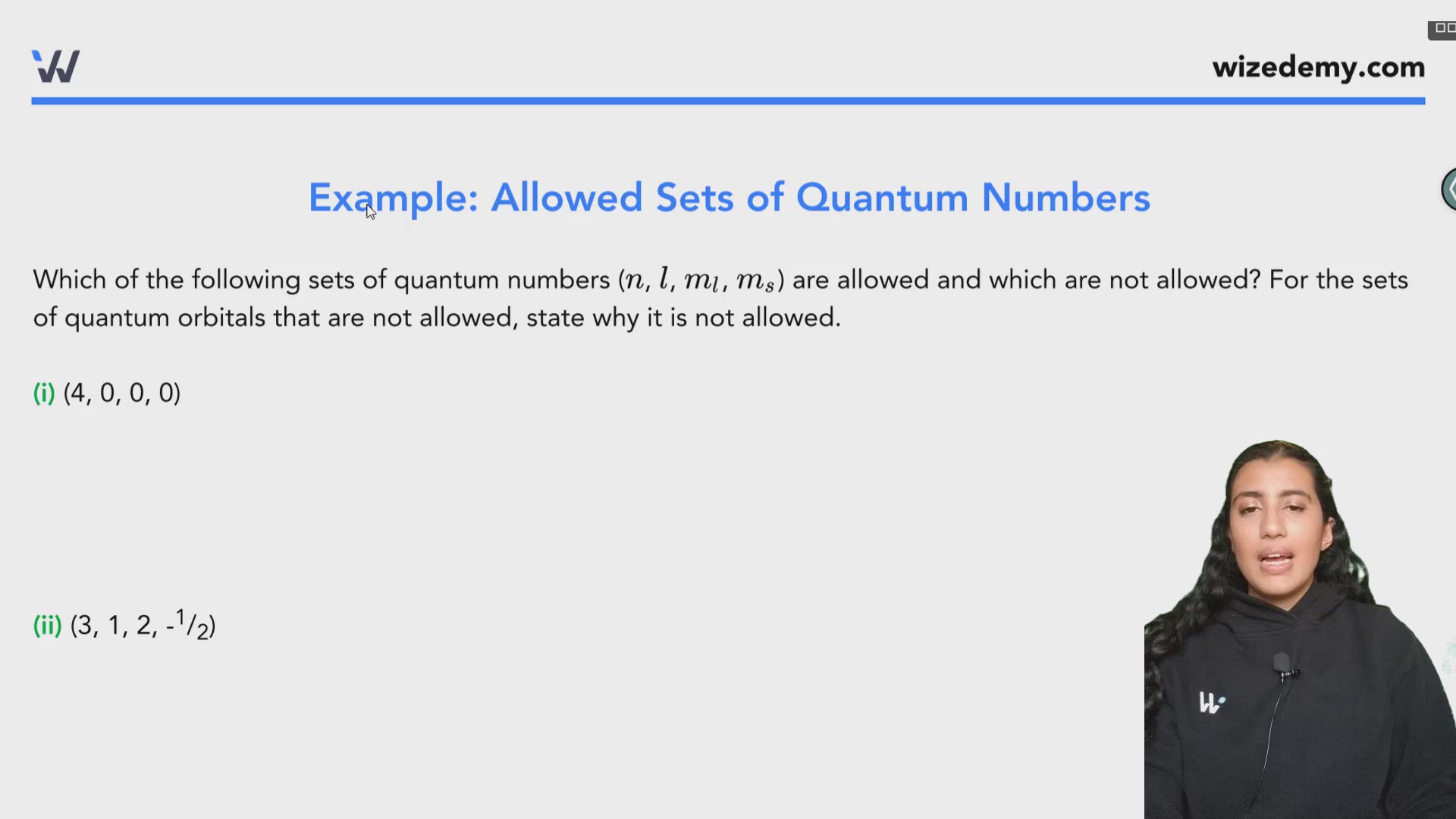
Example: Allowed Sets of Quantum Numbers
Which of the following sets of quantum numbers (, , , ) are allowed and which are not allowed? For the sets of quantum orbitals that are not allowed, state why it is not allowed.
(i) (4, 0, 0, 0)
Not allowed - cannot be equal to 0. Quantum number is always either +1/2 or -1/2.
(ii) (3, 1, 2, -1/2)
Not allowed - cannot be equal to 2 if = 1. Remember that equals all integers from to .
(iii) (5, 3, 0, +1/2)
Allowed. This set of quantum numbers describes a 5f orbital.
(iv) (4, 4, 3, -1/2)
Not allowed - cannot be equal to 4 if = 4. Remember that equals all integers from 0 to .
0:00 / 0:00
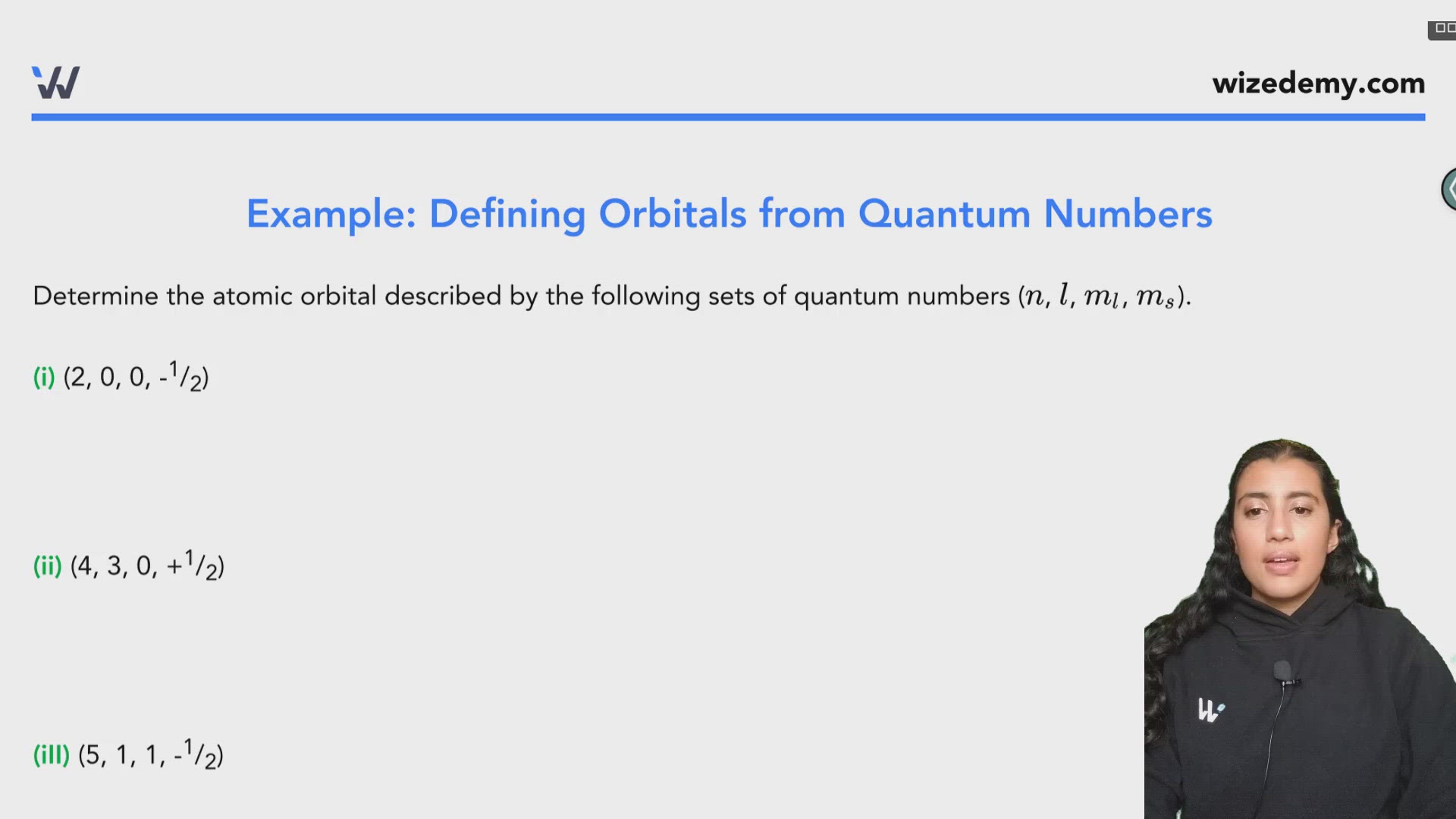
Example: Defining Orbitals from Quantum Numbers
Determine the atomic orbital described by the following sets of quantum numbers (, , , ).
(i) (2, 0, 0, –1/2)
2s orbital
(ii) (4, 3, 0, +1/2)
4f orbital
(iII) (5, 1, 1, –1/2)
5p orbital
Which of the following describes a correct set of quantum number for an orbital?