Popular Courses
English (Senior)
US High School
Grade 12 English
Canada High School
AP English Language and Composition Exam Prep Course
AP Exam Prep
AP English Literature and Composition Exam Prep Course
AP Exam Prep
English (Junior)
US High School
Grade 11 English
Canada High School
Intro to English
University Study Guides
English & Composition
University Study Guides
0:00 / 0:00
Poetry Definition and Overview
Poetry takes many forms. A general definition of poetry is that the sense or emotion of the material is expressed stylistically through language.
- Another way to think about it is that form and content are equally important for poetic texts where elements of rhyme or rhythm work to make meaning alongside the meaning of the words themselves.
- Poetic texts work through an expression of words where the denotation and connotation of the words work together to make meaning.
0:00 / 0:00
Sonnets
A sonnet is a 14 line poem with a specific rhyme scheme.
- Both Shakespearean and Petrarchan sonnets were popular during the Renaissance, and authors often wrote sonnet sequences.
- Shakespearean sonnets have three quatrains (4-lines), followed by a rhyming couplet; Petrarchan sonnets have an octave (two linked quatrains), followed by a seset (6-lines).
- Shakespearean sonnets are sometimes called "English sonnets."
- Lady Mary Wroth turned typical sonnet sequences on their heads, because a typical sonnet sequence took the form of a male speaker, wooing a female object of desire, but in Wroth's Pamphilia to Amphilanthus, the female speaker pines after the male object of her affection!
Sonnet 18: Shall I compare thee to a summer’s day?
BY WILLIAM SHAKESPEARE
Shall I compare thee to a summer’s day? A
Thou art more lovely and more temperate: B
Rough winds do shake the darling buds of May, A
And summer’s lease hath all too short a date; B
Sometime too hot the eye of heaven shines, C
And often is his gold complexion dimm'd; D
And every fair from fair sometime declines, C
By chance or nature’s changing course untrimm'd; D
But thy eternal summer shall not fade, E
Nor lose possession of that fair thou ow’st; F
Nor shall death brag thou wander’st in his shade, E
When in eternal lines to time thou grow’st: F
So long as men can breathe or eyes can see, G
So long lives this, and this gives life to thee. G
How do I love thee? Let me count the ways. A
I love thee to the depth and breadth and height B
My soul can reach, when feeling out of sight B
For the ends of being and ideal grace. A
I love thee to the level of every day’s A
Most quiet need, by sun and candle-light. B
I love thee freely, as men strive for right; B
I love thee purely, as they turn from praise. A
I love thee with the passion put to use C
In my old griefs, and with my childhood’s faith. D
I love thee with a love I seemed to lose C
With my lost saints. I love thee with the breath, E
Smiles, tears, of all my life; and, if God choose, C
I shall but love thee better after death. E
0:00 / 0:00
Free Verse
Free verse poetry does not have a strict or rigid rhyme or rhythm.
Excerpt from Song of Myself
BY WALT WHITMAN
Would you hear of an old-time sea-fight?
Would you learn who won by the light of the moon and stars?
List to the yarn, as my grandmother’s father the sailor told it to me.
Our foe was no skulk in his ship I tell you, (said he,)
His was the surly English pluck, and there is no tougher or truer, and never was, and never will be;
Along the lower’d eve he came horribly raking us.
We closed with him, the yards entangled, the cannon touch’d,
My captain lash’d fast with his own hands.
We had receiv’d some eighteen pound shots under the water,
On our lower-gun-deck two large pieces had burst at the first fire, killing all around and blowing up overhead.
0:00 / 0:00
Poetic Rhyming
Rhyme schemes refer to the end rhyming of a line of poetry.
- It can take many forms, and sometimes rhyme schemes include "slide rhyme."
- What is important to note is to identify rhyming couplets or rhyme schemes.
- The way that rhymes are noted is by using small case letters at the end of a line of poetry to indicate a rhyming match.
Because I could not stop for Death –
He kindly stopped for me –
The Carriage held but just Ourselves –
And Immortality.
We slowly drove – He knew no haste
And I had put away
My labor and my leisure too,
For His Civility –
We passed the School, where Children strove
At Recess – in the Ring –
We passed the Fields of Gazing Grain –
We passed the Setting Sun –
Or rather – He passed Us –
The Dews drew quivering and Chill –
For only Gossamer, my Gown –
My Tippet – only Tulle –
We paused before a House that seemed
A Swelling of the Ground –
The Roof was scarcely visible –
The Cornice – in the Ground –
Since then – 'tis Centuries – and yet
Feels shorter than the Day
I first surmised the Horses' Heads
Were toward Eternity –
0:00 / 0:00
Poetic Meter
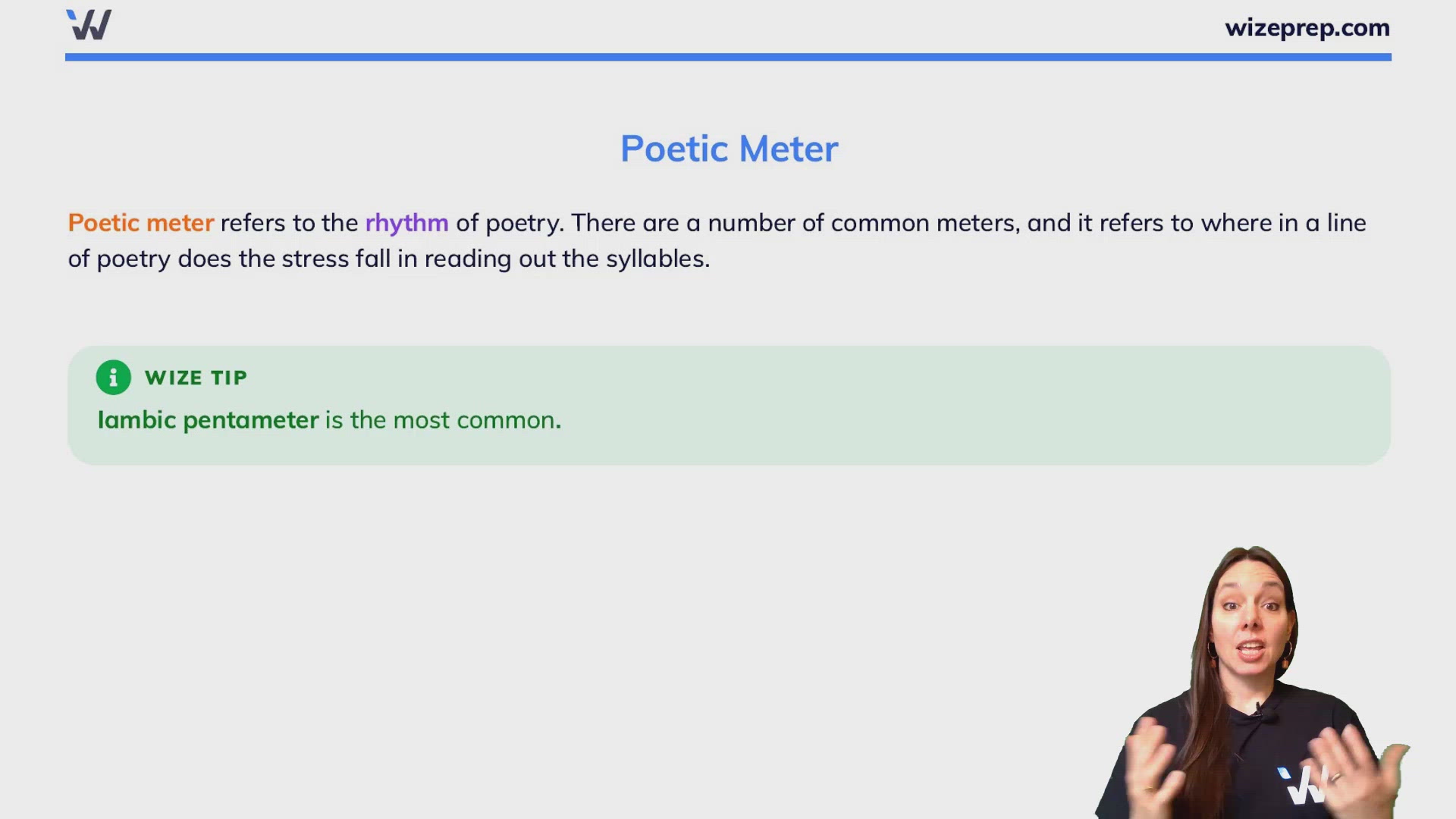
Poetic meter refers to the rhythm of poetry. There are a number of common meters, and it refers to where in a line of poetry does the stress fall in reading out the syllables.
Wize Tip
Iambic pentameter is the most common.
Two-syllable Feet
The meters with two-syllable feet are
- IAMBIC (x /) : That time of year thou mayst in me behold
- TROCHAIC (/ x): Tell me not in mournful numbers
- SPONDAIC (/ /): Break, break, break/ On thy cold gray stones, O Sea!
Three-syllable Feet
Meters with three-syllable feet are
- ANAPESTIC (x x /): And the sound of a voice that is still
- DACTYLIC (/ x x): This is the forest primeval, the murmuring pines and the hemlock (a trochee replaces the final dactyl)
0:00 / 0:00
Poetic Devices
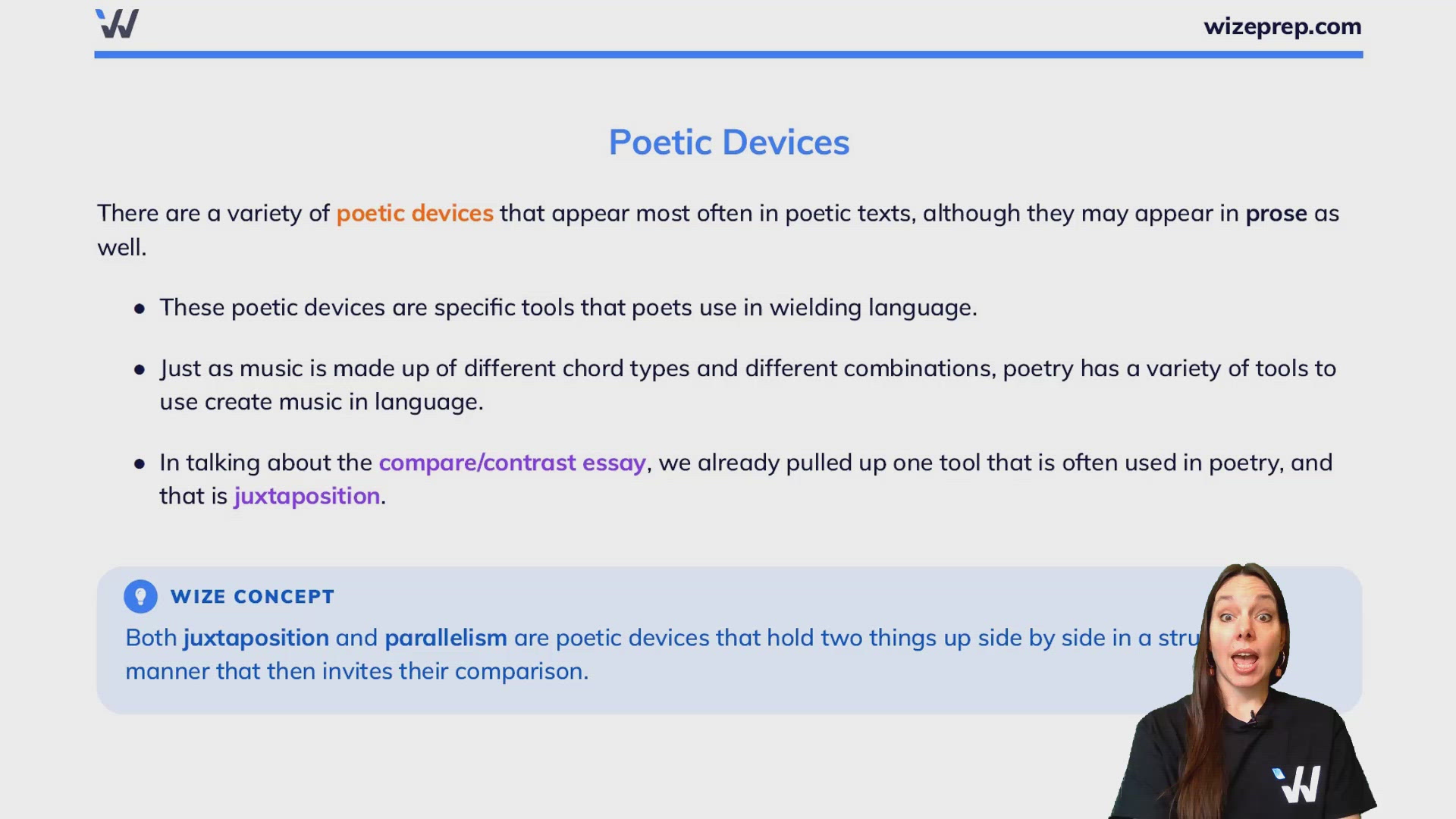
There are a variety of poetic devices that appear most often in poetic texts, although they may appear in prose as well.
- These poetic devices are specific tools that poets use in wielding language.
- Just as music is made up of different chord types and different combinations, poetry has a variety of tools to use create music in language.
- In talking about the compare/contrast essay, we already pulled up one tool that is often used in poetry, and that is juxtaposition.
Wize Concept
Both juxtaposition and parallelism are poetic devices that hold two things up side by side in a structural manner that then invites their comparison.
0:00 / 0:00
Literary Terms for Comparative Tropes
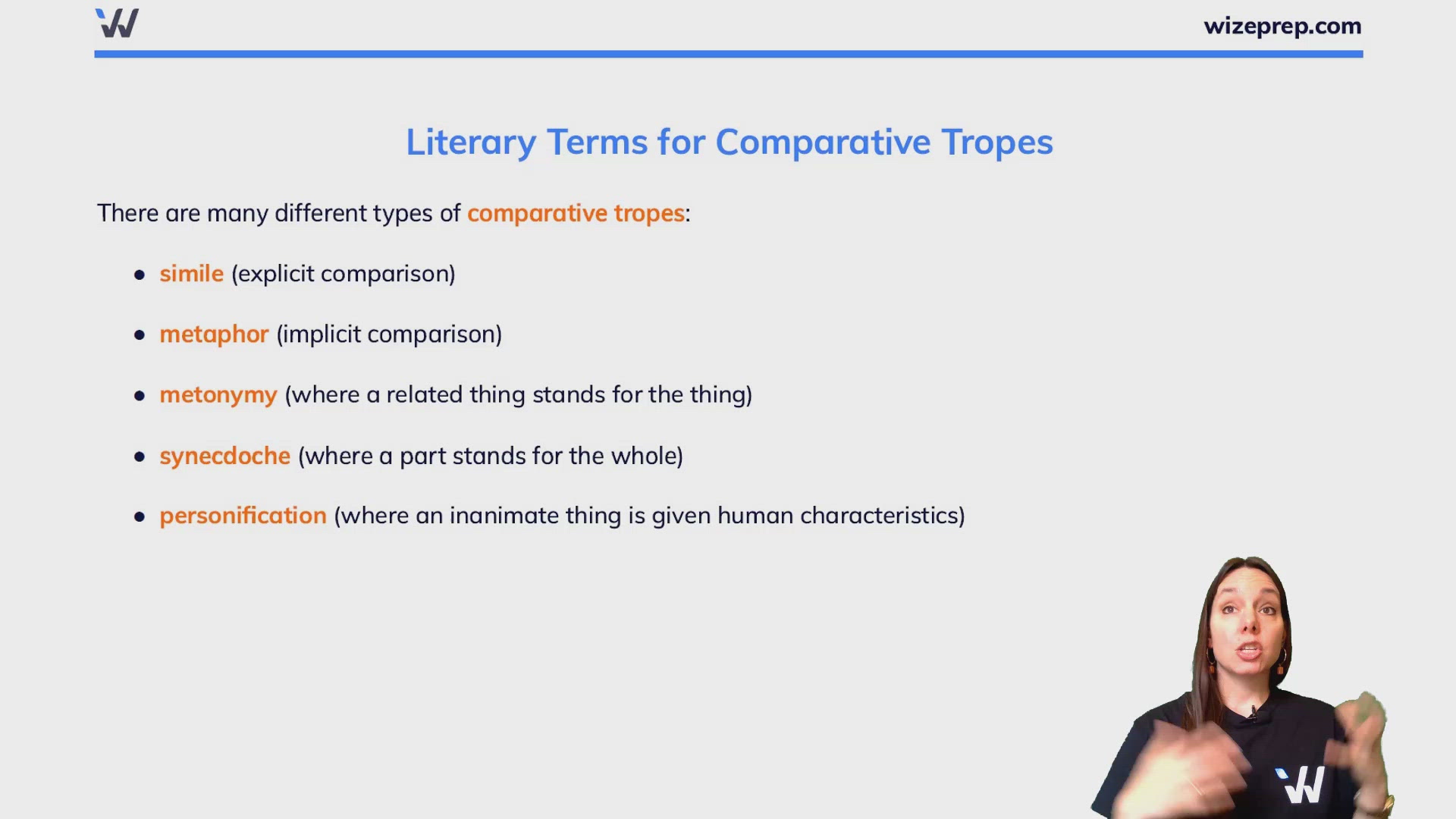
There are many different types of comparative tropes:
- simile (explicit comparison)
- metaphor (implicit comparison)
- metonymy (where a related thing stands for the thing)
- synecdoche (where a part stands for the whole)
- personification (where an inanimate thing is given human characteristics)
Pamphilia to Amphilanthus: 19 (modern spelling)
Come darkest night, becoming sorrow best;
Light; leave thy light; fit for a lightsome soul;
Darkness doth truly suit with me oppressed
Whom absence' power doth from mirth control:
The very trees with hanging heads condole
Sweet summer's parting, and of leaves distressed
In dying colours make a grief-full role;
So much (alas) to sorrow are they pressed.
Thus of dead leaves her farewell carpet's made:
Their fall, their branches, all their mournings prove;
With leafless, naked bodies, whose hues vade
From hopeful green, to wither in their love,
If trees and leaves, for absence, mourners be
No marvel that I grieve, who like want see.
Notes: lightsome = unburdened; vade = fade
Excerpt from Ode to a Nightingale
BY JOHN KEATS
...O, for a draught of vintage! that hath been
Cool'd a long age in the deep-delved earth,
Tasting of Flora and the country green,
Dance, and Provençal song, and sunburnt mirth!
O for a beaker full of the warm South,
Full of the true, the blushful Hippocrene,
With beaded bubbles winking at the brim,
And purple-stained mouth;
That I might drink, and leave the world unseen...
Let me not to the marriage of true minds
Admit impediments. Love is not love
Which alters when it alteration finds,
Or bends with the remover to remove.
O no! it is an ever-fixed mark
That looks on tempests and is never shaken;
It is the star to every wand'ring bark,
Whose worth's unknown, although his height be taken.
Love's not Time's fool, though rosy lips and cheeks
Within his bending sickle's compass come;
Love alters not with his brief hours and weeks,
But bears it out even to the edge of doom.
If this be error and upon me prov'd,
I never writ, nor no man ever lov'd.
0:00 / 0:00
Literary Terms for Sound Tropes
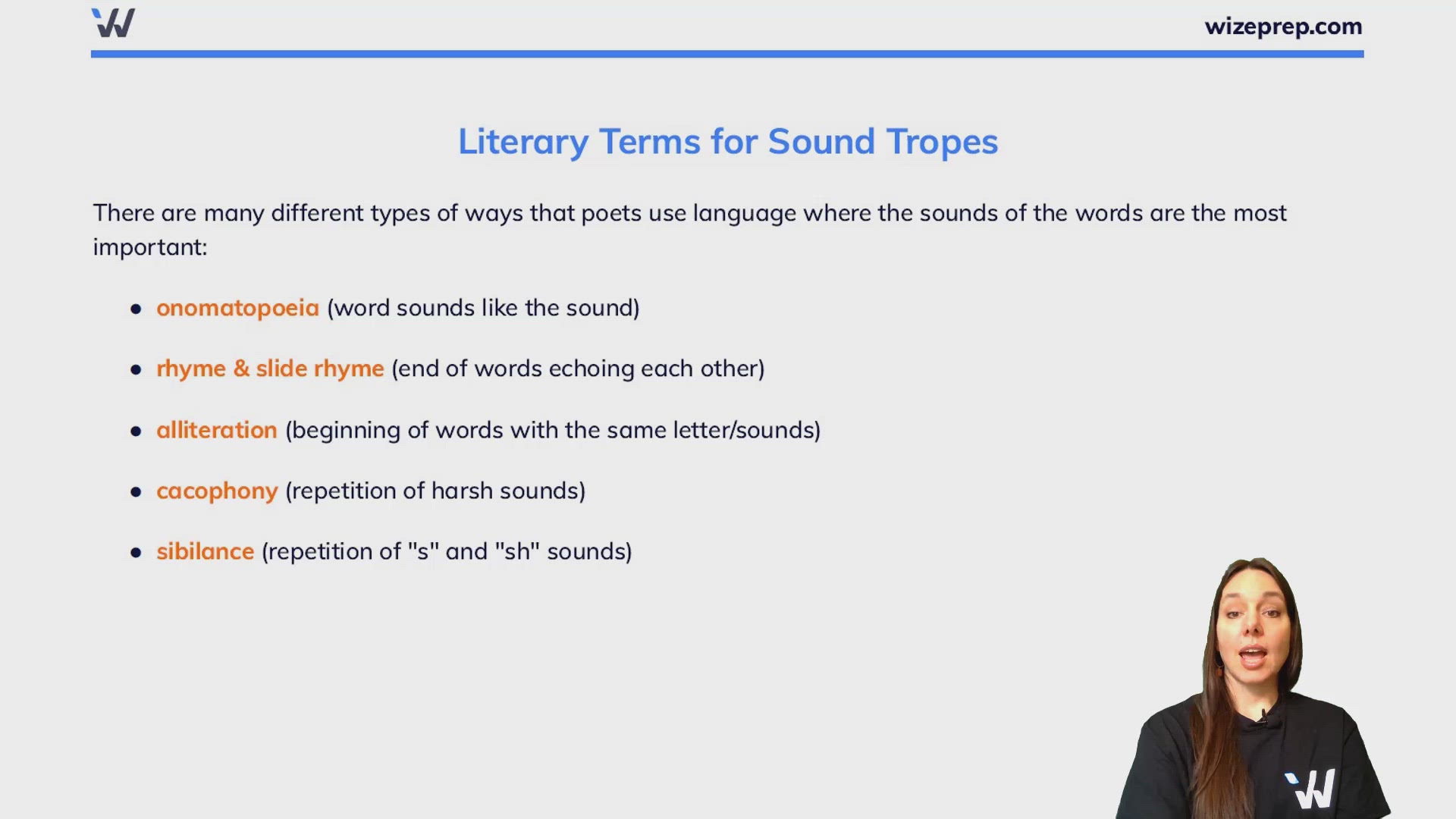
There are many different types of ways that poets use language where the sounds of the words are the most important:
- onomatopoeia (word sounds like the sound)
- rhyme & slide rhyme (end of words echoing each other)
- alliteration (beginning of words with the same letter/sounds)
- cacophony (repetition of harsh sounds)
- sibilance (repetition of "s" and "sh" sounds)
Fire Breathing Me
my blood boils like a bubbling bog
the pop of the bubbles like
boiling oil
spread out along the shoreline
leaving destruction in its wake
fish, flesh nor fowl
survive my boiling blood
in my rage I breathe a fire so pure
so pure it hurts, it burns, it doesn’t stop
the fire of me
I burn
I boil
I bubble
I scream!