Close Reading Non-Fiction Prose: Lesson 1 (Overview)
Close Reading Non-Fiction Prose: Lesson 2 (Theme or Thesis)
Close Reading Non-Fiction Prose: Lesson 3 (Style)
Close Reading Non-Fiction Prose: Lesson 4 (Structure)
Close Reading Fiction: Lesson 1 (Overview)
Close Reading Fiction: Lesson 2 (Theme)
Close Reading Fiction: Lesson 3 (Plot)
Close Reading Fiction: Lesson 4 (Style)
Close Reading Fiction: Lesson 5 (Structure)
Close Reading Poetry Lesson 1 (Overview)
Close Reading Poetry: Lesson 2 (Analyzing a Poem)
Close Reading from Shakespeare
Narrative Untrustworthiness and Bias: Lesson 1 (Overview)
Narrative Untrustworthiness and Bias: Lesson 2 (How to Spot an Unreliable Narrator)
Dramatic Irony
Classical Dramatic Theory: Aristotle
Oral Storytelling: Lesson 1 (Overview)
Oral Storytelling: Lesson 2 (First Nations Example)
Popular Courses
English (Senior)
US High School
Grade 12 English
Canada High School
AP English Language and Composition Exam Prep Course
AP Exam Prep
AP English Literature and Composition Exam Prep Course
AP Exam Prep
English (Junior)
US High School
Grade 11 English
Canada High School
Intro to English
University Study Guides
English & Composition
University Study Guides
0:00 / 0:00
Close Reading Non-Fiction Prose
Lesson 1 (Overview)
Let's get started on looking at non-fiction prose to think about how to begin analyzing it.
Sample text to analyze
One-Page Teaching Philosophy
John Dewey’s manifesto, “My Pedagogic Creed,” ushered in the modern era of educational theory with a social and holistic conceptualization of education. Taking up Dewey’s central notion of the child as a complete being, rather than a passive receptacle of information, educational theorist Howard Gardner articulated the idea of “multiple intelligences.” His schema is rooted in the idea – that now seems almost a truism – that students learn in different ways. My teaching philosophy is informed by these theories and reflects my commitment to holistic education and engaging the “multiple intelligences” of my students.
For me there are three fundamental reasons for the study of literature at the upper levels. First, I believe that through studying literature, the art of rhetoric, and the craft of academic prose students gain critical reading and writing skills. They learn to think critically about the world of “text” in which they find themselves, and, thus, have power to analyze and critique anything from a political speech to an advertisement to a piece of literature. Second, I believe in the value of a humanist and liberal arts education. Our society puts cultural significance on certain literary texts and figures, and students should not only be exposed to those in order to validate that cultural approbation, but also to (re)evaluate those very categories and “contingencies of value.” Third, I believe in the pure pleasure and joy that reading and analysis can offer students. Whether they are able to engage with a text through the satisfying recognition of identifying with its characters or situations, or through the gratifying escape into an utterly unknown environment, or through the sheer joy of the literary skill with which the author has crafted a text, I think that there should be enjoyment in the study of literature.
I have a passion for teaching and learning. As a life-long learner, I strive to inculcate habits of mind in my students allowing them to engage in the ongoing process of both self- and textual-analysis. Because, in my mind, if you can analyze the world around you, you can be empowered.
0:00 / 0:00
Lesson 2 (Theme or Thesis)
Let's start practicing how to analyze for the big ideas in a piece of non-fiction prose.
One-Page Teaching Philosophy
John Dewey’s manifesto, “My Pedagogic Creed,” ushered in the modern era of educational theory with a social and holistic conceptualization of education. Taking up Dewey’s central notion of the child as a complete being, rather than a passive receptacle of information, educational theorist Howard Gardner articulated the idea of “multiple intelligences.” His schema is rooted in the idea – that now seems almost a truism – that students learn in different ways. My teaching philosophy is informed by these theories and reflects my commitment to holistic education and engaging the “multiple intelligences” of my students.
For me there are three fundamental reasons for the study of literature at the upper levels. First, I believe that through studying literature, the art of rhetoric, and the craft of academic prose students gain critical reading and writing skills. They learn to think critically about the world of “text” in which they find themselves, and, thus, have power to analyze and critique anything from a political speech to an advertisement to a piece of literature. Second, I believe in the value of a humanist and liberal arts education. Our society puts cultural significance on certain literary texts and figures, and students should not only be exposed to those in order to validate that cultural approbation, but also to (re)evaluate those very categories and “contingencies of value.” Third, I believe in the pure pleasure and joy that reading and analysis can offer students. Whether they are able to engage with a text through the satisfying recognition of identifying with its characters or situations, or through the gratifying escape into an utterly unknown environment, or through the sheer joy of the literary skill with which the author has crafted a text, I think that there should be enjoyment in the study of literature.
I have a passion for teaching and learning. As a life-long learner, I strive to inculcate habits of mind in my students allowing them to engage in the ongoing process of both self- and textual-analysis. Because, in my mind, if you can analyze the world around you, you can be empowered
0:00 / 0:00
Lesson 3 (Style)
Once we know the theme or thesis of a piece of writing (in this case about teaching), we can then begin looking more closely at HOW the author achieves what they do through various stylistic techniques.
One-Page Teaching Philosophy
John Dewey’s manifesto, “My Pedagogic Creed,” ushered in the modern era of educational theory with a social and holistic conceptualization of education. Taking up Dewey’s central notion of the child as a complete being, rather than a passive receptacle of information, educational theorist Howard Gardner articulated the idea of “multiple intelligences.” His schema is rooted in the idea – that now seems almost a truism – that students learn in different ways. My teaching philosophy is informed by these theories and reflects my commitment to holistic education and engaging the “multiple intelligences” of my students.
For me there are three fundamental reasons for the study of literature at the upper levels. First, I believe that through studying literature, the art of rhetoric, and the craft of academic prose students gain critical reading and writing skills. They learn to think critically about the world of “text” in which they find themselves, and, thus, have power to analyze and critique anything from a political speech to an advertisement to a piece of literature. Second, I believe in the value of a humanist and liberal arts education. Our society puts cultural significance on certain literary texts and figures, and students should not only be exposed to those in order to validate that cultural approbation, but also to (re)evaluate those very categories and “contingencies of value.” Third, I believe in the pure pleasure and joy that reading and analysis can offer students. Whether they are able to engage with a text through the satisfying recognition of identifying with its characters or situations, or through the gratifying escape into an utterly unknown environment, or through the sheer joy of the literary skill with which the author has crafted a text, I think that there should be enjoyment in the study of literature.
I have a passion for teaching and learning. As a life-long learner, I strive to inculcate habits of mind in my students allowing them to engage in the ongoing process of both self- and textual-analysis. Because, in my mind, if you can analyze the world around you, you can be empowered
0:00 / 0:00
Lesson 4 (Structure)
After identifying the theme or thesis of the piece of writing, and then moving on to look at various stylistic elements, we can begin analyzing specific components of the text's structure.
One-Page Teaching Philosophy
John Dewey’s manifesto, “My Pedagogic Creed,” ushered in the modern era of educational theory with a social and holistic conceptualization of education. Taking up Dewey’s central notion of the child as a complete being, rather than a passive receptacle of information, educational theorist Howard Gardner articulated the idea of “multiple intelligences.” His schema is rooted in the idea – that now seems almost a truism – that students learn in different ways. My teaching philosophy is informed by these theories and reflects my commitment to holistic education and engaging the “multiple intelligences” of my students.
For me there are three fundamental reasons for the study of literature at the upper levels. First, I believe that through studying literature, the art of rhetoric, and the craft of academic prose students gain critical reading and writing skills. They learn to think critically about the world of “text” in which they find themselves, and, thus, have power to analyze and critique anything from a political speech to an advertisement to a piece of literature. Second, I believe in the value of a humanist and liberal arts education. Our society puts cultural significance on certain literary texts and figures, and students should not only be exposed to those in order to validate that cultural approbation, but also to (re)evaluate those very categories and “contingencies of value.” Third, I believe in the pure pleasure and joy that reading and analysis can offer students. Whether they are able to engage with a text through the satisfying recognition of identifying with its characters or situations, or through the gratifying escape into an utterly unknown environment, or through the sheer joy of the literary skill with which the author has crafted a text, I think that there should be enjoyment in the study of literature.
I have a passion for teaching and learning. As a life-long learner, I strive to inculcate habits of mind in my students allowing them to engage in the ongoing process of both self- and textual-analysis. Because, in my mind, if you can analyze the world around you, you can be empowered
0:00 / 0:00
Close Reading Fiction
Lesson 1 (Overview)
- In analyzing a piece of fiction, you want to be able to say something concrete about: theme, plot, characters, style, and structure.
- The following lessons give you a sample short story (it's really short!), and some focus questions to begin crafting the kinds of sentences that instructors are looking for when you are being asked to read a story critically.
Watch Out!
- One mistake students often make when instructors ask for "critical thinking" or "critical reading" or "critical writing" is to think that "critical" = to critique or find fault.
- But in this case, "critical" means simply to read or write in such a way as to display your ability to analyze the text at hand.
- In some ways "analytical thinking" or "analytical reading" or "analytical writing" would be a better way of saying it, but English is a funny, funny language!
It was a bleak winter day. The milkwater sky was the same white against the flat horizon in the distance. The air was cold on her cheek as she rolled down the window. The car was still in park. She was alone. She could hear the low buzz of the highway over in the distance, but she was too far to see it. She closed her eyes and pretended that the sound was the crashing of waves upon a beach. It was a low sound, a sound she could ignore but still feel as the chill crept into her bones.
She opened her eyes when she heard the crack like thunder, followed by footsteps.
But there was no screaming. There was no other sound besides the running of the footsteps in the silence after the crack that spit the sky in two. Then those footsteps stopped; the car door opened and slammed.
She felt herself being pulled along as the car sped away, the wind pulling at her face as she looked away from the driver. The cold outside was nothing compared to the cold she felt growing inside her. She would never be warm again.
0:00 / 0:00
Lesson 2 (Theme)
When reading fiction - a novel, short story, or novella - it is important to think about the overarching ideas or themes that unite the story as a whole. Works of fiction are not limited to having one theme or big idea, but they may only have one or two.
Wize Concept
Themes are ideas or notions that pervade or run throughout the entire work.
When assigned a piece of fiction to read for class, the first thing you want to identify are any over-arching or recurring ideas, because these will likely be the theme(s) of the work.
Let's read this very short story here to give you an idea of how to identify a theme of a work of fiction:
It was a bleak winter day. The milkwater sky was the same white against the flat horizon in the distance. The air was cold on her cheek as she rolled down the window. The car was still in park. She was alone. She could hear the low buzz of the highway over in the distance, but she was too far to see it. She closed her eyes and pretended that the sound was the crashing of waves upon a beach. It was a low sound, a sound she could ignore but still feel as the chill crept into her bones.
She opened her eyes when she heard the crack like thunder, followed by footsteps.
But there was no screaming. There was no other sound besides the running of the footsteps in the silence after the crack that spit the sky in two. Then those footsteps stopped; the car door opened and slammed.
She felt herself being pulled along as the car sped away, the wind pulling at her face as she looked away from the driver. The cold outside was nothing compared to the cold she felt growing inside her. She would never be warm again.
How do we begin to find the theme of this short story?
- The first trick is to look for repeating words such as cold. There are other related words to "cold," such as "winter" and "chill."
- So one theme would be something about coldness.
Then to refine this insight further, we might whether cold is literal or a metaphor or both.
- In this case, it seems as though the cold, winter setting echoes the emotional coldness the speaker expresses.
- When the atmosphere of a story reflects the character's mood it is referred to as pathetic fallacy, which is what seems to be at play here.
So a sample sentence summarizing the theme of this short story might be:
- This short story focuses around the theme of coldness, both in its actual landscape and the metaphoric landscape of the main character's emotions.
0:00 / 0:00
Lesson 3 (Plot)
Another way to analyze a fictional piece of writing is to begin looking at its plot.
All stories have a beginning, middle, and an end, and "plot" is the word we use to describe this action of the story.
To look again at our sample short story, we can begin thinking about its plot.
It was a bleak winter day. The milkwater sky was the same white against the flat horizon in the distance. The air was cold on her cheek as she rolled down the window. The car was still in park. She was alone. She could hear the low buzz of the highway over in the distance, but she was too far to see it. She closed her eyes and pretended that the sound was the crashing of waves upon a beach. It was a low sound, a sound she could ignore but still feel as the chill crept into her bones.
She opened her eyes when she heard the crack like thunder, followed by footsteps.
But there was no screaming. There was no other sound besides the running of the footsteps in the silence after the crack that spit the sky in two. Then those footsteps stopped; the car door opened and slammed.
She felt herself being pulled along as the car sped away, the wind pulling at her face as she looked away from the driver. The cold outside was nothing compared to the cold she felt growing inside her. She would never be warm again.
What happens in this story?
Some focus questions to figure it out:
- Q: what is the setting? A: a car parked somewhere by a highway in winter.
- Q: who are the characters? A: one person sitting in the car, another one who runs to the car and gets in
- Q: what happens? A: there is a loud sound while one character is away from the car (perhaps a gun shot), and then both characters drive away
By looking at these focus questions for any piece of fiction, you can begin to describe the plot of the story.
- So in this case, a plot summary may be something like: An unnamed speaker sits alone in a parked car in winter when she hears a loud sound; then her companion joins her in the car before they speed away, into the unknown.
0:00 / 0:00
Lesson 4 (Style)
- Another way to begin analyzing stories or other narrative texts is to look at the author's writing style.
- Writing style includes things such as word choice, point of view, or sentence length.
- All of these things work together to express a particular mode of writing, that we refer to as "style."
Let's look again at our sample short story:
It was a bleak winter day. The milkwater sky was the same white against the flat horizon in the distance. The air was cold on her cheek as she rolled down the window. The car was still in park. She was alone. She could hear the low buzz of the highway over in the distance, but she was too far to see it. She closed her eyes and pretended that the sound was the crashing of waves upon a beach. It was a low sound, a sound she could ignore but still feel as the chill crept into her bones.
She opened her eyes when she heard the crack like thunder, followed by footsteps.
But there was no screaming. There was no other sound besides the running of the footsteps in the silence after the crack that spit the sky in two. Then those footsteps stopped; the car door opened and slammed.
She felt herself being pulled along as the car sped away, the wind pulling at her face as she looked away from the driver. The cold outside was nothing compared to the cold she felt growing inside her. She would never be warm again.
Some ways to begin thinking about style include answering the following focus questions:
- Q: what is the narrative perspective (also called narrative voice)? A: third person
- Q: is the diction simple or complex? A: simple, but not slang
- Q: are the sentences short or long and does it matter? A: the sentences are mostly simple, but short ones are mixed in with long ones
- Q: what is the verb tense (past, present, future? A: the action mostly takes place in the past tense, except for the last sentence (bonus points if you identify that the last sentence in subjunctive tense)
- Q: are the sentences mostly declarative, imperative, or interrogative? A: the sentences are mostly declarative
So then a sample sentence summing up this short story's style might be something like:
This third, person story with simple, declarative sentences is stylistically straightforward and uncomplicated, narrating an event in the past.
0:00 / 0:00
Lesson 5 (Structure)
- After looking at elements such as theme, plot, and style, you can also look to the structural elements of a fictive text to be able to bring structure into your analysis.
- Structural observations will often take the form of simply saying what genre the piece of fiction falls into.
- Is it a narrative essay? A short story? A play? An epic, narrative poem? A novel? A novella?
Let's look again at our sample short story:
It was a bleak winter day. The milkwater sky was the same white against the flat horizon in the distance. The air was cold on her cheek as she rolled down the window. The car was still in park. She was alone. She could hear the low buzz of the highway over in the distance, but she was too far to see it. She closed her eyes and pretended that the sound was the crashing of waves upon a beach. It was a low sound, a sound she could ignore but still feel as the chill crept into her bones.
She opened her eyes when she heard the crack like thunder, followed by footsteps.
But there was no screaming. There was no other sound besides the running of the footsteps in the silence after the crack that spit the sky in two. Then those footsteps stopped; the car door opened and slammed.
She felt herself being pulled along as the car sped away, the wind pulling at her face as she looked away from the driver. The cold outside was nothing compared to the cold she felt growing inside her. She would never be warm again.
- There are a variety of different types of narratives as suggested above.
- What is this one? It's clearly not a novel, and it's clearly not a play.
- So what is it? As mentioned, it's a short story.
- There is even a subset of short stories that are so short they could fit on a postcard, and so they are called postcard stories.
- This story is short enough, that you can call it either just a short story or a postcard story.
Here's how a sample sentence about its structure might sound:
This short story is quite limited and can be considered a postcard story.

0:00 / 0:00
Close Reading Poetry
Lesson 1 (Overview)
Just as in analyzing narrative texts or non-fiction texts, there are specific things to look for when you start to analyze poetry.
Poetry is often the most difficult to understand, because while fiction and non-fiction texts may use literary devices and tropes to help communicate their meaning, poetic texts rely heavily on stylistic text to create a sense of expressive meaning, not straightforward communication of one, simple message or meaning.
Working through the poem through a few easy steps can help; otherwise, trying to analyze a poem holistically as one, big piece of literary art may prove too difficult to pin down.
Here's how we can begin walking through a poem:
- Look at the Title
- Paraphrase the Poem
- Are there Poetic Devices to Note?
- Is there anything about the tone/attitude to Note?
- What is the poem's Style?
- What is the poem's Structure?
- Can you figure out a central Theme?
0:00 / 0:00
Lesson 2 (Analyzing a Poem)
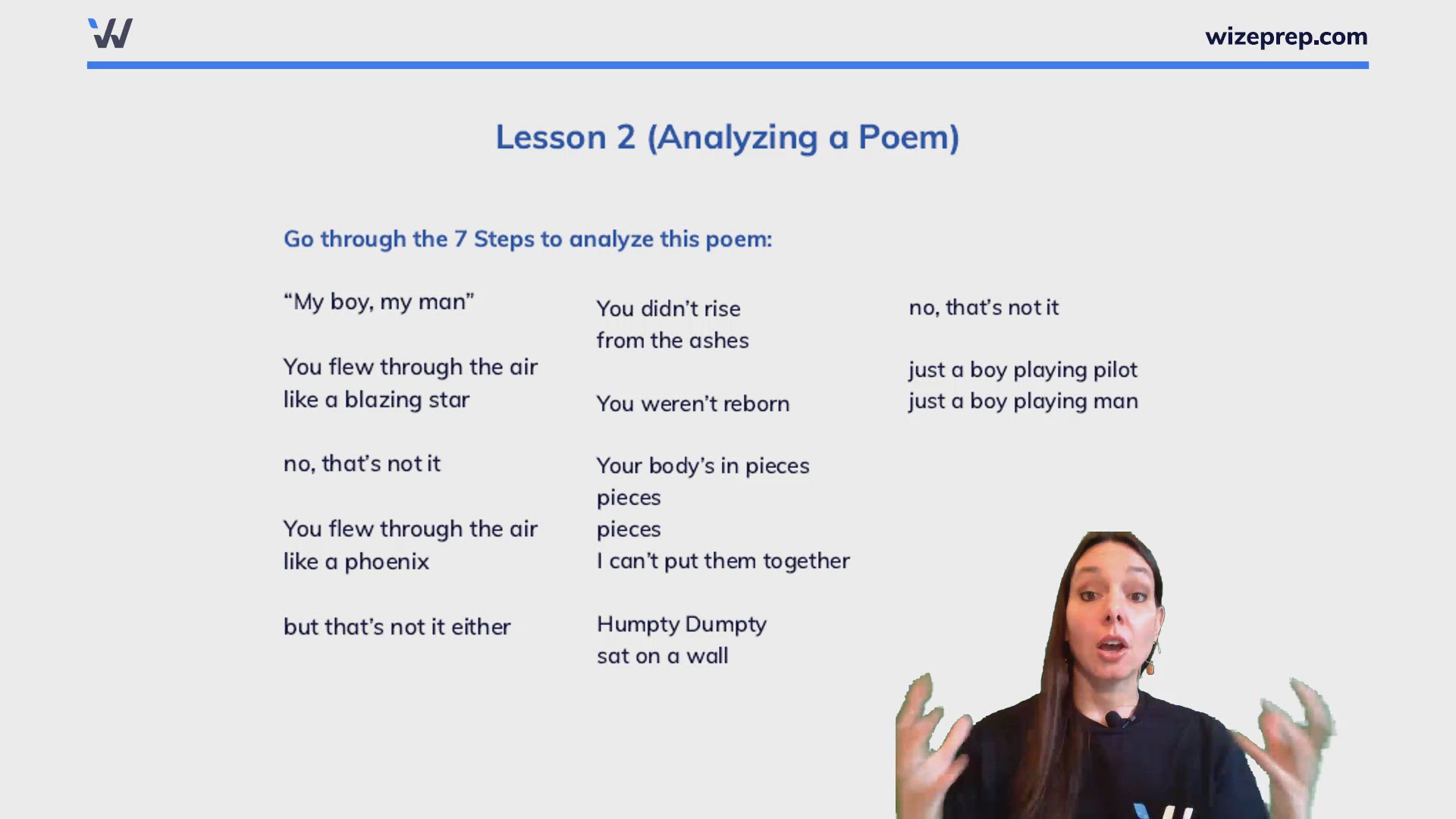
Go through the 7 Steps to analyze this poem:
“My boy, my man”
You flew through the air
like a blazing star
no, that’s not it
You flew through the air
like a phoenix
but that’s not it either
You didn’t rise
from the ashes
You weren’t reborn
Your body’s in pieces
pieces
pieces
I can’t put them together
Humpty Dumpty
sat on a wall
no, that’s not it
just a boy playing pilot
just a boy playing man
0:00 / 0:00
Close Reading from Shakespeare
The tricks that we use to analyze poetry (those 7 questions from the poetry lesson) come in quite handy when it comes to analyzing Shakespearean texts.
Let's work through a sample soliloquy step by step:
Tomorrow, and tomorrow, and tomorrow,
Creeps in this petty pace from day to day,
To the last syllable of recorded time;
And all our yesterdays have lighted fools
The way to dusty death. Out, out, brief candle!
Life's but a walking shadow, a poor player,
That struts and frets his hour upon the stage,
And then is heard no more. It is a tale
Told by an idiot, full of sound and fury,
Signifying nothing.
0:00 / 0:00
Narrative Untrustworthiness and Bias
Lesson 1 (Overview)
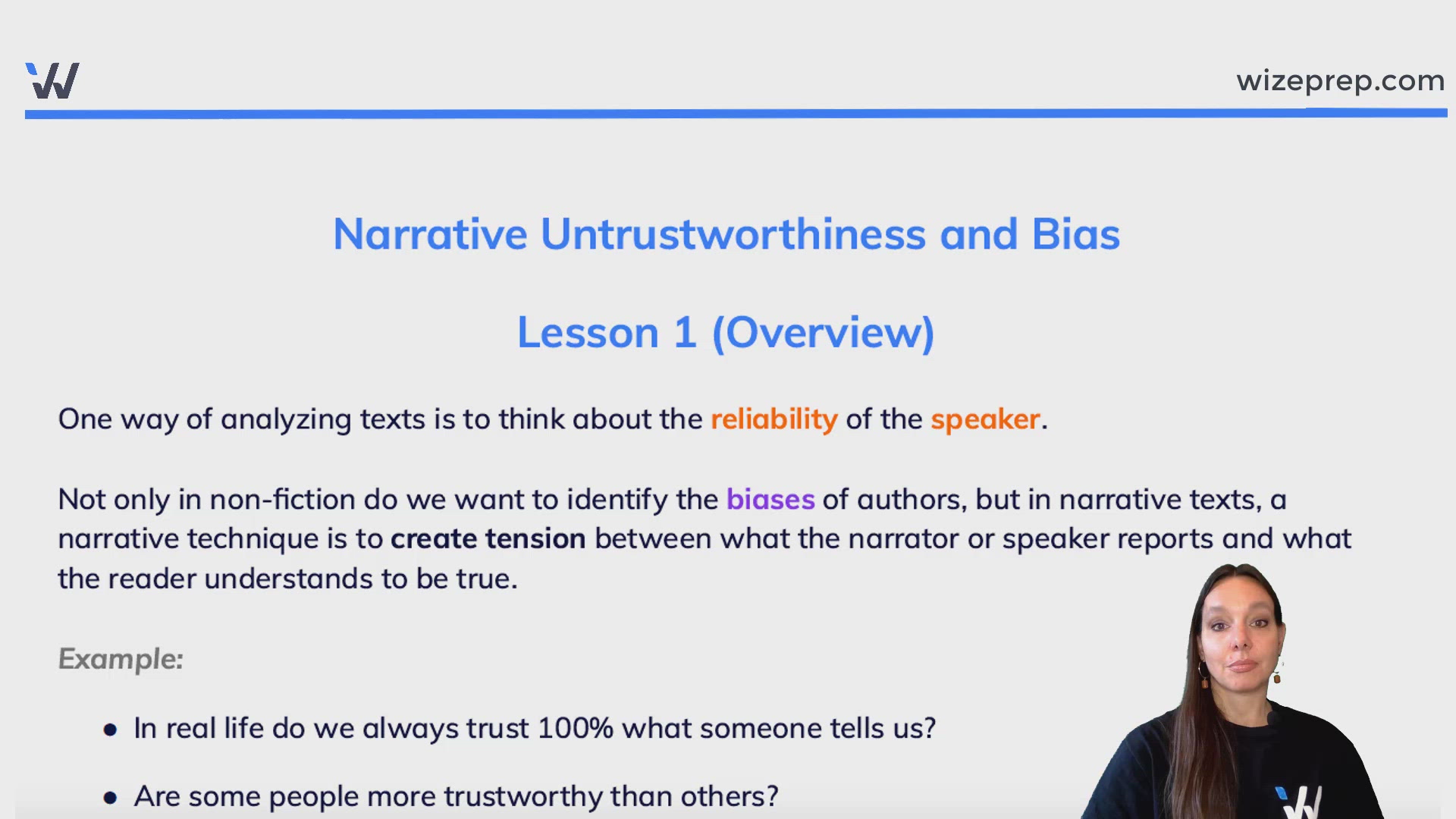
One way of analyzing texts is to think about the reliability of the speaker.
Not only in non-fiction do we want to identify the biases of authors, but in narrative texts, a narrative technique is to create tension between what the narrator or speaker reports and what the reader understands to be true.
Example:
- In real life do we always trust 100% what someone tells us?
- Are some people more trustworthy than others?
- Are some more reliable than others?
Wize Concept
We are constantly making these sorts of judgment calls in real life about who to believe and why, and we can do that when looking at written texts as well.
Here are some types of unreliable narrators
- Naive - This narrator is unreliable because of their lack of experience. They come across as childlike or innocent, and in some cases the narrator may even be a child.
- Outsider - This narrator is different from the others in the story. For instance, this type of narration is common in speculative fiction or science fiction when a character from our time either travels to another planet and meets aliens, or goes back in time. They may not describe things fully accurately, because they are outsiders who don't understand what is going on.
- Picaro - A picaro is a narrator who likes to embellish or exaggerate a story. This is like the typical "fishing story," where the size of the fish becomes bigger and bigger with every story.
- Insane - A narrator who has lost touch with reality or is otherwise insane can tell a compelling story that may not be reflective of the truth.
- Liar - This type of narrator intentionally deceives. These are rare to encounter, but they tell a nuanced story as the reader must try to sort fact from fiction.
0:00 / 0:00
Lesson 2 (How to Spot an Unreliable Narrator)
Now that we know not all narrators or speakers or writers (like not all journalists or people in general) can be trusted 100% of the time to be objective purveyors of truth, what are some tricks to find or expose an unreliable narrator?
Let's look at a sample excerpt from Wuthering Heights by Emily Brontë.
Don't worry if you've not read this novel; I'll tell you what it's about.
- It's set in 19th Century Western Yorkshire, the story focuses on two families who own neighbouring estates.
- The story begins in the present with Lockwood arriving at one of the estates, and through his visit, we learn of the intertwined past of the current landlord, Heathcliff, and his dead love, Catherine, who grew up on one estate, but married into the the neighbouring one.
- The story tells the intergenerational strife that began with Heathcliff and Catherine's generation, but carries through their children.
- The opening scene below is narrated in the first person, by Lockwood upon his arrival at Wuthering Heights, Heathcliff's estate.
Here's how the story opens:
"1801—I have just returned from a visit to my landlord—the solitary neighbour that I shall be troubled with. This is certainly a beautiful country! In all England, I do not believe that I could have fixed on a situation so completely removed from the stir of society. A perfect misanthropist’s Heaven—and Mr. Heathcliff and I are such a suitable pair to divide the desolation between us. A capital fellow! He little imagined how my heart warmed towards him when I beheld his black eyes withdraw so suspiciously under their brows, as I rode up, and when his fingers sheltered themselves, with a jealous resolution, still further in his waistcoat, as I announced my name."
Is Lockwood reliable and trustworthy?
0:00 / 0:00
Dramatic Irony
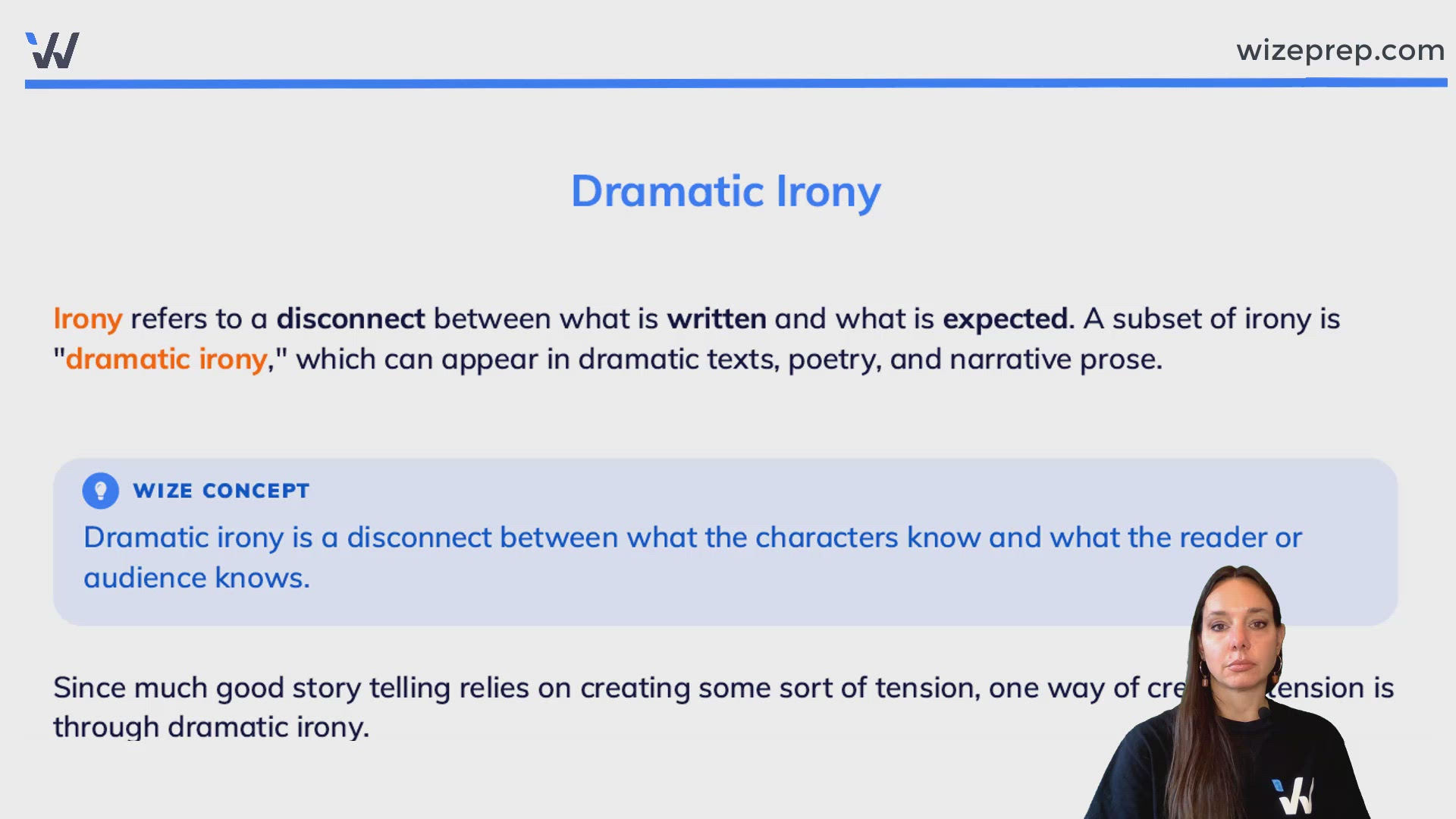
Irony refers to a disconnect between what is written and what is expected. A subset of irony is "dramatic irony," which can appear in dramatic texts, poetry, and narrative prose.
Wize Concept
Dramatic irony is a disconnect between what the characters know and what the reader or audience knows.
Since much good story telling relies on creating some sort of tension, one way of creating tension is through dramatic irony.
Example:
In reading a book or watching a movie about characters on the Titanic, we as readers or the audience know that the ship never arrives safely at its destination. So as characters refer to it as the "unsinkable ship," we know otherwise, and this is an example of dramatic irony.
Or in the classic tale of Beauty and the Beast (the Disney or original), we know from the outset that the beast is, in fact, a prince, but Belle, or Beauty, does not.
Comedic Function
Dramatic irony can also achieve a comedic function. Because we as the readers or audience know something the characters do not, their predicaments can be funny.
- The entire plot of Shakespeare's Twelfth Night, for example, works through dramatic irony.
- The play focuses on a brother and sister, separated by a shipwreck.
- The sister, Viola, dresses as her brother.
- The audience, of course, knows that she is Viola. So when she falls in love with Duke Orsino - and he thinks she is a boy - and the Countess Olivia - who the Duke Orsino is in love with - decides she loves "Viola," the entire cross-dressing, identity-swapping confusion of it all is appreciated by the audience, not the characters.
- In the end, of course, as happens in Shakespearean comedies, everyone is happy.
Shakespeare's Othello
In literature, one of the most well-known examples of dramatic irony is in Shakespeare's play Othello.
- In this play, the villain, named Iago, often turns to the audience to address us directly and tell us of his evil plans towards the main character, Othello.
- Othello, however, believes Iago to be his friend and refers to him often as "honest Iago," and says things like "I know thou ‘rt full of love and honesty."
- You can just imagine the Globe Theatre in Shakespeare's day exploding with shouts from the audience!
- And, sadly in the end, as in Shakespearean tragedy, the tragic hero dies.
0:00 / 0:00
Aristotle
The roots of literary critical theory often begins with Aristotle's Poetics.
Aristotle defines tragedy in Book VI as "an imitation of an action that is serious, complete, and of a certain magnitude; in language embellished with each kind of artistic ornament, the several kinds being found in separate parts of the play; in the form of action, not of narrative; through pity and fear effecting the proper purgation of these emotions."
- For Aristotle, comedy represents human beings as "worse than they are," but he notes that comic characters are not necessarily evil, just ridiculous and laughable.
- He contrasts comedy with tragedy, which represents humans as "better than they are."
Since we have talked about Shakespearean tragedy, it is important to recognize that his plays follow an Aristotelian model wherein the tragic hero falls not through some random act, but through specific actions associated with his own character flaws that bring about his downfall.
0:00 / 0:00
Oral Storytelling
Lesson 1 (Overview)
One aspect we have focused on thus far is analyzing the written word.
- Written texts in English follow a number of conventions, not the least of which is left to right and top to bottom reading, which leads to a sense of language progressing ever forward.
- English has developed from Old English in the times of Beowulf, through Chaucer's Middle English, to what we know today as Contemporary English.
- Through the centuries the language has unfolded in keeping with certain conventions of writing, especially from the 1588 invention of the printing press.
- From that point on, the oral storytelling techniques underpinning texts like Beowulf or The Aeneid or myths and stories from other cultures, became subsumed in a Euro-centric modality.
Canada
In Canada, it is important to understand what postcolonial theorists call our position within a "settler-invader" context.
- What this means is that while other postcolonial countries had a European imperial colonizer and a large, local colonized population, say, for instance in many countries in Africa or in India, places like Canada and Australia had smaller indigenous populations when colonized by European powers, and then those European countries, and others, continued to settle across the landscape, overwhelming indigenous populations.
- There's more to it than that, of course, but at a high level, you see that Canada's literary culture is often considered to be its written culture, but First Nations story-telling long predates European settlement in Canada.
- First Nations story-telling practices focus on orality rather than linear plot lines.
- As teachers, we work to indigenize our curriculum and expand our own knowledge base into different ways of knowing and passing on information.
0:00 / 0:00
Lesson 2 (First Nations Example)
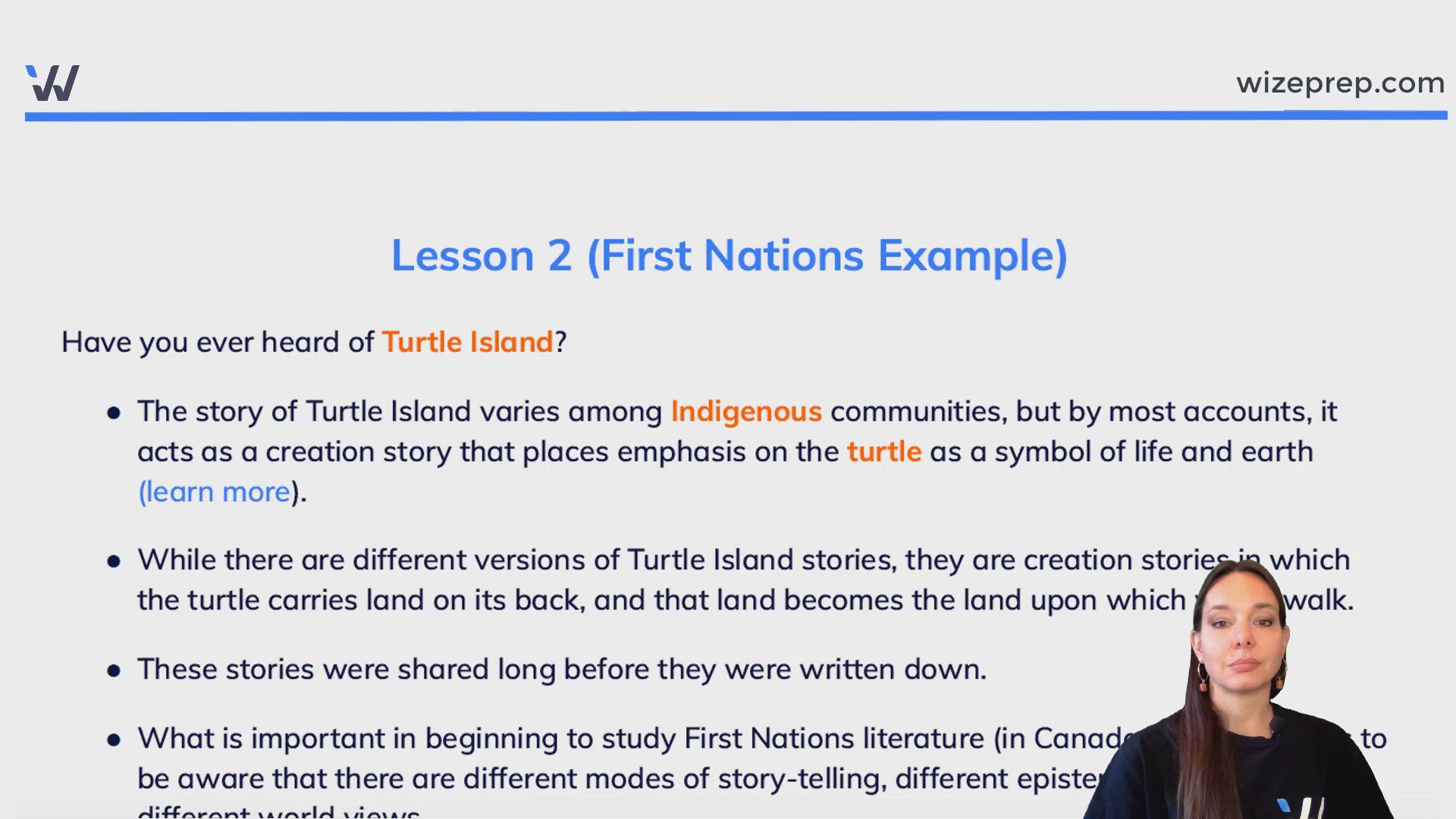
Have you ever heard of Turtle Island?
- The story of Turtle Island varies among Indigenous communities, but by most accounts, it acts as a creation story that places emphasis on the turtle as a symbol of life and earth (learn more).
- While there are different versions of Turtle Island stories, they are creation stories in which the turtle carries land on its back, and that land becomes the land upon which we all walk.
- These stories were shared long before they were written down.
- What is important in beginning to study First Nations literature (in Canada and globally) is to be aware that there are different modes of story-telling, different epistemologies, and different world views.
- Another element that is important in looking at First Nations literature is the idea of "cultural appropriation" or "appropriation of voice." Non indigenous writers perform a kind of literary colonization when they take indigenous stories and tell them. It's like stealing something to make it your own. Much better to get indigenous stories from indigenous artists and writers.