Popular Courses
Grade 10 Math
Canada High School
Grade 9 Math
Canada High School
DAT
General Course
DAT
General Course
Grade 10 Principles of Mathematics
Ontario High School
Math 10C
Alberta High School
Grade 9 Math (De-streamed)
Ontario High School
ADM 1305
University of Ottawa
Foundations of Math and Pre-Calculus 10
British Columbia High School
Math 9
Alberta High School
QMS 110
Toronto Metropolitan University
Grade 10 Foundations of Mathematics
Ontario High School
MATH 122
McGill University
MATH-1980
University of Windsor
MATH-1980
University of Windsor
MATH 1314
Tarrant County College District
MATH 1302
University of Texas at Arlington
MATH 0098
Baton Rouge Community College
0:00 / 0:00
Graphing Linear Equations - Table of Values

Given the equation of a line, we can graph the line by creating a table of values and plotting the points on the graph.
Example
Graph by using a table of values.

This can take a while! Instead, we want to use the slope and the y-intercept or another point to quickly graph a linear equation.
0:00 / 0:00
Graphing Linear Equations - Slope y-Intercept Form
Here are the steps for graphing a line using the slope and y-intercept information:
- If the equation is not already in slope y-intercept form, rewrite it into this form
- If the slope isn't already in fraction form, rewrite it as a fraction
- Plot the *You can also just plot any point that's on the line
- From this point, use the slope to determine another point on the graph
- If is positive, go up "rise" units, and go to the right "run" units
- If is negative, go down "rise" units, and go to the right "run" units
- Connect these two points and you have a line!
Example
Graph the line .
- Rewriting this:
- The slope is
- The y-intercept is 3.
- Starting at , go down 2 and right 1

- We arrive at the point . Connect this point with the y-intercept and we have our line!
0:00 / 0:00
Graphing Linear Equations - Using Intercepts

Recall
- The -intercept is where the graph of the line crosses the -axis (horizontal axis)
- The -intercept is where the graph of the line crosses the -axis (vertical axis)
Here are the steps for graphing a line using the intercept information:
- Find the by setting then solving for the value
- Find the by setting then solving for the value
- Plot these two intercept points on the graph
- Connect these two points to get the graph of your line!
Example
Graph the line .
- Set : So the -intercept is (meaning the line crosses the -axis at )
- Set : So the -intercept is (meaning the line crosses the -axis at )
- Plot the two intercepts:

- Connecting these points we get our linear graph!
Practice: Graphing Linear Equations
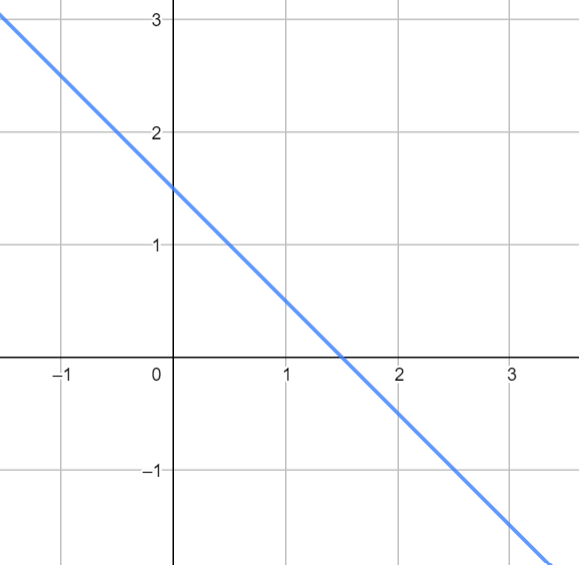
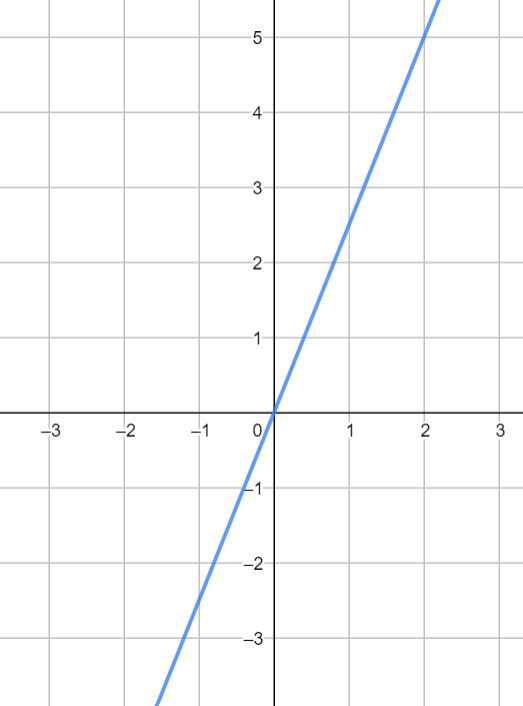
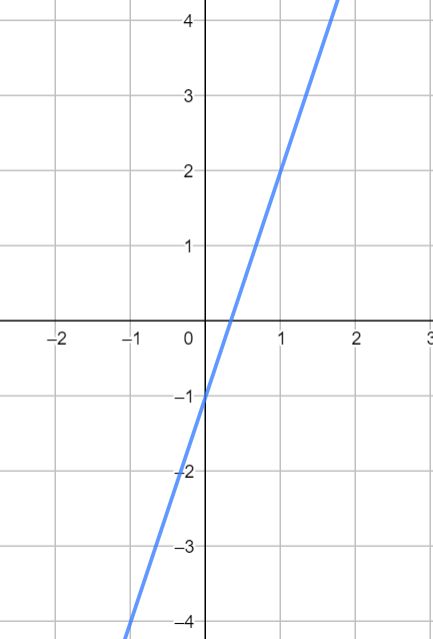
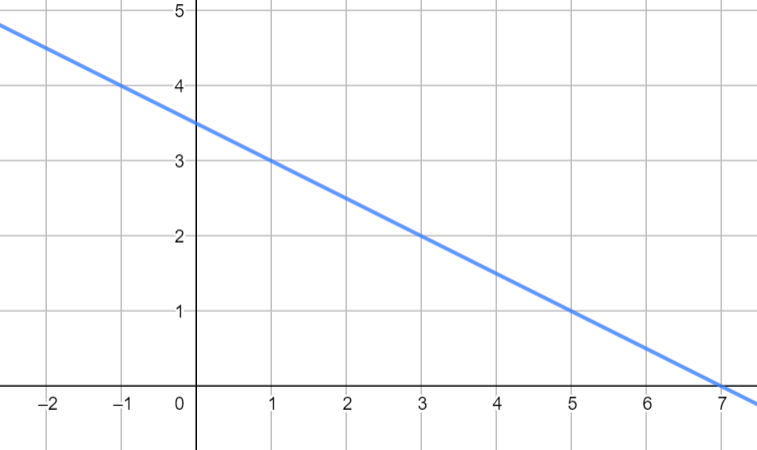
Match the following linear graphs with their equations.
A.
B.
C.
D.