Create a free account to get started

Unlock full course notes by signing up

  • Video lessons taught by top educators
  • Practice questions with guided solutions
  • Written review notes for reference
  • Expert answers anytime from course tutors

Intro to Rational Numbers
Image illustrating Intro to Rational Numbers


Numbers are used to represent quantities in everyday life.


Examples

  • The temperature on a hot day is 26 °C26\ \degree\text{C} or 79°F79\degree\text{F}
  • The temperature on a cold day is −20°C-20\degree\text{C} or −4°F-4\degree\text{F}
  • A coffee costs $1.45
  • 25\frac{2}{5} of the class wears glasses


A number line is a very helpful tool for organizing numbers


Image illustrating Intro to Rational Numbers

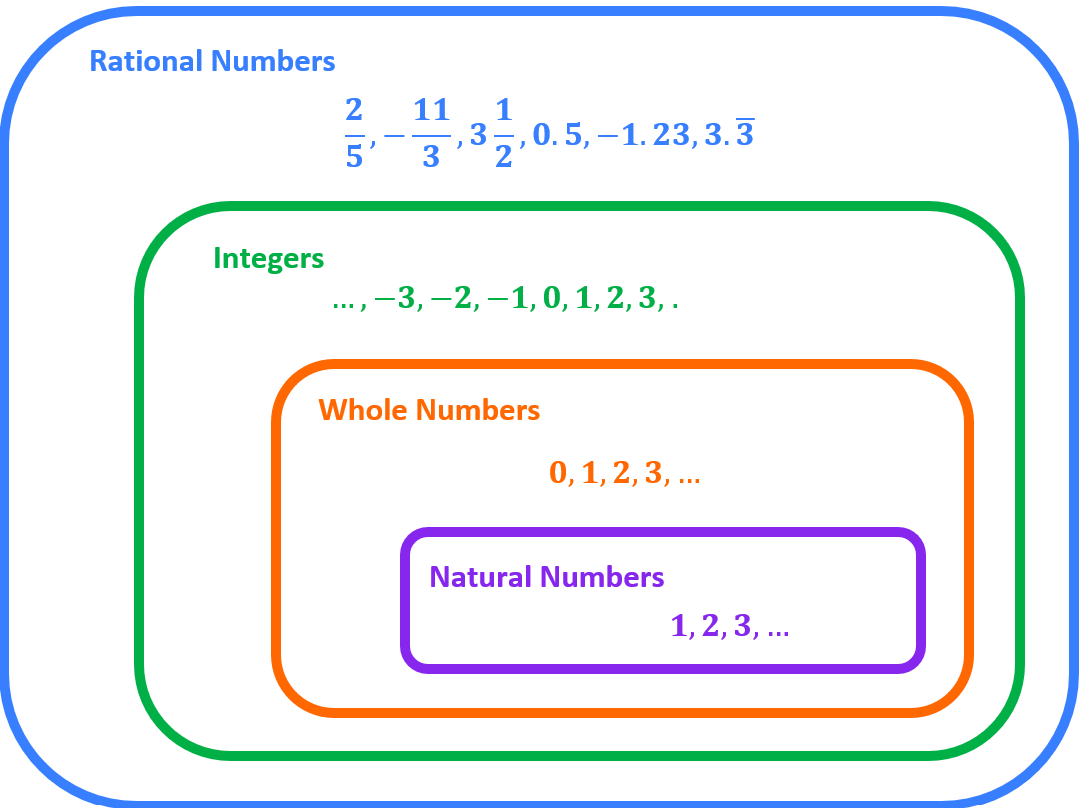
Types of Numbers

  • Natural Numbers - You count them, starting at 1
  • Examples: 1, 2, 3,...1,\ 2,\ 3,...
  • Represented by ________ for natural numbers
  • Whole Numbers - You count them, starting at 0
  • Examples: 0, 1, 2, 3,...0,\ 1,\ 2,\ 3,...
  • Represented by ________ for whole numbers
  • Integers - Positive and negative whole numbers
  • Examples: ..., −3, −2, −1, 0, 1, 2, 3,......,\ -3,\ -2,\ -1,\ 0,\ 1,\ 2,\ 3,...
  • We can put these on a number line
  • Represented by ________ for integers
  • Rational Numbers - Any number that can be written as a quotient (division) ab\displaystyle \frac{a}{b} where aa and bb are integers and b≠0b\neq 0
  • Examples: 25, −113, 312, 0.5, −1.23, 3.3‾\displaystyle \frac{2}{5},\ -\frac{11}{3},\ 3\frac{1}{2},\ 0.5,\ -1.23,\ 3.\overline{3}
  • Represented by ________ for quotient


Image illustrating Intro to Rational Numbers


Create a free account to get started

Unlock full course notes by signing up

  • Video lessons taught by top educators
  • Practice questions with guided solutions
  • Written review notes for reference
  • Expert answers anytime from course tutors

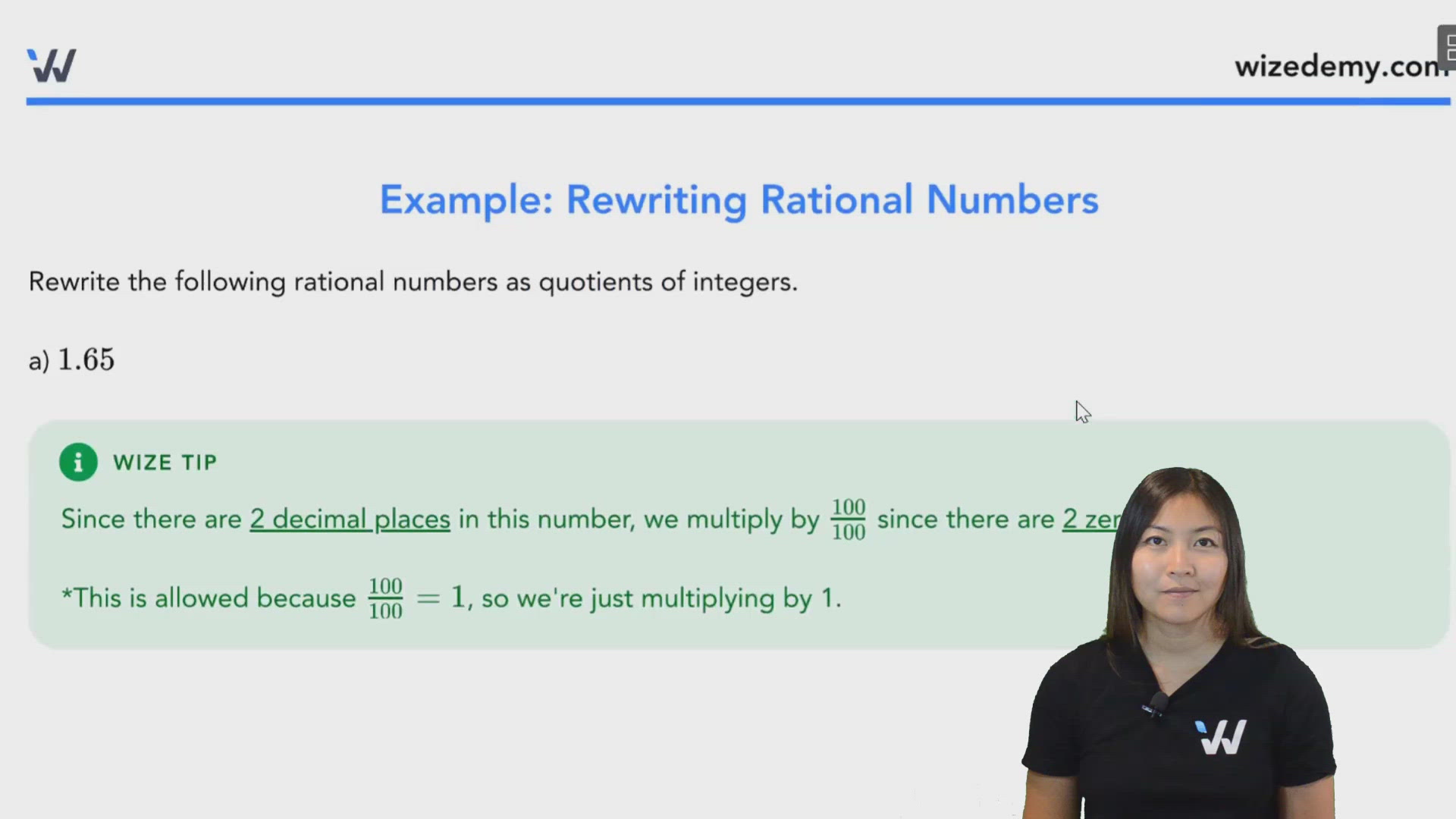
Example: Rewriting Rational Numbers

Rewrite the following rational numbers as quotients of integers.


a) 1.651.65


1.65=1.65×100100=1651001.65=\displaystyle 1.65\times\frac{100}{100}=\frac{165}{100}


You can also simplify this to 165100=3320\displaystyle \frac{\cancel{165}}{\cancel{100}}=\frac{33}{20}


b) −5-5


−5=−5×11=−51\displaystyle-5=-5\times\frac{1}{1}=-\frac{5}{1}


c) −0.302-0.302


−0.302=−0.302×10001000=−3021000 -0.302=\displaystyle -0.302\times\frac{1000}{1000}=-\frac{302}{1000}\


You can also simplify this to −3021000=−151500\displaystyle -\frac{\cancel{302}}{\cancel{1000}}=-\frac{151}{500}


d) −0.0013-0.0013


−0.0013=−0.0013×1000010000=−1310000-0.0013=\displaystyle -0.0013\times\frac{10000}{10000}=-\frac{13}{10000}


e) 00


01 or 02 or 0any non-zero integer\displaystyle \frac{0}{1}\text{ or } \frac{0}{2} \text{ or } \frac{0}{\text{any non-zero integer}}

Practice: Rewriting Rational Numbers

Rewrite the following rational numbers as quotients of integers.


a) 1.251.25


b) −0.160-0.160


c) −0.0005-0.0005


Enter your final answer as an improper fraction, make sure to simplify your answer.

Your answers

Create a free account to get started

Unlock full course notes by signing up

  • Video lessons taught by top educators
  • Practice questions with guided solutions
  • Written review notes for reference
  • Expert answers anytime from course tutors

Create a free account to get started

Unlock full course notes by signing up

  • Video lessons taught by top educators
  • Practice questions with guided solutions
  • Written review notes for reference
  • Expert answers anytime from course tutors

Example: Comparing Rational Numbers

List the following rational numbers from smallest to largest.

a) −3.45, 3.45, −3.451, −3.448, 3.451, 3.448-3.45,\ 3.45,\ -3.451,\ -3.448,\ 3.451,\ 3.448


Some of the numbers have 2 decimal places, some have 3. Rewrite them so that they have all 3 decimal places:


−3.450, 3.450, −3.451, −3.448, 3.451, 3.448-3.450,\ 3.450,\ -3.451,\ -3.448,\ 3.451,\ 3.448


Now it's much easier to compare them:


−3.451<−3.45<−3.448<3.448<3.45<3.451\boxed{-3.451<-3.45<-3.448<3.448<3.45<3.451}


b)  13, 23, −45, −23, −13, 45\displaystyle\ \frac{1}{3},\ \frac{2}{3},\ -\frac{4}{5},\ -\frac{2}{3},\ -\frac{1}{3},\ \frac{4}{5}


A common denominator is 3×5=153\times 5=15:


 1×53×5, 2×53×5, −4×35×3, −2×53×5, −1×53×5, 4×35×3\displaystyle\ \frac{1\colorFour{\times 5}}{3\colorFour{\times 5}},\ \frac{2\colorFour{\times 5}}{3\colorFour{\times 5}},\ -\frac{4\colorFour{\times 3}}{5\colorFour{\times 3}},\ -\frac{2\colorFour{\times 5}}{3\colorFour{\times 5}},\ -\frac{1\colorFour{\times 5}}{3\colorFour{\times 5}},\ \frac{4\colorFour{\times 3}}{5\colorFour{\times 3}}


Now all of the fractions have the same denominator:


 515, 1015, −1215, −1015, −515, 1215\displaystyle\ \frac{5}{15},\ \frac{10}{15},\ -\frac{12}{15},\ -\frac{10}{15},\ -\frac{5}{15},\ \frac{12}{15}


We just need to compare the numerators:


−1215<−1015<−515<515<1015<1215\displaystyle -\frac{12}{15}<-\frac{10}{15}<-\frac{5}{15}<\frac{5}{15}<\frac{10}{15}<\frac{12}{15}


Rewriting this back into our original fractions:


−45<−23<−13<13<23<45\boxed{\displaystyle -\frac{4}{5}<-\frac{2}{3}<-\frac{1}{3}<\frac{1}{3}<\frac{2}{3}<\frac{4}{5}}


c) −356, −334, −423\displaystyle -3 \frac{5}{6},\ \displaystyle -3 \frac{3}{4},\ -4\frac{2}{3}


A common denominator is 6×4×3=726\times 4\times 3=72:


−35×126×12, −33×184×18, −42×243×24\displaystyle -3 \frac{5\colorFour{\times12}}{6\colorFour{\times12}},\ \displaystyle -3 \frac{3\colorFour{\times18}}{4\colorFour{\times18}},\ -4\frac{2\colorFour{\times24}}{3\colorFour{\times24}}


Now all the fractions have the same denominator:


−36072, −35472, −44872\displaystyle -3 \frac{60}{72},\ -3 \frac{54}{72},\ -4 \frac{48}{72}


When comparing these, we first look at the whole number part, and only use the fraction part if there's a tie:


−44872<−36072<−35472\displaystyle -4\frac{48}{72}<-3\frac{60}{72}<-3\frac{54}{72}


Rewriting this back into our original fractions:


 −423<−356<−334\boxed{\displaystyle\ -4 \frac{2}{3}<-3 \frac{5}{6}<-3 \frac{3}{4}}


d) 0.3, 15, 0.33, −32, 1.2, −86, 0.329, −1.51\displaystyle 0.3,\ \frac{1}{5},\ 0.33,\ -\frac{3}{2},\ 1.2,\ -\frac{8}{6},\ 0.329,\ -1.51


Let's convert these to decimals:

  • 15=0.2\displaystyle \frac{1}{5}=0.2
  • −32=−1.5\displaystyle -\frac{3}{2}=-1.5
  • −86=−1.33333......repeating\displaystyle -\frac{8}{6}=-1.33333...... \text{repeating}

Now we can more easily compare these rational numbers

−1.51< −32<−86<15<0.3<0.329<0.33<1.2\boxed{\displaystyle-1.51<\ -\frac{3}{2}<-\frac{8}{6}<\frac{1}{5}<0.3<0.329<0.33<1.2}

Practice: Comparing Rational Numbers

In each of the following questions, you are asked to pick the smallest or biggest number in the group.

Pick the smallest number.

Choose an answer

Create a free account to get started

Unlock full course notes by signing up

  • Video lessons taught by top educators
  • Practice questions with guided solutions
  • Written review notes for reference
  • Expert answers anytime from course tutors

Create a free account to get started

Unlock full course notes by signing up

  • Video lessons taught by top educators
  • Practice questions with guided solutions
  • Written review notes for reference
  • Expert answers anytime from course tutors

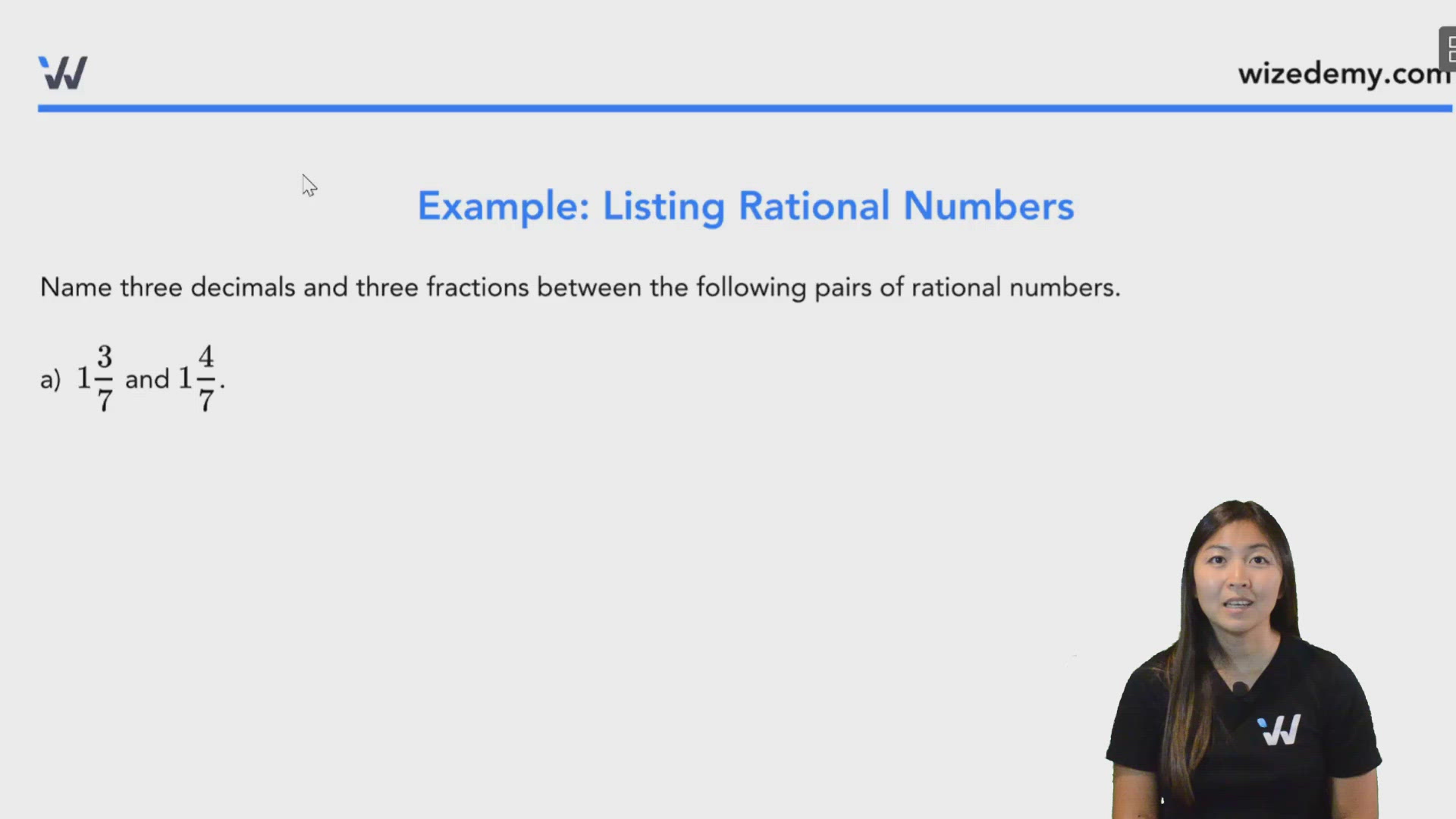
Example: Listing Rational Numbers

Name three decimals and three fractions between the following pairs of rational numbers.


a) 137\displaystyle1\frac{3}{7} and 147\displaystyle1\frac{4}{7}.

Decimal Method

Let's first convert these to decimals:

  • 137=1.42...\displaystyle1\frac{3}{7}=1.42...
  • 137=1.57...\displaystyle1\frac{3}{7}=1.57...

Therefore, three possibles decimals between these two rational numbers are 1.51, 1.52, 1.531.51,\ 1.52,\ 1.53 (there are many other possible answers).


Fraction Method

We can multiply the numerator and denominator by the same integer:

  • 13×107×10=13070\displaystyle1\frac{3\orange{\times10}}{7\orange{\times10}}=1\frac{30}{70}
  • 14×107×10=14070\displaystyle1\frac{4\orange{\times10}}{7\orange{\times10}}=1\frac{40}{70}

Therefore, three possible fractions between these two rational numbers are 13170, 13270, 13370\displaystyle 1\frac{31}{70},\ 1\frac{32}{70},\ 1\frac{33}{70} (there are many other possible ansers).


*Note: you could have chosen to multiply the numerator and denominator by any other integer.


b) −215\displaystyle -2\frac{1}{5} and −225-\displaystyle 2\frac{2}{5}.

Decimal method

Let's first convert these to decimals:

  • −215=−2.2\displaystyle-2\frac{1}{5}=-2.2
  • −225=−2.4\displaystyle-2\frac{2}{5}=-2.4

Therefore, three possibles decimals between these two rational numbers are −2.21, −2.22, −2.23-2.21,\ -2.22,\ -2.23 (there are many other possible answers).


Fraction method

We can multiply the numerator and denominator by the same integer:

  • −21×105×10=−21050\displaystyle-2\frac{1\orange{\times10}}{5\orange{\times10}}=-2\frac{10}{50}
  • −22×105×10=−22050\displaystyle-2\frac{2\orange{\times10}}{5\orange{\times10}}=-2\frac{20}{50}

Therefore, three possible fractions between these two rational numbers are −21150, −21250, −21350\displaystyle -2\frac{11}{50},\ -2\frac{12}{50},\ -2\frac{13}{50} (there are many other possible answers).


*Note: you could have chosen to multiply the numerator and denominator by any other integer.

Practice: Possible Rational Numbers

The thickness of a wooden plank needed to build a shelf must be between 38"\displaystyle\frac{3}{8}^" and 58"\displaystyle\frac{5}{8}^". At a local lumber store, you're able to find wood with the following thicknesses. Select all of the ones that you can use to build this shelf.


Illustration for practice question: Practice: Possible Rational Numbers


Choose an answer

Create a free account to get started

Unlock full course notes by signing up

  • Video lessons taught by top educators
  • Practice questions with guided solutions
  • Written review notes for reference
  • Expert answers anytime from course tutors