Wize High School Grade 9 Math Textbook > Rational Numbers
Intro to Rational Numbers

0:00 / 0:00
Intro to Rational Numbers

Numbers are used to represent quantities in everyday life.
Examples
- The temperature on a hot day is or
- The temperature on a cold day is or
- A coffee costs $1.45
- of the class wears glasses
A number line is a very helpful tool for organizing numbers

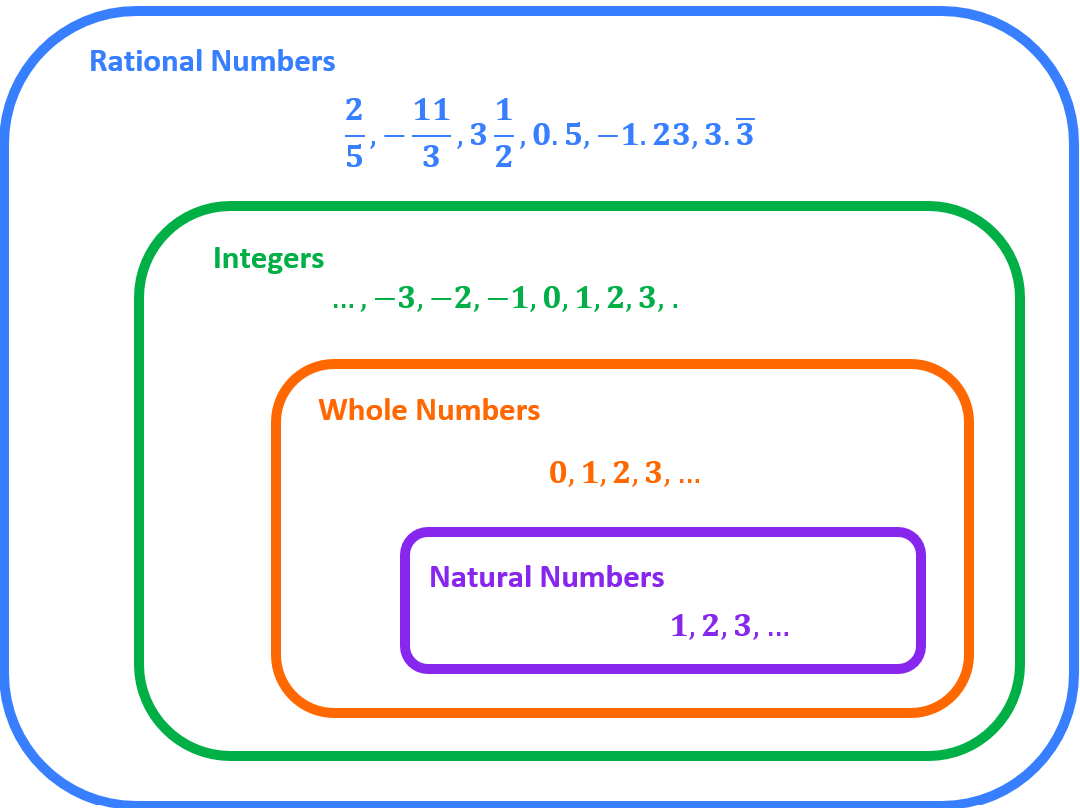
Types of Numbers
- Natural Numbers - You count them, starting at 1
- Examples:
- Represented byNfor natural numbers
- Whole Numbers - You count them, starting at 0
- Examples:
- Represented byWfor whole numbers
- Integers - Positive and negative whole numbers
- Examples:
- We can put these on a number line
- Represented byIfor integers
- Rational Numbers - Any number that can be written as a quotient (division) where and are integers and
- Examples:
- Represented byQfor quotient
Wize Tip
You might hear your teacher call two numbers opposite, this just means that they are negatives of one another.
0:00 / 0:00
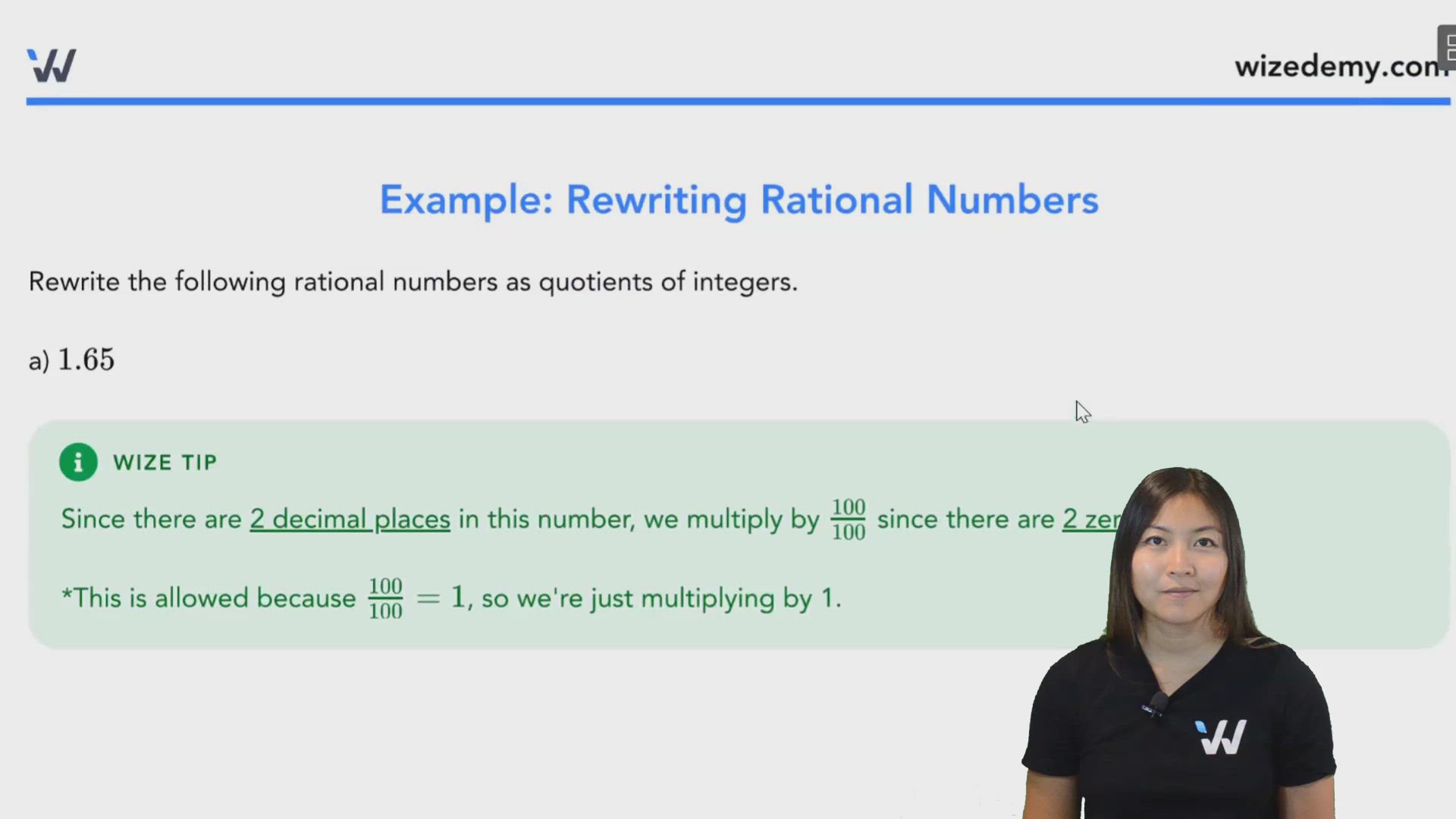
Example: Rewriting Rational Numbers
Rewrite the following rational numbers as quotients of integers.
a)
Wize Tip
Since there are 2 decimal places in this number, we multiply by since there are 2 zeros in 100.
*This is allowed because , so we're just multiplying by 1.
You can also simplify this to
b)
Wize Tip
Most commonly, you will see rather than .
c)
Wize Tip
Since there are 3 decimal places in this number, we multiply by since there are 3 zeros in 1000.
*This is allowed because , so we're just multiplying by 1.
You can also simplify this to
d)
Wize Tip
Since there are 4 decimal places in this number, we multiply by since there are 4 zeros in 10000.
*This is allowed because , so we're just multiplying by 1.
e)
Practice: Rewriting Rational Numbers
Rewrite the following rational numbers as quotients of integers.
a)
b)
c)
Enter your final answer as an improper fraction, make sure to simplify your answer.

0:00 / 0:00
Example: Comparing Rational Numbers
List the following rational numbers from smallest to largest.
a)
Wize Tip
When a number is negative, the larger the value looks, the smaller the actual number is.
Example: but
Some of the numbers have 2 decimal places, some have 3. Rewrite them so that they have all 3 decimal places:
Now it's much easier to compare them:
b)
Wize Tip
When comparing fractions, it helps to convert them to a common denominator.
You can also draw pictures, use a number line, or use fraction tiles to help you see how big each fraction is.
If you're allowed a calculator, you can convert the fractions to decimals first.
A common denominator is :
Now all of the fractions have the same denominator:
We just need to compare the numerators:
Rewriting this back into our original fractions:
c)
Wize Tip
When comparing fractions, it helps to convert them to a common denominator.
You can also draw pictures, user a number line or use fraction tiles to help you see how big each fraction is.
If you're allowed a calculator, you can convert the fractions to decimals first.
A common denominator is :
Now all the fractions have the same denominator:
When comparing these, we first look at the whole number part, and only use the fraction part if there's a tie:
Rewriting this back into our original fractions:
d)
Wize Tip
To compare rational numbers in different forms, it's easier if we convert them all to fractions or all to decimals.
Let's convert these to decimals:
Now we can more easily compare these rational numbers
Practice: Comparing Rational Numbers
In each of the following questions, you are asked to pick the smallest or biggest number in the group.
Pick the smallest number.
0:00 / 0:00
Example: Listing Rational Numbers
Name three decimals and three fractions between the following pairs of rational numbers.
a) and .
Decimal Method
Let's first convert these to decimals:
Therefore, three possibles decimals between these two rational numbers are (there are many other possible answers).
Fraction Method
We can multiply the numerator and denominator by the same integer:
Therefore, three possible fractions between these two rational numbers are (there are many other possible ansers).
*Note: you could have chosen to multiply the numerator and denominator by any other integer.
b) and .
Decimal method
Let's first convert these to decimals:
Therefore, three possibles decimals between these two rational numbers are (there are many other possible answers).
Fraction method
We can multiply the numerator and denominator by the same integer:
Therefore, three possible fractions between these two rational numbers are (there are many other possible answers).
*Note: you could have chosen to multiply the numerator and denominator by any other integer.
Practice: Possible Rational Numbers
The thickness of a wooden plank needed to build a shelf must be between and . At a local lumber store, you're able to find wood with the following thicknesses. Select all of the ones that you can use to build this shelf.