0:00 / 0:00

Adding & Subtracting Integers & Decimals
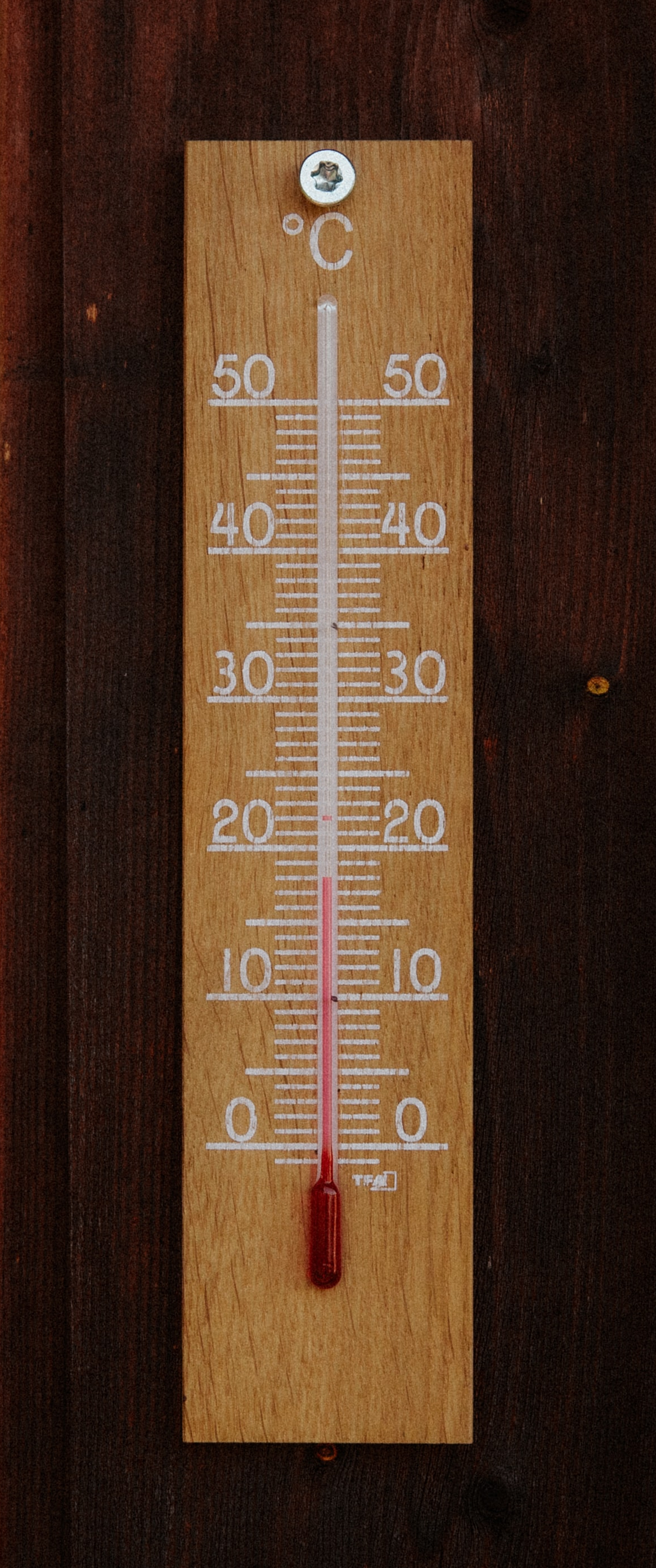

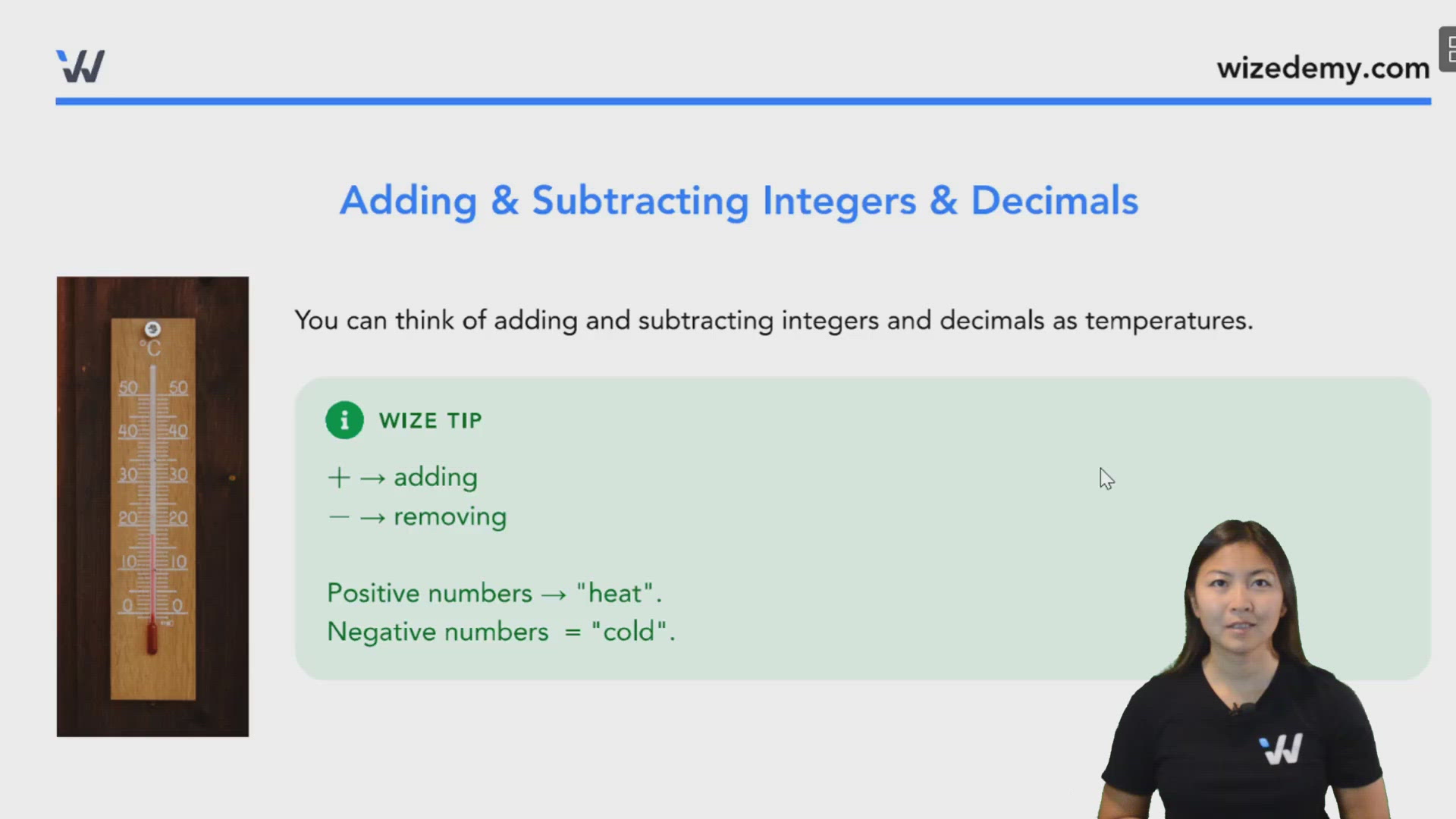
You can think of adding and subtracting integers and decimals as temperatures.

Wize Tip
++ → adding
- → removing

Positive numbers → "heat".
Negative numbers = "cold".

PAGE BREAK
Example 1
14.1(+5.3)=14.1-(+5.3)=
8.8

It's 14.1 degrees, and you're "removing 5.3 degrees of heat" → the final temperature will be 8.8 degrees.

Example 2
14.1+(5.3)=14.1+\left(-5.3\right)=
8.8

It's 14.1 degrees, and you're "adding 5.3 degrees of cold" → the final temperature will be 8.8 degrees.

Example 3
14.1(5.3)=14.1-\left(-5.3\right)=
19.4

It's 14.1 degrees, and you're "removing 5.3 degrees of cold" → the final temperature will be 19.4 degrees.

PAGE BREAK

Remember these Shortcuts!

Wize Tip
Same signs side-by-side make a positive+ + +   +Ex.  3+(+2)=3+2=5Ex.  3(2)=3+2=5Opposite signs side-by-side make a negative+   +  Ex.  3+(2)=32=1Ex.  3(+2)=32=1\begin{array}{|c|c|} \hline \\ \begin{array}{c}\text{Same signs side-by-side make a positive}\\+\ +\ \to +\\-\ -\ \to\ +\end{array} & \begin{array}{l}\text{Ex. \ }3\bcf+(\bcf+2)=3\bcf+2=5\\ \text{Ex. \ }3\bcf-(\bcf-2)=3\bcf+2=5 \end{array} \\ \\ \hline \\ \begin{array}{c}\text{Opposite signs side-by-side make a negative}\\+\ -\ \to -\\-\ +\ \to\ -\end{array} & \begin{array}{l}\text{Ex. \ }3\bcf+(\bcf-2)=3\bcf-2=1\\ \text{Ex. \ }3\bcf-(\bcf+2)=3\bcf-2=1 \end{array} \\ \\ \hline \end{array}

Examples 4 (revisited)
  1. 14.1(+5.3)=14.15.3=8.814.1\bcf-(\bcf+5.3)=14.1\bcf-5.3=8.8
  2. 14.1+(5.3)=14.15.3=8.814.1\bcf+\left(\bcf-5.3\right)=14.1\bcf-5.3=8.8
  3. 14.1(5.3)=14.1+5.3=19.414.1\bcf-\left(\bcf-5.3\right)=14.1\bcf+5.3=19.4
0:00 / 0:00

Example: Adding & Subtracting Integers & Decimals
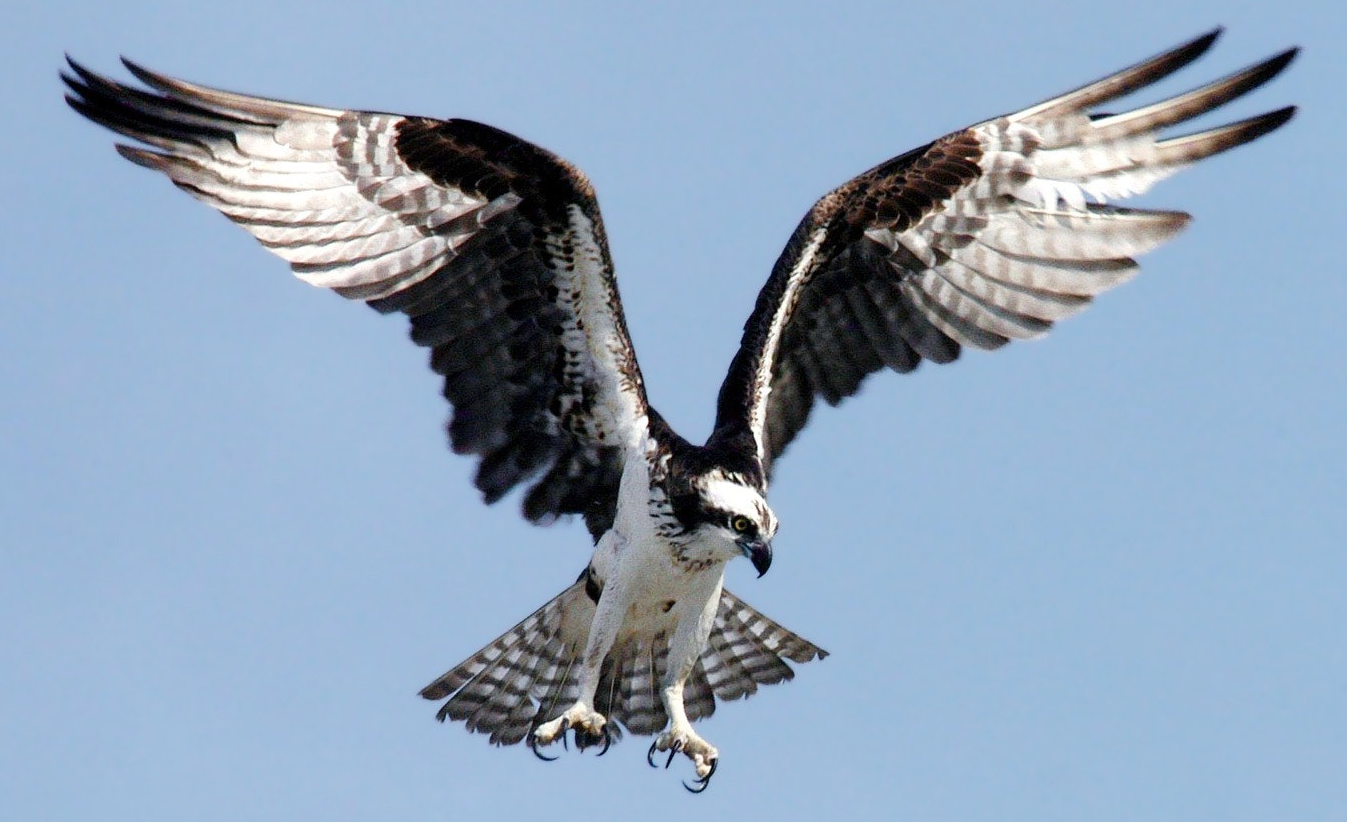

A bird flies off its nest that is 11.3 meters above the ground to catch a fish in the pond that is 4.7 meters deep. The bird dives a total of 13.4 meters.

a) What is the distance this bird dove below the surface of the pond water?

b) What is the distance from the bottom of the pond to the bottom of the bird's dive?

Part a)

The bird's total diving distance subtract the distance it dove above the water will give us the distance the bird dove below the surface:

13.411.3=2.113.4-11.3=2.1

Therefore, the bird dove 2.1 meters below the surface of the pond.

Part b)

The distance from the bottom of the pond to the bottom of the bird's dive is 4.72.1=2.64.7-2.1=2.6 meters.

Alternatively, we can complete this problem by treating the ground level (or surface of the pond) as our 0 reference point:
If we let the surface of the water be at height 0, the distance above the water be positive, and the distance below the water be negative, then the distance is 4.7(2.1)=4.7+2.1=2.6-4.7-(-2.1)=-4.7+2.1=-2.6 meters.

Practice: Adding & Subtracting Decimals

Evaluate 3.5(0.7)+(1.2)+1.4-3.5-\left(-0.7\right)+\left(-1.2\right)+1.4.
0:00 / 0:00

Multiplying & Dividing Integers & Decimals

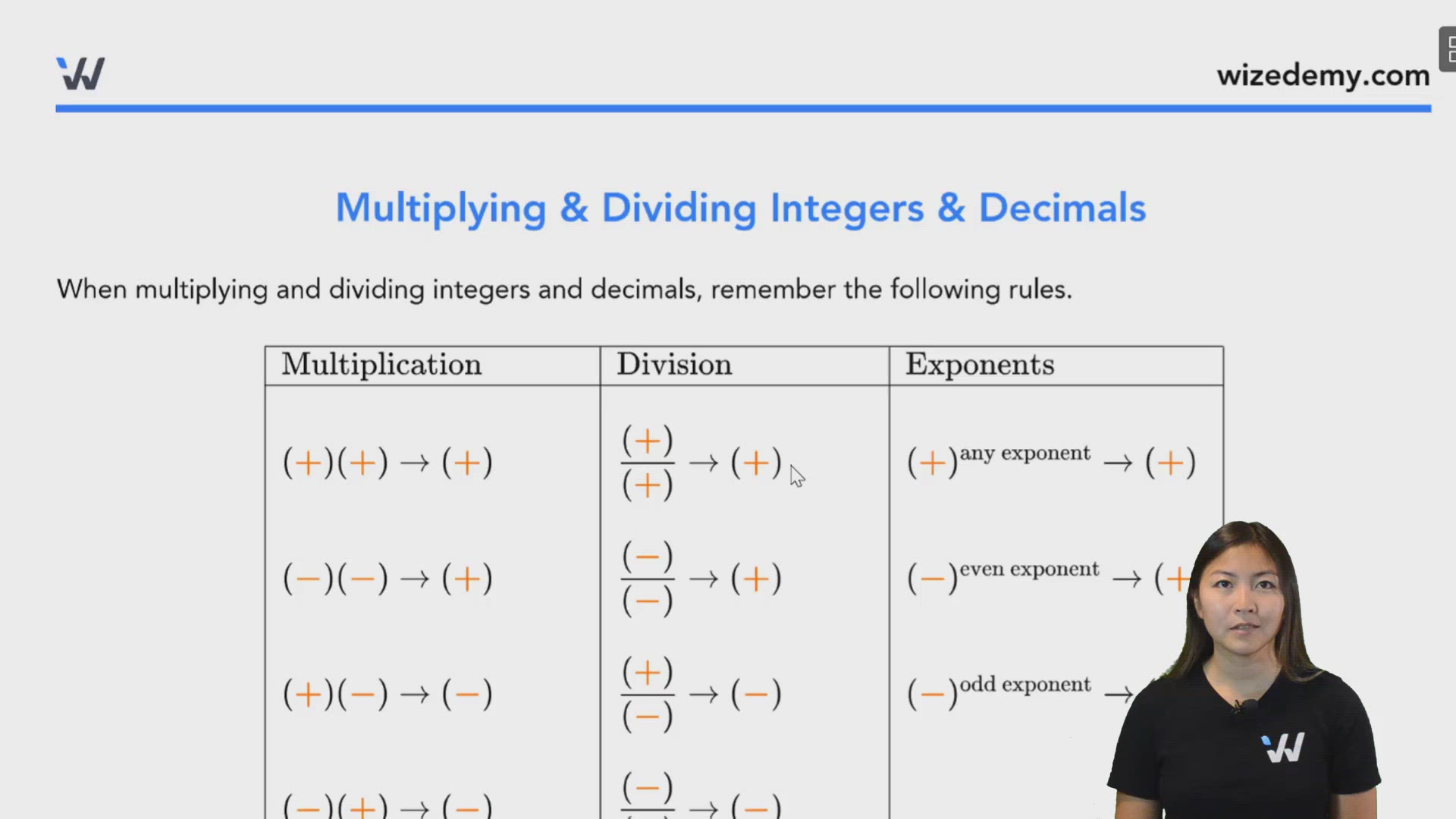
When multiplying and dividing integers and decimals, remember the following rules.

Multiplication       Division(+)(+)(+)(+)(+)(+)()()(+)()()(+)(+)()()(+)()()()(+)()()(+)()\begin{array}{|lc|lc|} \hline \text{Multiplication}&~~~~~~~&\text{Division}\\ \hline\\ (\bcf+)(\bcf+)\to(\bcf+)&& \displaystyle\frac{(\bcf+)}{(\bcf+)}\to(\bcf+)\\\\ (\bcf-)(\bcf-)\to(\bcf+)&& \displaystyle\frac{(\bcf-)}{(\bcf-)}\to(\bcf+)\\\\ (\bcf+)(\bcf-)\to(\bcf-)&& \displaystyle\frac{(\bcf+)}{(\bcf-)}\to(\bcf-)\\\\ (\bcf-)(\bcf+)\to(\bcf-)&&\displaystyle\frac{(\bcf-)}{(\bcf+)}\to(\bcf-)\\\\ \hline \end{array}

PAGE BREAK
Example 1
a) 4.7×(2)=-4.7\times(-2)=
9.4

Remember: ()×()(+)(\bcf-)\times(\bcf-)\to(\bcf+)

So the answer is +(4.7×2)=+9.4\bcf+(4.7\times2)=\bcf+9.4

b) 5.5(3)=5.5(-3)=
- 16.5

Remember: (+)×()()(\bcf+)\times(\bcf-)\to(\bcf-)

So the answer is (5.5×3)=16.5\bcf-(5.5\times3)=\bcf-16.5

c) 10÷2.5=-10\div2.5=
- 4

Remember: ()÷(+)()(\bcf-)\div(\bcf+)\to(\bcf-)

So the answer is (10÷2.5)=4\bcf-(10\div2.5)=\bcf-4

d) 8(2.5)5=\dfrac{8(-2.5)}{-5}=
4

This can be rewritten as 8(2.5)÷(5)8(-2.5)\div(-5)
Remember: (+)×()÷()    ()÷()    (+)(\bcf+)\times(\bcf-)\div(\bcf-)~~\to~~(\bcf-)\div(\bcf-)~~\to~~(\bcf+)

So the answer is +[8×2.5÷5]=+4\bcf+[8\times2.5\div5]=\bcf+4

e) (3)2×(2)3=(-3)^2\times(-2)^3=
- 72

Rewriting this as multiplication:
(3)(3)×(2)(2)(2)(-3)(-3)\times(-2)(-2)(-2)

Since every two negatives make a positive, we get
+(3×3)×(2×2×2)\bcf+(3\times3)\times\bcf-(2\times2\times2)
=(3×3×2×2×2)=\bcf-(3\times3\times2\times2\times2)
PAGE BREAK
Example 2
Evaluate 2×(3.5)×(3)2(1.1)2\times\left(-3.5\right)\times\left(-3\right)-2\left(-1.1\right)

Simplify this using BEDMAS

(+2)×(3.5)×(3)MultiplicationThe first two numbers make a Then this and the third number make a+(+2)(1.1)Multiplication \underbrace{(\bcf+2)\times(\bcf-3.5) \times(\bcf-3)}_ {\begin{array}{c} \scriptsize{\text{Multiplication}}\\ \scriptsize\text{The first two numbers make a }-\\ \scriptsize\text{Then this }- \text{and the third number make a}+ \end{array}} -\underbrace{(\bcf+2)(\bcf-1.1)}_\text{Multiplication}

=(+21)(2.2)Subtraction=\underbrace{(\bcf+21)-(\bcf-2.2)}_\text{Subtraction}

=+21+2.2=\bcf{+}21\bcf+2.2

=+23.2=\bcf+23.2

=23.2=\boxed{23.2}
PAGE BREAK
Example 3
Evaluate [1.5(4)10.2]÷(2)2.1(3)(2.5)5\displaystyle [-1.5\left(-4\right)-10.2]\div{(-2)}-\frac{2.1\left(-3\right)\left(-2.5\right)}{-5}

[1.5(4)10.2]BracketDeal with multiplication first÷(2)2.1(3)(2.5)5\underbrace{[\bcf-1.5\left(\bcf-4\right)-10.2]}_{\begin{array}{c}\scriptsize\text{Bracket}\\\scriptsize\text{Deal with multiplication first}\end{array}}\div{(-2)}-\dfrac{2.1\left(-3\right)\left(-2.5\right)}{-5}

=[+610.2]Bracket÷(2)2.1(3)(2.5)5=\underbrace{[\bcf+6-10.2]}_\text{Bracket}\div{(-2)}-\dfrac{2.1\left(-3\right)\left(-2.5\right)}{-5}

=4.2÷(2)Division2.1(3)(2.5)5Multiplication and DivisionThe 3 negatives make a negative=\underbrace{\bcf-4.2\div{(\bcf-2)}}_\text{Division}-\underbrace{\dfrac{2.1\left(\bcf-3\right)\left(\bcf-2.5\right)}{\bcf-5}}_{\begin{array}{c}\scriptsize\text{Multiplication and Division}\\\scriptsize\text{The 3 negatives make a negative}\end{array}}

=+2.1(3.15)=\bcf+2.1-(\bcf-3.15)

=+2.1+3.15=\bcf+2.1\bcf+3.15

=5.25=\boxed{5.25}

Practice: Multiplying & Dividing Integers & Decimals

Evaluate the following without using a calculator.
  • If the answer is negative, make sure to include - in your answer (for example, if the answer is negative ten, you should type -10).
  • If the answer is positive, don't include + in your answer (for example, if the answer is positive 10, you should just type 10).

a) (25)(6)=(-25)(-6)=

b) 4×(13)=4\times(-13)=

c) 497=\dfrac{-49}{7}=

d) 125÷(5)=-125\div(-5)=

Practice: Muliplying & Dividing Integers & Decimals

What is the simplified answer to (2)(5.55)(0.5)(2)4(-2)\left(\dfrac{5.5}{-5}\right)-(-0.5)(-2)^4?

Practice: Working with Integers & Decimals

Evaluate (x)3(y3+(x)(y))(x×2.2y)+(y)4(-x)^3\left(y^3+(x)(-y)\right)-\left(\dfrac{-x\times2.2}{y}\right)+(-y)^4 when x=3x=3 and y=2y=2.