0:00 / 0:00

Adding & Subtracting Fractions


The quickest way to add and subtract fractions is to come up with a common denominator, then add or subtract the numerators only.

Example 1
45+13=\displaystyle \frac{4}{5}+\frac{1}{3}=
17/5

4×35×3+1×53×5\displaystyle \frac{4\orange{\times3}}{5\orange{\times3}}+\frac{1\orange{\times5}}{3\orange{\times5}}

=1215+515\displaystyle =\frac{12}{15}+\frac{5}{15}

=12+515\displaystyle =\frac{12+5}{15}

=1715\displaystyle =\frac{17}{15}
You can also rewrite this as a mixed fraction12151\frac{2}{15}.

See video for a picture explanation.

PAGE BREAK
Example 2
115512=\displaystyle \frac{1}{15}-\frac{5}{12}=
- 21/60

1×415×45×512×5\displaystyle \frac{1\orange{\times4}}{15\orange{\times4}}-\frac{5\orange{\times5}}{12\orange{\times5}}

=4602560\displaystyle =\frac{4}{60}-\frac{25}{60}

=42560\displaystyle =\frac{4-25}{60}

=2160\displaystyle =-\frac{21}{60}

Another method
If you struggle with finding the lowest common denominator (LCD) between two fractions, you can simply multiply both denominators together.

1×1215×125×1512×15\displaystyle \frac{1\orange{\times12}}{15\orange{\times12}}-\frac{5\orange{\times15}}{12\orange{\times15}}

=1218075180\displaystyle =\frac{12}{180}-\frac{75}{180}

=1275180\displaystyle =\frac{12-75}{180}

=63180\displaystyle =-\frac{63}{180} (÷\div numerator and denominator by 3)

=2160\displaystyle =-\frac{21}{60}

Practice: Adding & Subtracting Fractions

Evaluate the following without using a calculator.

a) 4725=\dfrac{4}{7}-\dfrac{2}{5}=

b) 112+58=\dfrac{1}{12}+\dfrac{5}{8}=

c) 710(35)=-\dfrac{7}{10}-\left(-\dfrac{3}{5}\right)=

Practice: Adding & Subtracting Fractions

Evaluate 56+(14)(13)\dfrac{5}{6}+\left(-\dfrac{1}{4}\right)-\left(-\dfrac{1}{3}\right).
0:00 / 0:00

Multiplying & Dividing Fractions

Multiplying

To multiply fractions, we multiply the numerators (tops) together, and we multiply the denominators (bottoms) together.

Example 1
35×(74)=-\frac{3}{5}\times\left(-\frac{7}{4}\right)=
21/20

35×(74)\bcf-\dfrac{3}{5}\times\left(\bcf-\dfrac{7}{4}\right)

=+3×75×4=\bcf+\dfrac{3\times7}{5\times4}

=+2120=\bcf+\dfrac{21}{20}

We can rewrite this as a mixed fraction 11201 \dfrac{1}{20}.

PAGE BREAK

Dividing

To divide fractions, we multiply the first fraction by the "flip" of the second fraction.

Wize Tip
I remember this as "Flip & Multiply".

Example 2
35÷(74)=\dfrac{3}{5}\div\left(-\dfrac{7}{4}\right)=
-12/35

+35÷(74)\bcf+\dfrac{3}{5}\div\left(\bcf-\dfrac{7}{4}\right)

*We use our "flip & multiply" trick:

+35×(47)\bcf+\dfrac{3}{5}\bcth\times\left(\bcf-\bcth{\dfrac{4}{7}}\right)

=3×45×7=\bcf-\dfrac{3\times4}{5\times7}

=1235=\bcf-\dfrac{12}{35}

PAGE BREAK

Tips for Simplifying Your Calculations

Sometimes we can simplify our fractions along the way to make the numbers we are working with smaller.

Wize Tip
Tip #1
Divide out numbers that go into both the numerator and denominator within a fraction

Tip #2
Divide out numbers that go into both the numerator and denominator across fractions

Example 3
46×2715\dfrac{4}{6}\times\dfrac{27}{15}
  • You can divide 2 from the top and bottom of the first fraction
  • You can divide 3 from the top and bottom of the second fraction
=4  96  5×27  215  3=\dfrac{\cancel4^{~~9}}{\cancel6^{~~5}}\times\dfrac{\cancel{27}^{~~2}}{\cancel{15}^{~~3}}

=23×95=\dfrac{2}{3}\times\dfrac{9}{5}
  • You can divide 3 from the bottom of the first fraction and the top of the second fraction
=23  1×9  35=\dfrac{2}{\cancel3^{~~1}}\times\dfrac{\cancel9^{~~3}}{5}

=21×35=\dfrac{2}{1}\times\dfrac{3}{5}

=2×31×5=\dfrac{2\times3}{1\times5}
=65=\boxed{\dfrac{6}{5}}

Practice: Multiplying & Dividing Fractions

Evaluate the following without using a calculator.

a) 34×67=\dfrac{3}{4}\times\dfrac{6}{7}=

b) 37÷12=\dfrac{3}{7}\div\dfrac{1}{2}=

c) 27÷(821)=-\dfrac{2}{7}\div\left(-\dfrac{8}{21}\right)=

Enter your answers as improper fractions, reduce your answer to most simplified form.

Practice: Multiplying & Dividing Fractions

Simplify the following:

a) 1215×78÷(215)-\dfrac{12}{15}\times\dfrac{7}{8}\div\left(-\dfrac{21}{5}\right)

b) 310×15\dfrac{3}{10}\times15

c) 310÷9\dfrac{3}{10}\div9

Practice: Baking with Fractions

Andrew is baking chocolate chip cookies. Here's the recipe for one batch of (very basic, kind of gross) cookies:
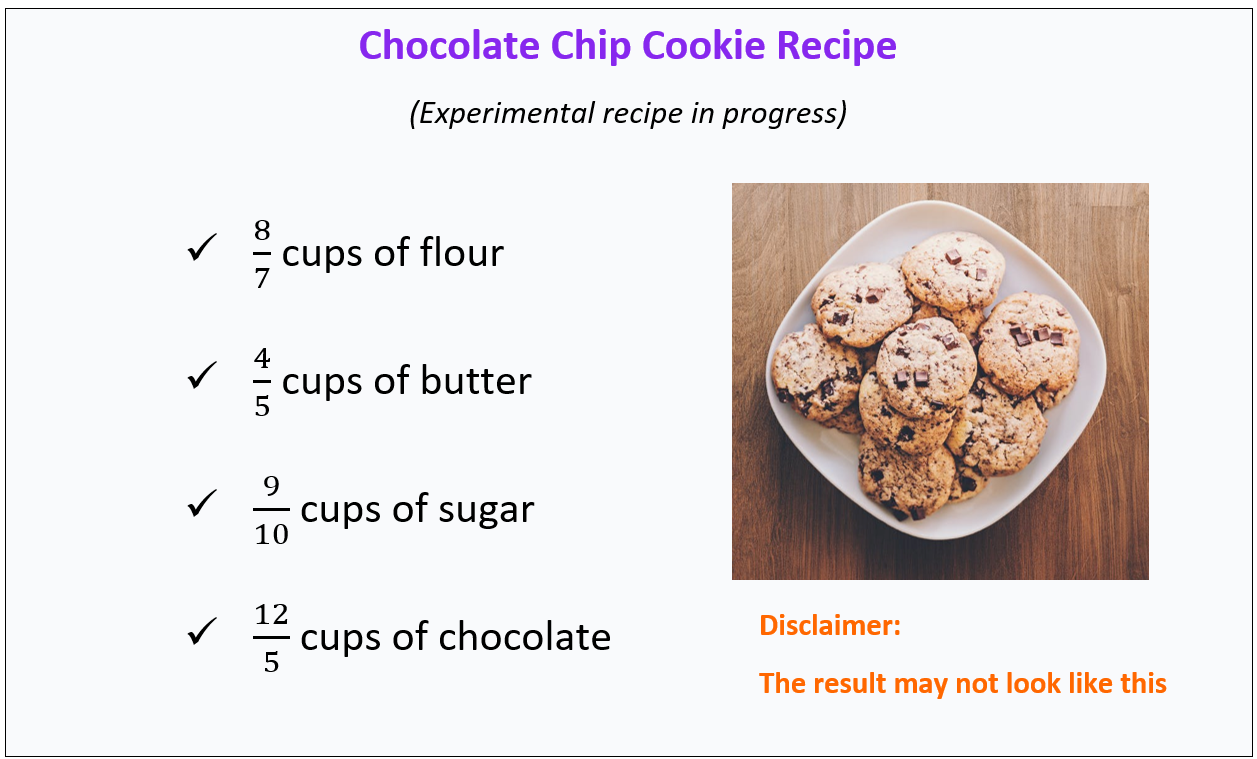

How many cups of total ingredients is needed in this recipe?