0:00 / 0:00

The SI System

The SI System (Système international d'unités) is a system of measurement where all the units are based on multiples of 10. It is commonly known as the metric system.

UnitAbbreviationkilo...k...hecto...h...deca...da......(base unit)......deci...d...centi...c...milli...m...\begin{array}{|c|c|} \hline \text{Unit}&\text{Abbreviation}\\ \hline \text{kilo...}&k...\\ \text{hecto...}&h...\\ \text{deca...}&da...\\ ...\text{(base unit)...}&...\\ \text{deci...}&d...\\ \text{centi...}&c...\\ \text{milli...}&m...\\ \hline \end{array}

Wize Tip
This might help you memorize this!

KiloHectoDecaUnitDeciCentiMilli            KingHectorDiedUnexpectedlyDrinkingChocolateMilk\begin{array}{lllllll} \colorThree{\bm{\underline{\text{K}}}\text{ilo}}& \colorThree{\bm{\underline{\text{H}}}\text{ecto}}& \colorThree{\bm{\underline{\text{D}}}\text{eca}}& \colorThree{\bm{\underline{\text{U}}}\text{nit}}& \colorThree{\bm{\underline{\text{D}}}\text{eci}}& \colorThree{\bm{\underline{\text{C}}}\text{enti}}& \colorThree{\bm{\underline{\text{M}}}\text{illi}} \\\\ &&&~~~~~~~~~~~~\bm\downarrow \\\\ \colorThree{\bm{\underline{\text{K}}}\text{ing}}& \colorThree{\bm{\underline{\text{H}}}\text{ector}}& \colorThree{\bm{\underline{\text{D}}}\text{ied}}& \colorThree{\bm{\underline{\text{U}}}\text{nexpectedly}}& \colorThree{\bm{\underline{\text{D}}}\text{rinking}}& \colorThree{\bm{\underline{\text{C}}}\text{hocolate}}& \colorThree{\bm{\underline{\text{M}}}\text{ilk}} \end{array}

Did you know?

  • The SI (or metric) system is commonly used in many countries such as Canada, Japan, Australia, etc.
  • The SI (or metric) system is generally used in the area of science
PAGE BREAK

Measurements of Lengths (Distance)


PAGE BREAK

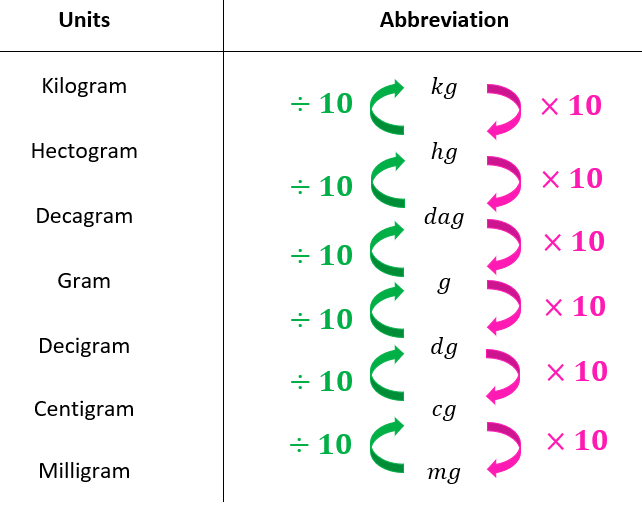
Measurements of Weight (Mass)


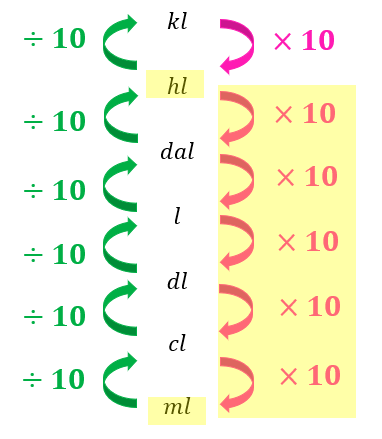
Measurements of Capacity (Volume)

0:00 / 0:00

Example: Unit Conversion

Convert the following quantites to the unit indicated.

a) 160 m to cm

Method 1
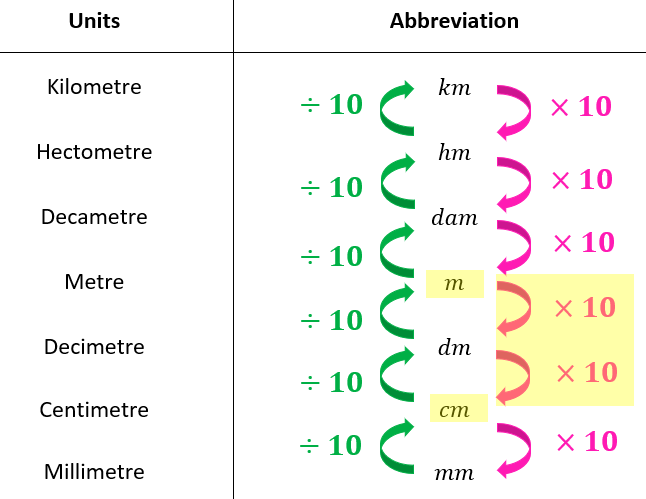
160×10×10=160×100=16000 cm\begin{array}{cl} &160\times 10\times 10\\ =&160\times100\\ =&\boxed{16000~cm} \end{array}

Method 2
160 m×100 cm1 m=160 m1×100 cm1 m=160×100 cm1=16000 cm\begin{array}{cl} &160~m\times\dfrac{100~cm}{1~m}\\[1em] =&\dfrac{160~\cancel{m}}{1}\times\dfrac{100~cm}{1~\cancel{m}}\\[1em] =&\dfrac{160\times100~cm}{1}\\[1em] =&\boxed{16000~cm} \end{array}

PAGE BREAK
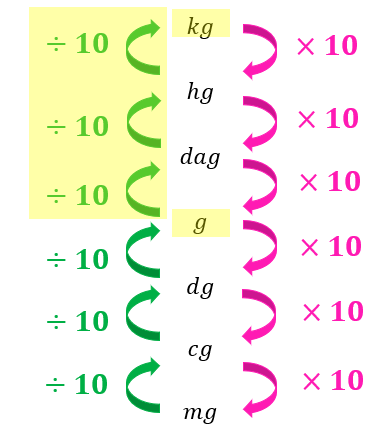
b) 225 g to kg

Method 1

225÷10÷10÷10=225÷1000=0.225 kg\begin{array}{cl} &225\div 10\div 10\div 10\\ =&225\div1000\\ =&\boxed{0.225~kg} \end{array}

Method 2
225 g×1 kg1000 g=225 g1×1 kg1000 g=225 kg1000=0.225 kg\begin{array}{cl} &225~g\times\dfrac{1~kg}{1000~g}\\[1em] =&\dfrac{225~\cancel{g}}{1}\times\dfrac{1~kg}{1000~\cancel{g}}\\[1em] =&\dfrac{225~kg}{1000}\\[1em] =&\boxed{0.225~kg} \end{array}

PAGE BREAK

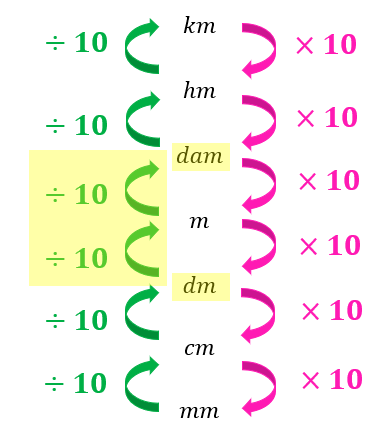
c) 17.5 dm to dam
Method 1

17.5÷10÷10=17.5÷100=0.175 dam\begin{array}{cl} &17.5\div 10\div 10\\ =&17.5\div100\\ =&\boxed{0.175~dam} \end{array}

Method 2
17.5 dm×1 dam100 dm=17.5 dm1×1 dam100 dm=17.5 dam100=0.175 dam\begin{array}{cl} &17.5~dm\times\dfrac{1~dam}{100~dm}\\[1em] =&\dfrac{17.5~\cancel{dm}}{1}\times\dfrac{1~dam}{100~\cancel{dm}}\\[1em] =&\dfrac{17.5~dam}{100}\\[1em] =&\boxed{0.175~dam} \end{array}

PAGE BREAK

d) 0.081 hl to ml
Method 1

0.081×10×10×10×10×10=0.081×100000=8100 ml\begin{array}{cl} &0.081\times 10\times 10\times 10\times10\times10\\ =&0.081\times100000\\ =&\boxed{8100~ml} \end{array}

Method 2
0.081 hl×100000 ml1 hl=0.081 hl1×10000 ml1 hl=0.081×100000 ml1=8100 ml\begin{array}{cl} &0.081~hl\times\dfrac{100000~ml}{1~hl}\\[1em] =&\dfrac{0.081~\cancel{hl}}{1}\times\dfrac{10000~ml}{1~\cancel{hl}}\\[1em] =&\dfrac{0.081\times100000~ml}{1}\\[1em] =&\boxed{8100~ml} \end{array}

Practice: Unit Conversion

If you are measuring a person's height, you might use m or cm, but if you are measuring the thickness of a coin, mm might be more appropriate.


Convert the following measurements into units that are more appropriate.
The distance between Toronto and Montreal is 540000 metres.

Discussion Time!

Can you think of common measurements of length (distance), weight (mass), and capacity (volume) that uses the different SI units kilo, hecto, deca, base unit, deci, centi, and milli? Which of these units seem to be the most common in our everyday lives?

Share your thoughts in the Ask a Question box 😄